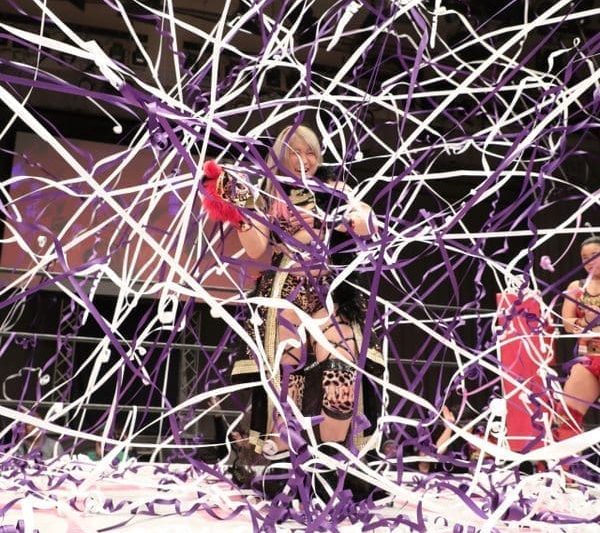
“お前、ボコボコにしたぞ!” (Special thanks to John Carroll for help with the translation.)
Some might say we will find a brighter day, but you might say that Yuma Aoyagi and Yuma Anzai had runs in AJPW’s Ōdō Tournament that were truly dazzling. (I’m sure that René Auberjonois and Armin Shimerman were thrilled by the Yumas’ performances.)
Elsewhere, we checked in on Tim Bosby, Karl Greco-Malenko, and Low Ki, as well as Power Pro Lucha, the spiritual successor to Chikara. Finally, some footage from Osaka Pro actually emerged, so we’ll travel back in time to see VerteX Xplode as Ryuya Matsufasa defend his title against Aran Sano.
In this edition, I covered:
- Daisuke Sekimoto vs. Yuma Aoyagi (AJPW, September 16, 2026)
- Yuma Anzai vs. Yuma Aoyagi (AJPW, September 22, 2026)
- Matt Mako vs. Tim Bosby (ACTION/PRODUCE, September 13, 2026)
- Karl Greco-Malenko vs. Low Ki (ACTION/PRODUCE, September 13, 2026)
- Modern Age Violence (Dominic Garrini, Jonathan Gresham & Kevin Ku) vs. FIST (Myung-Jae Lee, Ryan Mooney & Travis Huckabee) (Power Pro Lucha, September 4, 2026)
- Ryuya Matsufusa (c) vs. Aran Sano (Osaka Pro, July 20, 2026)
Daisuke Sekimoto vs. Yuma Aoyagi
AJPW Oudou Tournament 2026 – Day 4
September 16, 2026
Cagematch ranking as of 10/1/26: 8.04
Cagematch rating as of 10/1/26: 278

First, let’s travel down the Royal Road for this second round match between Daisuke Sekimoto and Yuma Aoyagi. Sekimoto defeated Shotaro Ashino to reach this match, and Aoyagi had defeated Jun Saito. A chance to challenge for the Triple Crown Championship was at stake, so this represented a chance for redemption for Aoyagi, who was Triple Crown Champion for 116 days in 2023 and 79 days in 2024. He was also the scapegoat, fairly or not, for AJPW’s recent disastrous detour into the “pop and light” style. Since he returned from his suspension for his involvement in a car accident, Aoyagi seemed to be refocused on delivering action instead of comedy.
Sekimoto still looked like a fire hydrant, but he seemed to move as well as a fire hydrant during his entrance. It was a stark reminder that time remained undefeated, even if you’ve been hard since 1999.
This was the rematch from Aoyagi and Sekimoto’s enjoyable encounter during the Champion Carnival in April. That match emphasized Aoyagi’s tenacity and the danger that Sekimoto presented to his opponents, even at this stage of his career. Beyond the tournament, Aoyagi also had a chance to redeem his loss to Sekimoto in the Champion Carnival. Meanwhile, Sekimoto could use this match to justify his cosmetological tribute to Natalie Dormer.
Even more than in their Champion Carnival bout, the 6’1″/186 cm tall Aoyagi seemed to tower over the 5’9″/175 cm tall Sekimoto. In spite of the height disadvantage, Sekimoto showed that he still had the lower center of gravity and firmer stance by winning the early grappling exchanges and repelling all of Aoyagi’s attempts to bowl him over. I was concerned when Aoyagi got some laughs from the Shin-Kiba 1st RING crowd for telling Sekimoto to charge at him instead, but he kept his focus and didn’t play for chuckles even after his dropkick bounced off of Sekimoto and Sekimoto sent him rolling out of the ring with a shoulder charge.
When a crowd became conditioned to perceive you as funny, it could be hard to be taken seriously again. (Just ask any teacher.) Aoyagi had taught the AJPW crowd to laugh at his antics and to be amused by him, and he would have to channel his best Joe Pesci impression to get the crowd to question if he were like a clown to them. Sekimoto helped by beating the ha-has and yuck-yucks out of Aoyagi, carrying him around ringside in an Argentine Backbreaker, slamming him to the mat, dropping elbows on his back, and bending him with a Half Crab, a Boston Crab, and the pro version of the Bow and Arrow (as opposed to the freestyle version).
Aoyagi’s high level of energy in his comeback also helped to push the narrative that he should be taken seriously. Getting up for a second dropkick after whiffing and landing flat on your back after the first one showed off Aoyagi’s athleticism, and he reached good foot speed on his running corner splash on Sekimoto. He also demonstrated his athleticism with his body splashes on to Sekimoto. After Aoyagi’s barrage of dropkicks, Sekimoto showed off that he was still hard by rising like a demon from two of Aoyagi’s German Suplexes and sending Aoyagi flying with a clothesline. Sekimoto then made me eat my earlier words about his having the mobility of a fire hydrant.

Unable to overpower Sekimoto, Aoyagi tried to use guile to outmaneuver Sekimoto with roll-up pin attempts. (I imagine that Sekimoto was more of a Zangief player.) Aoyagi and Sekimoto managed the match very deliberately so that Aoyagi’s momentum in the match grew even though Sekimoto initially seemed unstoppable. By the time that Sekimoto took his best shot with a superplex, a top rope splash, a stalling German Suplex after stuffing Aoyagi’s attempt to roll him again, and a beefy lariat, the pump felt primed for Aoyagi to start his attack. A crucifix pin attempt set Sekimoto on to his backfoot, and Aoyagi pressed with a German Suplex, a top rope elbow drop, and the Rockstar Buster.

A second, modified Rockstar Buster, called The Fool, was enough for Aoyagi to claim victory over Sekimoto and advance to the semifinals to face Yuma Anzai.
Sometimes, you just want a warm bowl of chili, minestrone, chicken noodle soup, or whatever your choice of comforting, hearty food might be. This match was solid and entertaining without striving to be the greatest match that the 334 fans at Shin-Kiba 1ST RING had ever seen. I was impressed that Sekimoto and Aoyagi paced the match so well that the switch to Aoyagi’s turn on offense felt velvety smooth, though I thought the outcome came a beat or two too fast. As the show’s main event, it satisfied me and left me curious how Anzai vs. Aoyagi would go. Throughout this match, Aoyagi was buoyed by a host of high-pitched voices, which spoke to his popularity among young female fans. How would that crowd split between Anzai and Aoyagi?
You can watch the match and the show on AJPW.tv.
Yuma Anzai vs. Yuma Aoyagi
AJPW Oudou Tournament 2026 – Day 7
September 22, 2026
Cagematch ranking as of 10/1/26: 15
Cagematch rating as of 10/1/26: 9.16

In August 2024, Yuma Aoyagi ended Yuma Anzai’s first Triple Crown Championship reign after 140 days. Then, in May 2025, on the twelfth night of the Champion Carnival, Aoyagi defeated Anzai to effectively knock him out of the tournament. Here, before 1,510 fans at Korakuen Hall, in the semi-finals of the Ōdō Tournament, Anzai and Aoyagi faced off for the opportunity to face Ryuki Honda in the finals and a shot at Kento Miyahara’s Triple Crown title.
I wonder what Aoyagi and Anzai thought when the crowd seemed so receptive to their bog standard opening grappling section. Did they think, “Oh, we’ve got the crowd, and one of us will have to wrestle Honda later in the show, so we don’t have to go to extremes”? Or did they think, “We’ve got the crowd, now let’s kick it up a notch for the person who won’t be advancing to the finals”? We can only speculate based on the rest of the match, but I would conjecture that that they went with option B. (Sit down, TNA. No one’s talking about option C here.)
We got some of the usual hits from Anzai and Aoyagi, like Anzai’s hop from a reverse Irish Whip over the guardrail and leaping forearm strike.

However, there just seemed to be a little more stank, a little more oomph in that forearm strike. Also, although that attack was a well-known part of Anzai’s war crate, it was worth noting that he varied when he would use the attack. Against Miyahara in the Champion Carnival, it came later. Against Shiozaki during the same tournament, he used it early, like he did here.
Similarly, with the host of high-pitched voices behind him once more, Aoyagi threw Anzai into the barricades with a little more mustard, a little more power than on other occasions. Back inside the ring, he retained control of Anzai’s wrist and pinned Anzai again and again to make a point to Anzai, who had yet to ever beat Aoyagi in a singles match, that hey now, he was an all-star. Cue the Waka Flocka Flame because that’s that stuff I like.

As a result, Anzai had to battle back in this match, and he kept the crowd engaged with his periodic comebacks, throwing a dropkick at Aoyagi amidst Aoyagi’s onslaught of diving body presses and running forearm strikes. They stoked the crowd into a fever pitch by exchanging forearm strikes and German Suplexes to set up the double down. After a Tornado DDT and a diving elbow, Aoyagi pinned Anzai but picked him up at two to lock him into a sleeper hold to wear him down some more. Aoyagi only tried to pin Anzai again after Anzai almost reached the ropes to break the hold. Cue the Waka Flocka Flame again.
In the past, I haven’t loved Anzai’s jumping knee strike because they seemed like glancing blows at best, but they were more impactful in this match. Specifically, Anzai’s jumping knee to counter Aoyagi’s jumping body press looked very convincing.

Nailing these jumping knee strikes made a later one that Aoyagi blocked seem more convincing, and Anzai really projected his confusion at Aoyagi’s successful block. That block shifted the momentum back to Aoyagi, who would wiggle out of Anzai’s attempts at the Gimlet multiple times. They traded bludgeoning lariats, and Anzai landed one more beautiful jumping knee, but he couldn’t quite knock Aoyagi out without the Gimlet. Instead, Aoyagi was able to land the German Suplex that he had reached for all match, a Rockstar Buster, and finally The Fool to put Anzai down to the crowd’s delight and to advance to the finals.
Anzai and Aoyagi did nothing revolutionary here, but they tapped into an intensity that was greatly enhanced by the crowd’s enthusiasm. Their timing was nearly perfect, and they found a way to express a deep dislike for each other while refraining from melodrama. You could read a lot into how Anzai disdained Aoyagi for ending his Triple Crown reign and how Aoyagi resented Anzai because he was the preferred Yuma. Anzai was the golden boy who was on the Bachelorette, and Aoyagi was the scapegoat for AJPW’s troubled “pop and light” period and the one whom the company suspended for his car accident. Little things like pinning Anzai again and again and picking him up out of a pin to wear him down with a sleeper hold got that feeling across clearly and strongly.
Clearly, AJPW also recognized that the battle of the Yumas was the foundation for the future. After the match, both men got a chance to address each other and the crowd, which Ryuki Honda was not able to do after his opening match with Xyon. (Honda would get that chance after the main event, where he would beat Aoyagi to earn his shot at Miyahara.)
You can watch the match and the show on AJPW.tv. I recommend it.
Tim Bosby vs. Matt Mako
ACTION/PRODUCE DEAN~!!! Sunday School
September 13, 2026
Cagematch ranking as of 10/1/26: 1170
Cagematch rating as of 10/1/26: 7.17

When we last saw Tim Bosby, we saw that he was a big, strong lad, but his raw strength was no match for Karl Greco-Malenko’s veteran wiles. This time, Bosby faced off against Matt Mako, formerly known as Matt Makowski. True to his Chikara roots, Mako has also been wrestling in Chikara’s spiritual successor, Power Pro Lucha, as Nemesis, one third of the Hands of Fate along with Eris (aka Sloane Jacobs) and Moros (aka “Hot Sauce” Tracy Williams, who was once Silver Ant).
I’ve always had a soft spot for Mako because he wrestled a technical style without feeling dry; Julius Creed’s sole match outside of the WWE system was memorable because Mako’s MMA-influenced style and intensity meshed so well with Creed’s size and brute strength. (According to Tapology, Mako had a 6-2-0 professional MMA record, which meant that he had a better winning percentage than Takahiro Tababa, at least.) Bosby potentially presented a similar pairing with Mako, though Bosby probably wouldn’t have a match with Mako that was as one-sided as Mako’s match with Creed was.
The match’s story was fairly simple. Mako tried to live up to his (self-given?) moniker, “the King of the Cross Armbreaker,” by breaking Bosby’s defenses against the hold. Bosby could power through Mako’s attempts for a while, but he eventually found himself unable to use his strength advantage to plow through the problems that Mako presented. Early on, he could pick Mako up with one arm and crack open Mako’s hold on his arm with a backbreaker.

Mako and Bosby headed outside the ring to brawl a little, as a treat, which gave Mako a chance to do one of the most meat-headed things I’ve seen in wrestling in some time. Bosby baited Mako into kicking the ringpost, so Mako, amped up on adrenaline, just kicked the ringpost a few more times to prove that pain don’t hurt.

Since Bosby clearly hurt his right knee after slamming Mako spine first on to it, it became Mako’s obvious target for chopping him down to the ground. That was why it was confusing when Walker Stewart said that Mako had targeted Bosby’s weak point when he started to attack Bosby’s left leg. Stewart could have easily explained that Bosby had already hurt one leg, so taking out the other leg ensured that Bosby’s movement would be impaired.

Still, Bosby committed to trying to convince us that his left leg hurt in big and small ways. He couldn’t quite plant his feet to generate power or run around as quickly as he normally would, and he used just his upper body to throw Mako around so he wouldn’t need to navigate the act of rising on his damaged leg. Also, he grabbed his leg in pain after planting it to throw Mako with a German Suplex.

Ultimately, this match didn’t provide the joy of sudden, brutal violence the way that Creed vs. Makowski did. Instead, it was the story of Mako, the veteran, relentlessly targeting Bosby’s vulnerability until he trapped Bosby and forced him to submit. It was a fine, little match.
You can watch the match and the show on MyAEW.
Low Ki vs. Karl Greco-Malenko
ACTION/PRODUCE DEAN~!!! Sunday School
September 13, 2026
Cagematch ranking as of 10/1/26: 376
Cagematch rating as of 10/1/26: 7.88

Now this, this was fun. When PRODUCE announced this match after Karl Greco-Malenko defeated Bosby at PRODUCE Volume 2: Azucar, my friend and I looked at each other and started debating whether we could justify a trip to Jersey City. Ultimately, we decided against traveling to the White Eagle Hall that day. And because I try to follow the Tao of Tim Riggins, I had committed to feeling no regrets about missing this match. (I am sorry if this column came in late. I was distracted by watching a bunch of clips from Friday Night Lights, like when Tim Riggins was on a Christian radio show or when Tim Riggins and Matt Saracen went hunting together or when Brian “Smash” Williams absolutely bombed in his roast of Coach Eric Taylor.)
Once again, the production and announcing teams could not figure what the man’s name was. In the pre-match hype video, he was billed as “Karl Greco Malenko.” In the on-screen graphic as he made his entrance, he was “Karl Malenko,” as if he were disgraced former Utah Jazz and Dream Team player, Karl Malone. The ring announcer announced him as “Greco Malenko.” Only Walker Stewart, ever the professional, and Jack Solomon called him “Karl Greco-Malenko” on commentary. Solomon even apologized on air when he said an incorrect version of the man’s name.
Nonetheless, I don’t think ACTION and PRODUCE struggled with how to identify this man quite as much as Monsta Mack and Low Ki did with taking off Low Ki’s Agent 47 cosplay pants.
At 47 years of age, Ki had slimmed down from his beefier heyday, but he retained the aura of danger and unpredictability that made him an attraction. Sure, it was all fun and games until Ki took it too far and knocked his opponent out and proceeded to do moves on him. And sure, a wrestler could probably still create a similar aura without taking it quite as far as Ki did. I would still contend that no one ever truly replaced Ki in professional wrestling, for better or worse, which made this match, his first since his match against the new Hayabusa in March in New Horizon Pro Wrestling in Australia, so enticing.
Given that Greco-Malenko had a match against Josh Barnett scheduled for PRODUCE Volume 6: Hell Comes to Dogtown, he entered the match as the favorite to win despite Ki’s fierce reputation for protecting his wrestling persona. They fought under BattlArts rules (wrestlers lose if they reach four knockdowns or use four rope breaks, and they can win by knockout, submission, or referee’s stoppage), which would have given Ki some narrative leeway for suffering a loss.
Somehow, this was also not the first time Greco-Malenko and Ki had faced each other. In 2003, Ki teamed in AJPW with Kendo Kashin (before his infamous turn as Dragon Solder B in ROH Best of American Super Juniors Tournament, as ThROH the Years had recounted) to face Greco-Malenko, whose nom de guerre at the time was Carl Contini, in tag teams with Hideki Hosaka and Nobukazu Hirai during that year’s Champion Carnival. These matches helped to set up Greco-Malenko’s eventual win in that year’s Junior Champion Carnival by beating Jimmy Yang and unsuccessfully challenge for Kashin’s AJPW World Junior Heavyweight title.
I had imagined that this would be a fight between Greco-Malenko the grappler and Ki the striker, but it was actually a good ol’ case of grapplefuck. Watching Greco-Malenko attack Ki’s right arm from underneath, trying to trap it in a kimura, only to use that action as a feint so that he could wrap his legs around Ki’s right leg and bring him down with a leglock felt like wizardry. Seeing Greco-Malenko use his body weight to push his head out of Ki’s tight headlock while snaking his arm in to lock Ki’s attacking arm into a kimura was just as magical.

Greco-Malenko’s surprising flexibility was his greatest weapon. As Stewart and Solomon pointed out on commentary, Greco-Malenko was able to pull his legs up in a criss-cross-apple-sauce position by his feet while on his back so that he could move them past Ki’s shoulders and thus his defenses. Ki, sensing that Greco-Malenko was positioning him for yet another triangle choke attempt, countered by driving his knees into Greco-Malenko’s butt to push him away and jar Greco-Malenko’s grip.
It surprised me that Greco-Malenko broke the seal on striking first. He had slapped Ki’s head earlier in the match, but he, not Ki, threw the first body kicks and knee strikes to the body in the corner. So, Greco-Malenko charged Ki with his first knockdown of the match. I’d seen criticisms of Greco-Malenko’s punches in this match, but I thought his shots to Ki’s body looked as forceful and fast as Ki’s punches did. The slaps to Ki’s covered face from the mount weren’t meant to punch through Ki’s hands, so I wasn’t bothered that they looked light.
However, I burst out laughing when Ki picked up Greco-Malenko for a Ki Krusher. The idea of using a pro wrestling driver like the Ki Krusher in a match like this was patently absurd and perfectly in line with Low Ki’s persona.

I half-expected Low Ki to then run at Greco-Malenko with a Tidal Wave kick or a John Woo dropkick, but he probably refrained because it might have cost him another knockdown. Instead, Ki rushed in with knee lifts, but Greco-Malenko was undeniable. He again used his flexibility to escape Ki’s leg choke, opened Ki’s defenses with knee strikes to the ribs from the side, caught Ki’s right arm, controlled Ki’s neck, and bound him with his legs in a choke that Ki could not escape. That forced the referee to stop the match, ending it with the expected victory for Greco-Malenko.
This was like catnip for grapplefuck afficionados like me. Greco-Malenko’s flexibility was dazzling because it allowed his body to contort and shrink and expand as needed for his offense and defense. Ki, frankly, seemed overwhelmed by Greco-Malenko, which was shocking. I thought we would see Ki throw kicks, but only Greco-Malenko tried body kicks or a head kick in this match. In effect, this transferred some of Ki’s mystique over to Greco-Malenko ahead of his match with Barnett. So, the match accomplished its goal. That said, I wish we got a little more of the old, completely irresponsible Low Ki. After the match, Ki festooned Greco-Malenko with his red tie, and they paid respect to each other.
You can watch the match on PRODUCE’s YouTube channel and the show on MyAEW. Go watch the match.
FIST (Ryan Mooney, Myung-Jae Lee & Travis Huckabee) vs. Modern Age Violence (Dominic Garrini, Jonathan Gresham & Kevin Ku)
PPL Attack on Trios – Day 1
September 4, 2026
Cagematch ranking as of 10/1/26: 707
Cagematch rating as of 10/1/26: 7.55

One of my favorite live wrestling memories was attending Chikara King of Trios 2009. It was my second overnight wrestling trip (the first was Chikara Young Lions Cup VI, which meant three nights in Hellertown, Pennsylvania where the best dining option was the Waffle House less than a mile away from the Edward H. Ackerman American Legion Post 397), and I was drawn to the show primarily by the presence of Bryan Danielson. (Shocking, I’m sure.) This was before Danielson had announced that he was signing with WWE to appear on NXT (that happened in August 2009), but Danielson was wrestling more outside of Ring of Honor than he had since 2007.
This was also his first appearance in Chikara, which was as odd a fit as any setting could be for the American Dragon. Because Danielson was one of the greatest wrestlers of his generation, he slotted right in, and Team Uppercut, his trios team with Dave Taylor and Claudio Castangoli, advanced to the finals before losing to Team FIST (Chuck Taylor, Gran Akuma, and Icarus). My fondest memory was from Night 3 at The Arena. A couple of other fans and I chanted “You’re going to get your bleepin’ (or it might have been flippin’ or frickin’) head kicked in” before one of Team Uppercut’s matches. Because Chikara had a no profanity rule to support its family friendly image, Bryce Remsburg was horrified and started waving his hands at us to stop. Then, he realized what we were chanting and was relieved that we weren’t going to cause an issue.
Putting aside his behavior that contributed to Chikara’s demise and his own banishment from the professional wrestling mainstream, part of Quackenbush’s legacy was in creating the King of Trios tournament, promoting awful puns in independent wrestling, and referencing outside media in show titles. When I attended ROH Death Before Dishonor 2025, I was handed a card promoting Power Pro Lucha, Chikara’s spiritual successor, outside the 2300 Arena. Specifically, the card advertised the company’s Chrono Trios show, a trios tournament that clearly modeled itself after the King of Trios, some Chikara veterans like the Spectral Envoy (Frightmare, Hallowicked, and Ultramantis Black) and some revivals of acts from Chikara (specifically a new Colony and a new FIST).
Power Pro Lucha committed deeper to its Chikara homage/revival with an Ace of the Skies match (to emulate the Rey de Voladores match), a Prodigy Cup tournament (to emulate the Young Lions Cup), and shows titled Aniversario. For now, they seemed to be focused on building its fan base in Philadelphia; they held their only show outside the city in Alburtis, a suburb around 60 miles northwest of Philadelphia. And hey, their show after Attack on Trios was named Neon Genesis Cibernetico, and I appreciated a tortured attempt to invoke Neon Genesis Evangelion. Go forth, young American lucharesu independent wrestling company, and you’ll become a legend.
By my count, this had to have been the fourth iteration of FIST. The first and arguably most successful version was the group of Gran Akuma, Icarus, and Chuck Taylor, which had Taylor’s manic energy and hatred of children, Akuma’s silent but deadly persona, and Icarus’s infamously ill-advised back tattoo. They worked well together, they had a great entrance theme, and they were a consistent and persistent thorn in the Chikara tecnicos’ sides. Akuma and Icarus held the Chikara Campeonatos de Parejas Championship for 343 days between 2006 and 2007, and the three were key parts of Chikara’s Kings of Wrestling that ran roughshod over the tecnicos for years.
I had drifted away from Chikara by the time the second version, composed of Icarus, Taylor, Johnny Gargano, and Sugar Dunkerton formed, so I had no connection to their run from 2010 to 2013. Nor did I have a connection to the next version, comprised of Icarus, Travis Huckabee, and Tony Deppen, that primarily wrestled in Chikara until the company shut down in 2020. Still, Power Pro Lucha’s homage to Chikara wouldn’t have been complete without a FIST of its own, so Akuma returned to wrestling after three years away for Power Pro Lucha’s debut show, reGeneration, to team with Huckabee to reform FIST. Huckabee then brought in New Jersey wrestler Ryan Mooney, called in his former stablemate Deppen, and recruited South Korean wrestler Myung-Jae Lee to bring FIST back to full strength.
In this Triple Tech Trials first round match, FIST faced Jonathan Gresham, Dominic Garrini, and Kevin Ku. We last saw Garrini and Ku in their blood-soaked battle with the Grizzled Young Veterans (James Drake and Zack Gibson) at DPW Title Fight in Vegas from WrestleMania Week 2025. Since DPW ceased its operations, Garrini and Ku have traveled the globe separately and together, from C4 in Canada to wherever GCW and PRODUCE happened to find a venue. We also last saw Gresham in a blood-soaked battle; his was with Masashi Takeda when Gresham wrestled rather unexpectedly in GCW’s deathmatch tournament, Tournament of Survival.
Huckabee and Mooney came to the ring to Orgy’s cover of “Blue Monday” and proceeded to taunt the crowd about Harleen Lopez’s injury. The show then played Lopez’s entrance music so Lee could rile the crowd up further by appearing and holding his neck and back. During his opponents’ entrance, Lee tried to yell over the Cranberries’ “Zombie” to deny the crowd a chance to sing along. Just as I thought when my opponent busted out a Channel to deal game-ending damage to me in a recent game of Magic: The Gathering, I couldn’t help but laugh in admiration. Sometimes, the old ways are still the best ways.
It was strange to see Kevin Ku fall victim to the same allergy to the top rope that afflicted Hanan. I could think of no other reason why he opted to stand on the floor instead of the apron, thereby rendering him ineligible as a legal tag for Gresham, at the start of the match.
Huckabee and Gresham started with some light-hearted mat-based shenanigans around Gresham’s control of Huckabee’s hand and foot. Gresham, like Danielson before him, read the mood as much more carefree and acted accordingly, smiling broadly while he clapped his against Huckabee’s hand and foot and bending Huckabee’s shoulders without an expressly violent intent. Everything, from Garrini and Huckabee’s grappling to Huckabee, Lee, and Mooney ‘s period of control over Garrini to even Ku’s charging retaliatory attacks against Huckabee and Lee in opposite corners, felt a step slower than my preference. To his credit, Ku raised the match’s intensity; he seemed like he was going out there to hurt someone.
Nevertheless, Ku also came across like a dummy when he charged at Huckabee after he saw Lee and Mooney take down his teammates. And it was unclear whether Huckabee and Lee had figured out what they were trying to do when Huckabee lifted Lee up into what turned out to be a double stomp.
After the fans chanted for violence, Gresham and Huckabee stood and tried to give the people what they wanted with fists to faces. When Lee tried to step in, Gresham put Lee’s kick through a Rube Golbergian process to produce a Dragon Screw to Lee’s leg. The match was chaotic, so it felt energetic, but it felt like sound and fury signifying nothing until Huckabee brought Ku down with a Codebreaker and kept him bent over so Lee could fly in with a double stomp from one corner and Mooney with a frog splash from another corner.
And then the match ended with Lee awkwardly jumping from the top rope to try to stomp Ku and stumbling into the referee instead, giving Lopez a chance to punch Huckabee, which then let Ku to roll up Huckabee to beat FIST and advance. It was a messy conclusion to an uninspired match, but it advanced Power Pro Lucha’s story with Huckabee and Lopez forward so that they can face each other at the next show.
Regarding FIST specifically, Huckabee, Lee, and Mooney all have bits and pieces of Taylor and Icarus, but the team was missing an Akuma, a deadly serious killer to back up the others’ antics. Lee’s double stomp on Ku felt dangerous, so there might be potential there if Lee took more influence from Akuma or Low Ki. Mooney didn’t get much time to shine as the team’s supposed wildman, so it was hard to draw a conclusion about him.
Even at the peak of Chikara’s powers in bringing in surprising teams and arranging intriguing match-ups, the King of Trios would have some matches that were as interesting as driving from Denver, Colorado to Kansas City, Missouri along Interstate 70. This match had the most recognizable participants (with perhaps Team ChocoPro as the other contender), so I understand why it also had the most votes in Cagematch. It was fine, but it didn’t inspire me to spend time on the other tournament matches.
You can watch the match and the show on IWTV.
Ryuya Matsufasa (c) vs. Aran Sano
Osaka Pro Osaka Castle Town Festival 2026
July 20, 2026
Cagematch ranking as of 10/1/26: N/A
Cagematch rating as of 10/1/26: N/A
When we last saw Aran Sano, he and Tigers Mask had just lost the OPW Tag Team Championship to Ultimate Spider Jr. and Takoyakida. (Takoyakida and Spider Jr. promptly lost that title to the Rogue Nation combination of Shu Asakawa and TORU forty-three days later.) Freed of the obligations that came with the tag team title, Sano was now free to pursue the Osaka Pro title from his stablemate in VerteX, Ryuya Matsufasa, who won the title from TORU in December 2025. Sano was Matsufasa’s third defense and arguably his toughest test yet.
This was my first time seeing Matsufasa in action, and I had high expectations because he was VerteX’s leader and the company’s champion. Beyond the haircut, his mannerisms and footspeed reminded me of Alex Shelley both in his youthful prime and during his later run in 2023 and 2024 when he was bedecked with championship belts by GCW, NJPW STRONG, TNA, DEADLOCK Pro, The Wrestling Revolver, Prestige Wrestling, Combat 1 Wrestling.
Matsufasa and Sano started with a simple story: as fast as Matsufasa might be, Sano could keep up just as well, and Sano had a power advantage to boot. So, Matsufasa retreated from the ring to strategize and lured Sano into clotheslining the ring post, thereby opening an avenue of attack on Sano. Sano, being a young meathead, couldn’t help but use his damaged right arm to attack Matsufasa, but he showed how debilitating the pain was on his super gutwrench suplex. Because he couldn’t use his arm to lift Matsufasa for the rotation, he had to rely more on his back and legs to bring Matsufasa down. He also had to use his left arm for his headlock on Matsufasa, and he stomped him more than he punched.
After suffering at Sano’s hands for a lengthy stretch, Matsufasa made the most of the little space that Sano gave him and again showed off his velocity and acceleration.

Matsufasa also hit a very elegant jumping knee to Sano after, but Sano blocked Matsufasa’s running knee and unleashed a mighty grunt and a meaty belly to belly suplex.

And so the match went on, pitting Sano’s power against Matsufasa’s craftiness and speed. At times, it reminded me of Shelley’s sole singles match with Samoa Joe, from TNA’s Super X Cup 2005 on a fairly random episode of iMPACT. By instinct, Sano cracked Matsufasa with a shot with his damaged right arm, and he committed to pushing through the pain to slug it out with Matsufasa. That adrenaline-fueled stubbornness only got Sano so far, and he withered before Matsufasa’s own right-handed shots before blistering Matsufasa with a desperate blow. That opened Matsufasa for a slow gutwrench sitout powerbomb (filmed from an odd angle by Osaka Pro’s or GAORA TVs camera operator) that scored a nearfall for Sano.

For all of Sano’s power, his right arm was still a brightly painted and lit target for Matsufasa, who exploited the vulnerability to once against top Sano in his tracks. When Sano charged at Matsufasa, Matsufasa nailed him with a knee to the face. That stunned Sano enough for Matsufasa to drive him down with a Canadian Destroyer, but Sano still had the wherewithal to kick out. Matsufasa tried to escalate further, but he paid for his attempt when Sano overpowered him on the top rope and powerbombed him instead.

That powerbomb and one last pulverizing lariat were Sano’s last spark, and Matsufasa snuffed it out with a couple of knee strikes to Sano’s face. Charging himself up with one more yell, Matsufasa turned Sano over for a final Canadian Destroyer (Destoroyah?) to at last put Sano down for three. Sano remained winless against Matsufasa since their first match in 2023.

Given their relative ages (Matsufasa was 27, Sano 23) and experience levels, this was very well-composed. Sano and Matsufasa told a straightforward, easy-to-follow story about Matsufasa navigating the danger of Sano’s power to retain his championship. Sano looked like a credible threat, but Matsufasa felt like a deserving winner because he was able to withstand Sano’s best blows before delivering his own knockout. They moved at a deliberate, main event pace and because Osaka Pro saved its long match lengths for its major matches, this probably had a very different flavor than any of the other matches on the show. (The GAORA TV broadcast only had this match and a comedy match between Tigers Mask, Ebessan, and Joichiro Osaka, while the actual show had a Light Heavyweight title match between SUZAKU and Yasutaka Oosera and the aforementioned tag team title match.)
As much as I would love to see Sano and Matsufasa face outside talent, that’s probably an unrealistic wish for them. In a finer world, we would probably see Ali Najima face Sano, for example.
You will need to conduct some Internet sleuthing in the archives to find this show, but this match is worth the effort.
Next time: The men showed their best. Now, it’s time for the women, featuring some of our favorites like Chihiro Hashimoto, Sareee, Takumi Iroha, Mika Iwata, Miyu Yamashita, (the) AZM, and Saya Kamitani to show who run this mutha.