


In 1919, German baker Karl Juchheim introduced the baumkuchen to Japanese culinary culture at an exhibition of arts and crafts by German prisoners of war held at the Hiroshima Prefectural Products Exhibition Hall. Since, the skill required to lay the concentric rings of batter on top of each other to form the baumkuchen, its delicate flavor, and its airy texture raised it from its humble beginnings. In 2010, Juchheim Co., Ltd. declared March 4 to be Baumkuchen Day to commemorate when Juchheim’s first display. Putting aside its origin’s place in an international web of political intrigue (for example, why was a civilian baker in Tsingtao, China captured by the Japanese Imperial Army treated as a prisoner of war), the baumkuchen was a curious case of the intersection of cultures.
In celebration of the baumkuchen and Neon Genesis Evangelion, which introduced me to the baumkuchen, we’ll spend some time with German and Japanese professional wrestling. (I wish that we also had time to revisit Nanae Takahashi’s feud with Utami Hayashishita in Stardom in 2023, where Takahashi compared herself to a baumkuchen and declared that Hayashishita would not be able to eat her. We only have so many hours.)
In this edition, I covered:
- Alejandro & Dragon Bane (c) vs. Love and Peace (JACKY KAMEI & Riiita) (NOAH, July 18, 2026)
- Dan Tamura (c) vs. Naruki Doi (AJPW, July 25, 2026)
- El Lindaman (c) vs. T-Hawk (GLEAT, July 1, 2026)
- Genkai (c) vs. Kodai Nozaki (Kyushu Pro, June 27, 2026)
- Ali Najima & Hinata Kasai vs. Kosuke Sato & Ryuma Sekimo (Fuminori Abe & Takuya Nomura Produce, July 1, 2026)
- Fuminori Abe, Shuji Ishikawa & Yuki Ishikawa vs. Daisuke Ikeda, Kazunari Murakami, and Ali Najima (Fuminori Abe & Takuya Nomura Produce, July 1, 2026)
- Peter Tihanyi vs. Ricky Sosa (wXw, July 11, 2026)
- Ahura (c) vs. Kouga (GWF, July 12, 2026)
Alejandro & Dragon Bane (c) vs. Love and Peace (JACKY KAMEI & Riiita)
NOAH Summer Epic 2026
July 18, 2026
Cagematch ranking as of 8/1/26: 98
Cagematch rating as of 8/1/26: 7.24
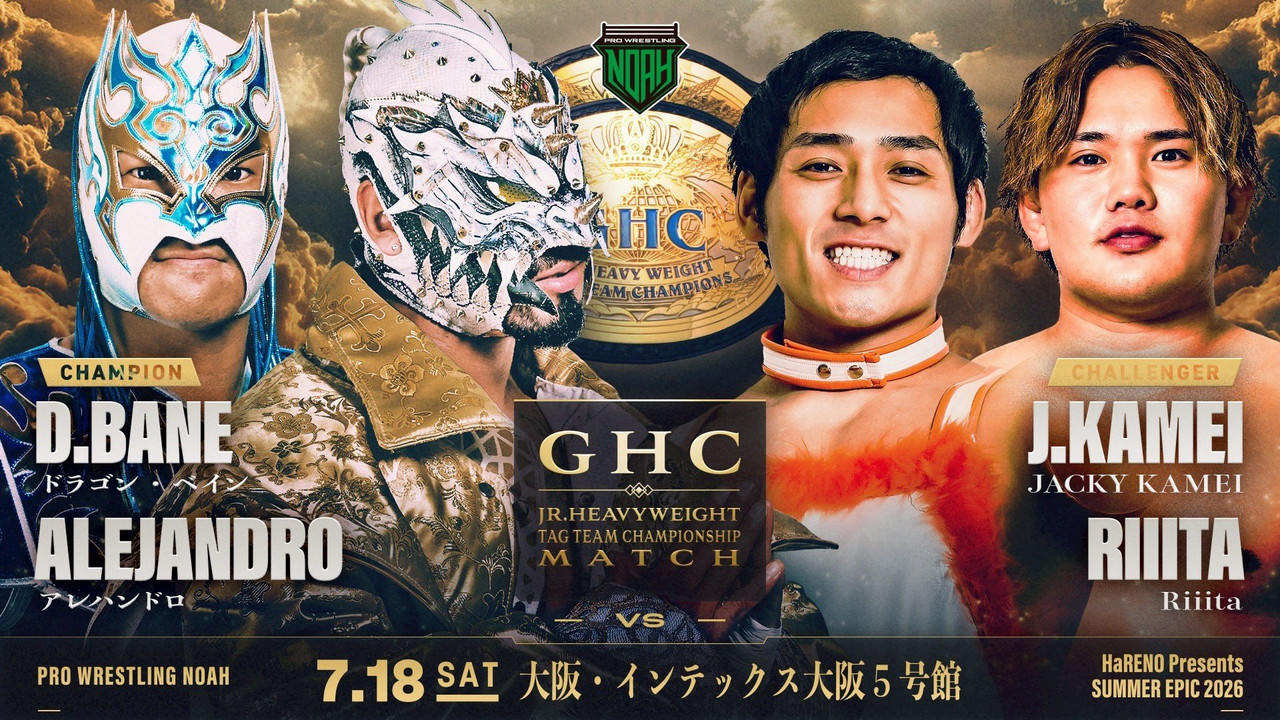
Ah, the mysteries of graphic design. The graphic maker listed the name of Jacky Kamei (the wrestler on the left on the challenger’s side of the picture) above Riiita’s. On the champion’s side, the graphic maker listed Alejandro’s name below Dragon Bane’s even though his picture is on the left. Dear graphic makers: please label wrestlers in the order that they appear from left to right and consistently if you’re going into the realm of the y axis. (Let’s not even start on getting companies to standardize putting the champions on the left instead of the right.)
Eita dethroned Dragon Bane at Eita’s 15th Anniversary Show for the GHC Junior Heavyweight Championship, but he still had the GHC Junior Heavyweight Tag Team Championship. KAMEI and Riiita lost their Open the Twin Gate Championship on May 23 to Gajadokuro (ISHIN and Yoshiki Kato), which removed intercompany politics from the match between Kamei (the 10th ranked wrestler) and Riiita (an honorable mention in this year’s 30 Under 30) and Bane (an honorable mention) and Alejandro.
Riiita and Alejandro got right down to business to a disappointingly muted reaction from the crowd at INTEX Osaka Hall 5. Riiita repeatedly appealed for the crowd to start clapping to no avail. He even made the universal belt gesture at the crowd to try to rile them up. Nevertheless, they persisted in forming a wall of silence.
For example, how did the crowd not respond to Riiita’s corkscrew twist off of the middle rope at all?
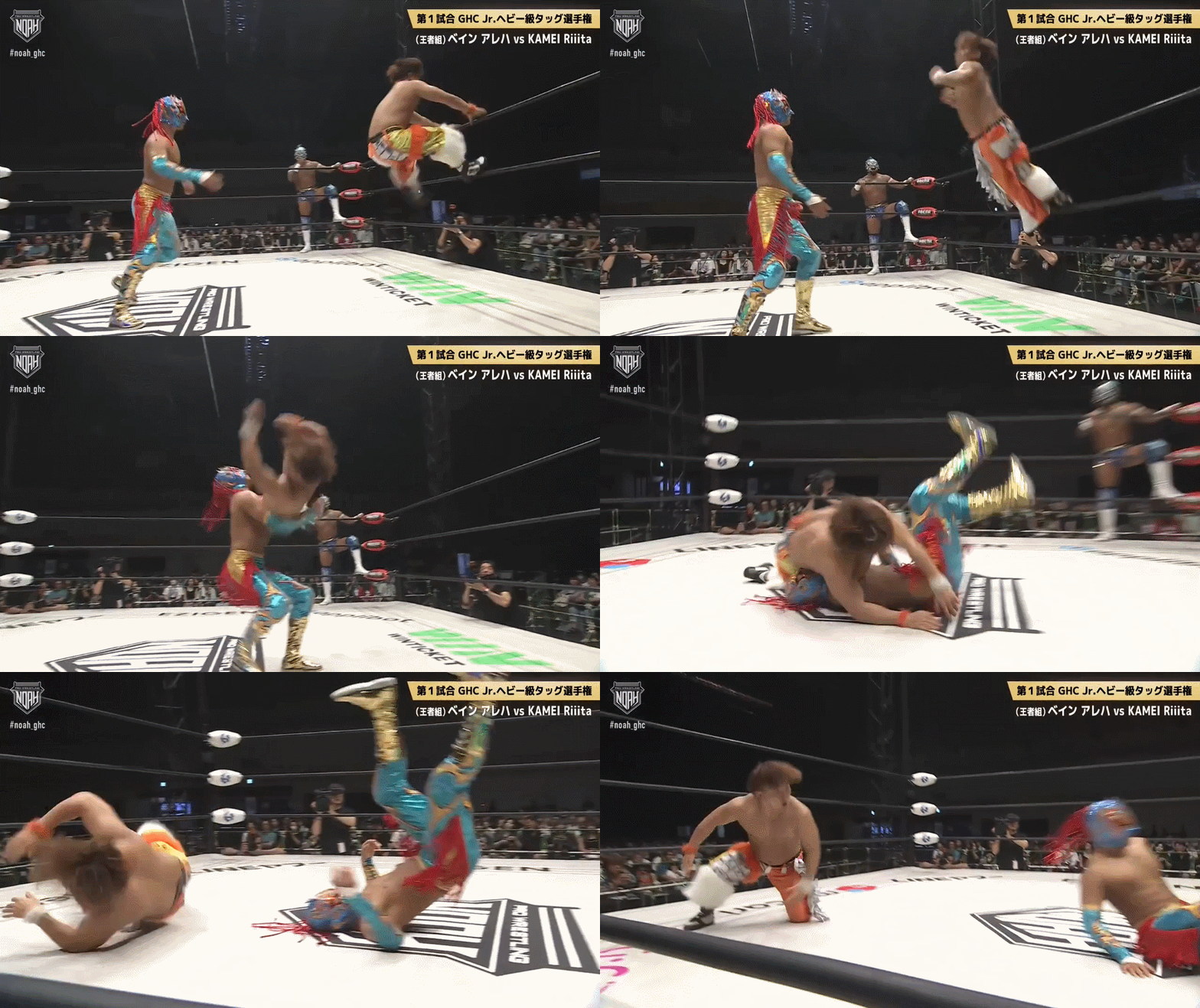
It was hard for me to understand how the crowd had no reaction to Kamei’s and Bane’s great athleticism on this armdrag either.
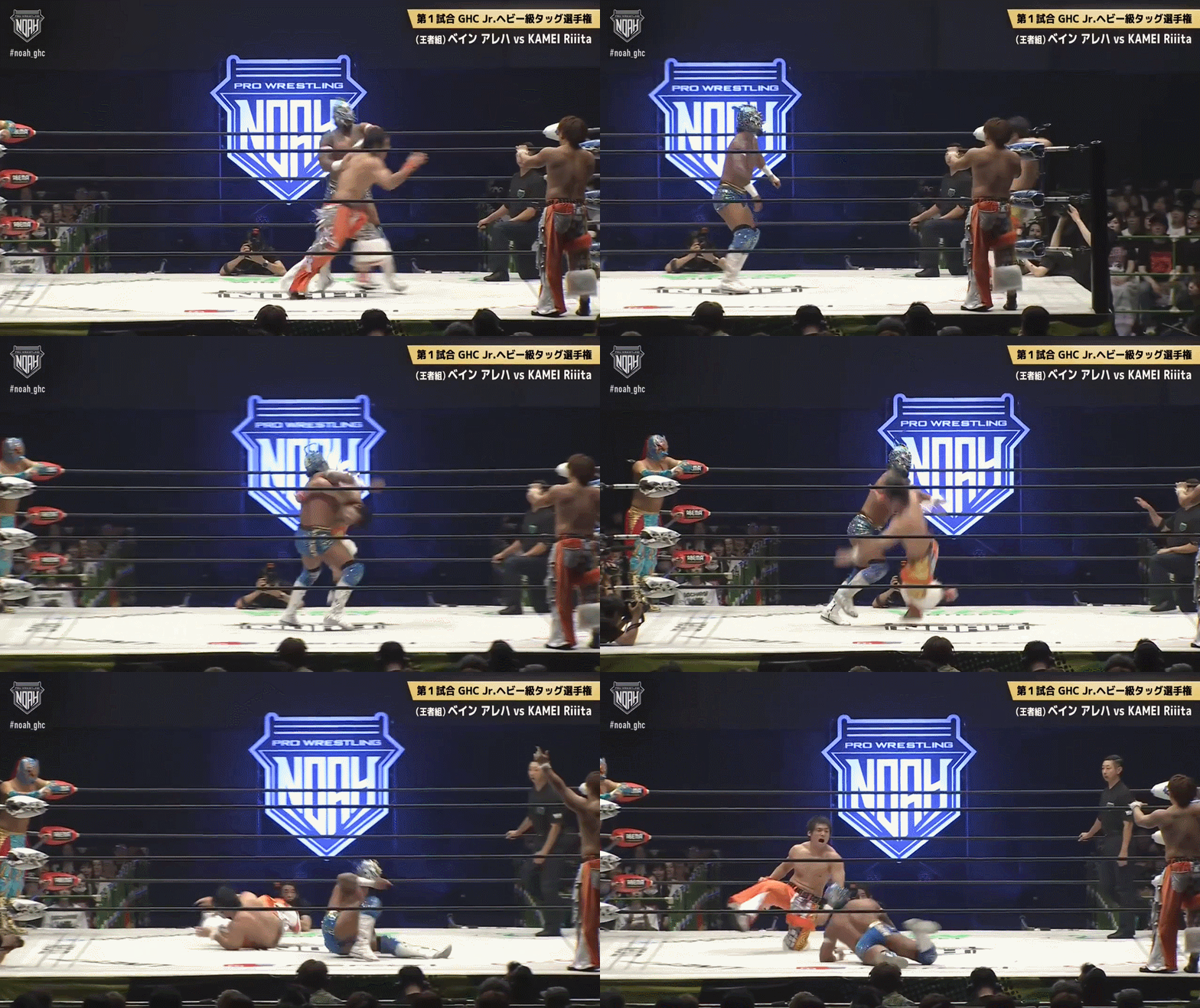
Kamei also showed a tightness and velocity to his kick that Alejandro certainly lacked. The main appeal of the match came down to Bane’s explosiveness athleticism vs. Kamei’s precision.
Bane and Alejandro stunned Kamei with a set of double dropkicks, and their combination attacks also took Riiita out when he tried his hand at them. Kamei and Riiita displayed a level of coordination to set up their stereo dives to the outside that made me really wish they would have a straight tag match against Sinner and Saint. I winced when Kamei clipped his ankles on the barricade on the dive; I don’t think he overshot Alejandro on the left side of the ring. The issue was more likely that Alejandro was positioned too far from the ring and thus too close to the barricade. Luckily, Kamei seemed unaffected.
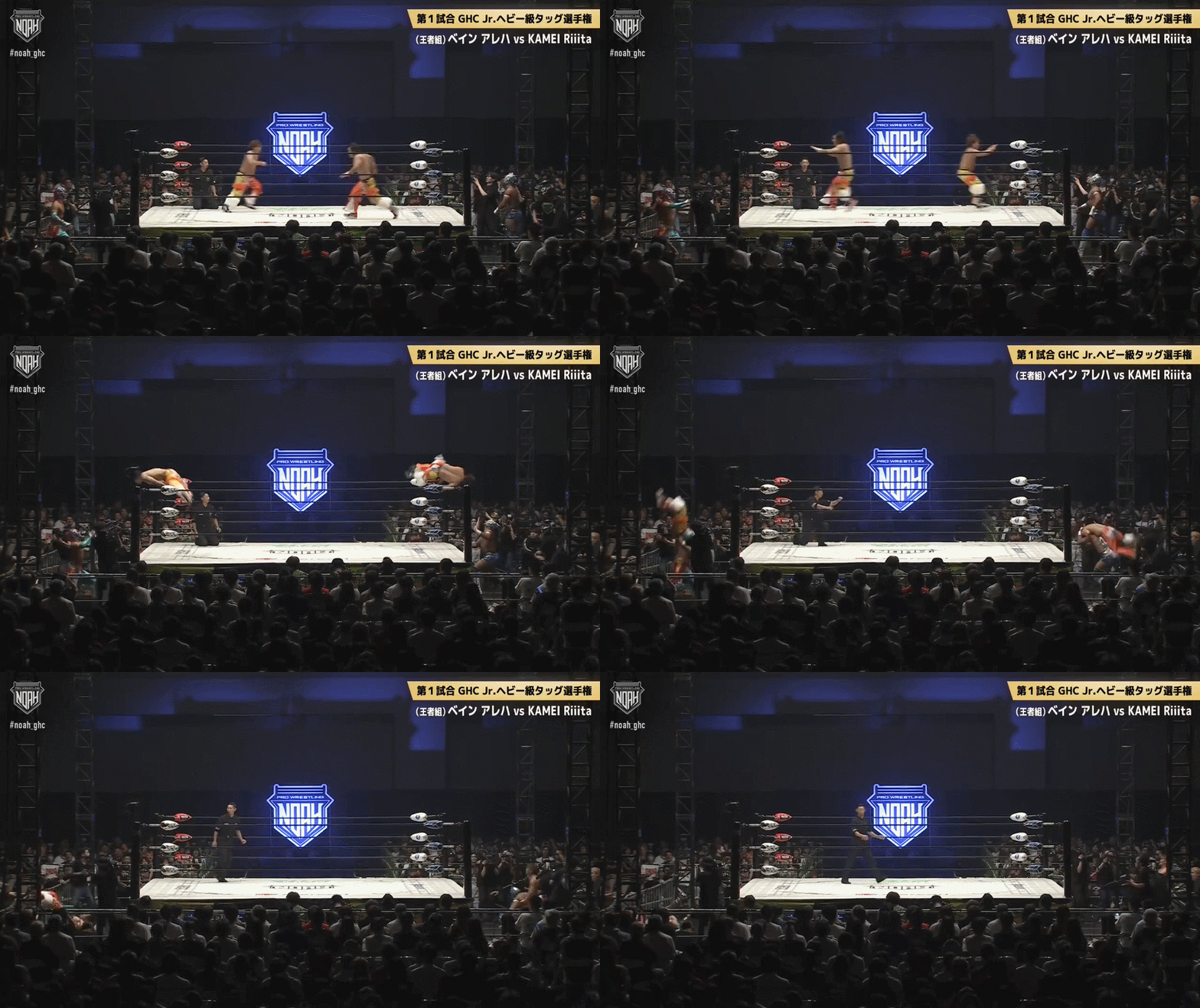
I suppose it was a NOAH crowd there to see NOAH wrestlers because the fans gave Alejandro’s assisted elevated double dropkick to both Kamei and Riiita some light applause (even though it looked like it missed Kamei). Later, both Alejandro and Dragon Bane also collided with the barricade on his dive to the outside, so it was a rough night for most of the flyers.
Alejandro and Bane isolated Riiita inside the ring, and Alejandro and Riiita muffed an Irish whip reversal because Alejandro looked like he was rushing to his position to set up Bane’s handspring kick to combo with his enzuigiri to Riiita. Kamei made Bane pay for saying rude things about Riiita’s mother by…calmly walking up to Bane and then launching him with a headscissors from the top rope. That was a bewildering choice. Could Kamei also be feuding with Riiita’s mother?
Still, it laid the stage for Kamei and Riiita’s double team offense on Bane, which was fresh and crisp. (Not now, YOH. We don’t need your Ziploc bag coat’s Croc-Loc zippers featuring TripleTrak technology to keep it tight.) In particular, Kamei’s leg lariat that knocked Bane down to Riiita’s knees so Kamei could launch himself on to Bane with a Lionsault to weaken Bane for Riiita’s pin attempt was a fun Rube Goldberg machine to watch unfold. So, it was disappointing later to see Kamei give us a full NXT Shocked Pikachu face when Dragon Bane kicked out of his JFK, a spinning headscissors into a crucifix pin. Perhaps the move would be more effective against Yanagase Pro and occasional AJPW wrestler Jack Kennedy.
Riiita tried to save Kamei from further double-teamed harassment, but he was gifted a Canadian Destroyer by Alejandro for his troubles. Then, we had the awkwardness of Riiita melting to the mat from the Canadian Destroyer, rolling outside, and popping back to his feet so that he could catch Alejandro on his plancha. Alone in the ring, Kamei and Bane couldn’t quite pull off Bane’s poisoned hurricanrana, but they tried to overwrite that memory with Bane’s shooting star press. The lasting impression that they imparted to viewers was Bane’s very loose Santa Maria to close the match.
The cold crowd, the awkward setups, and the surprising sloppiness from all participants shocked me. I know that they’re capable of a better match, but I would need to be convinced to give this combination another try.
You can watch the match and the show on Wrestle Universe.
Dan Tamura (c) vs. Naruki Doi
AJPW Summer Action Series 2026 – Day 3
July 25, 2026
Cagematch ranking as of 8/1/26: 801
Cagematch rating as of 8/1/26: 7.25
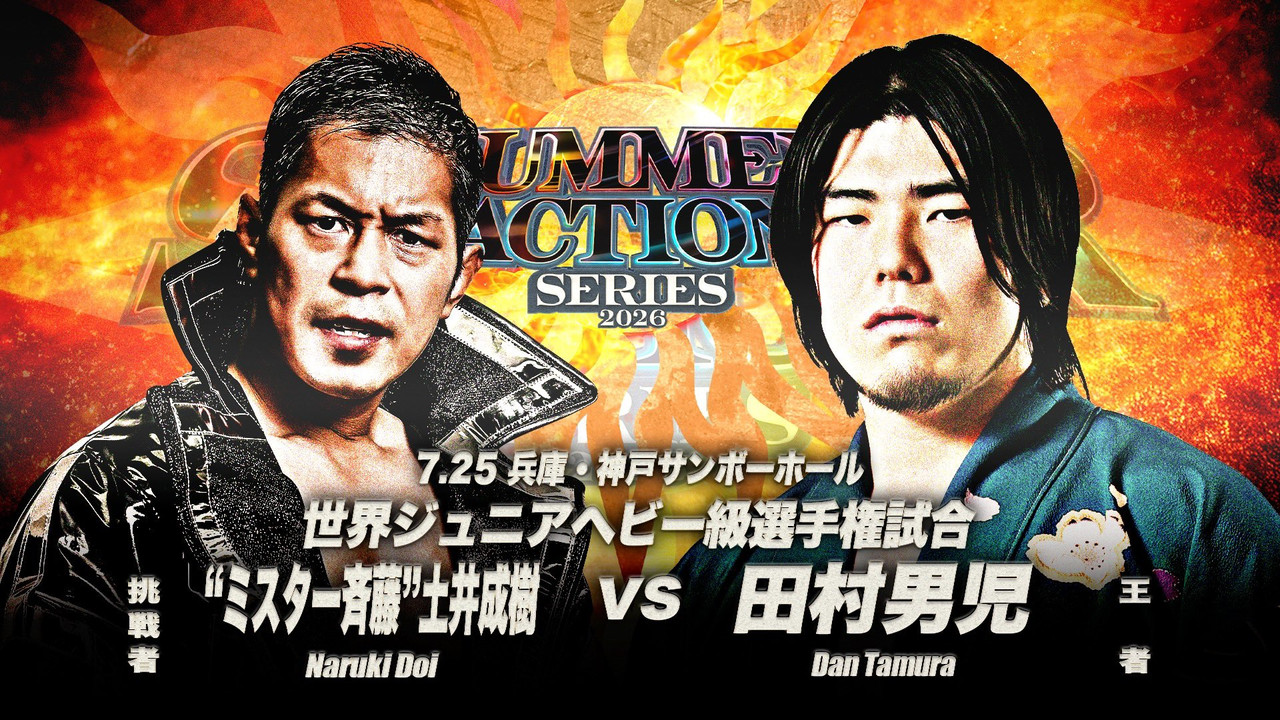
I had originally imagined a whole column devoted to All Japan’s very good July, which was highlighted by:
- Yuma Aoyagi & Go Shiozaki vs. Suwama & Suwama (AJPW, July 19, 2026)
- Atsuki Aoyagi & Rising HAYATO (c) vs. Shota Kofuji & Yuma Anzai (AJPW, July 19, 2026)
- Jun Saito & Rei Saito (c) vs. Daisuke Sekimoto & Kengo Mashimo (AJPW, July 19, 2026)
- Dan Tamura (c) vs. Naruki Doi (AJPW, July 25, 2026)
- Kento Miyahara (c) vs. Ren Ayabe (AJPW, July 25, 2026)
However, time constraints forced me to choose between devoting myself to catching up with All Japan or settling for the most interesting match from the company’s slate in July. So, the compromise was to rescue Tamura vs. Doi from that column and leave the rest behind. Call me Daniel Plainview, if you must.
We last saw Tamura when he won the AJPW World Junior Heavyweight Championship from Seigo Tachibana in a very enjoyable match. Doi, a two-time former champion, was Tamura’s first challenger. He had also just shown crispness and malevolence against Ryoya Tanaka the month before. Since I’ve advocated for scheduling former champions as the new champions’ first defense elsewhere, I embraced Doi as Tamura’s first challenger.
Though Doi and Tamura were billed at the same height and approximately the same weight (only three pounds separated them), Tamura projected as the larger wrestler. Tamura’s larger frame allowed AJPW and Tamura to have some laughs at press conferences, like when they teased that Tamura exceeded the junior heavyweight limit. Though he was eighteen years older and was wiry compared to Tamura, Doi still gave the impression of being the stronger wrestler. For this match, unlike in his match against Tanaka, Doi donned the long boys.
After Tamura bowled over Doi with a shoulder charge, Doi resorted to veteran wiles to drag Tamura into the mud. Doi all but told Tamura that the Kobe Sambo Hall wasn’t a mudhole; instead, it was an operating table, and he was the surgeon. He found a fan’s frilly umbrella, and that was his scalpel. I wish Tamura had fought back more when he and Doi were among the fans, but he made up for it by reversing Doi’s whip into the ring post. Unfortunately for Tamura, Doi outsmarted him again by stepping out of Tamura’s lariat’s range. My mon Doi don’t shiv.
That gave Doi a target, but it didn’t neutralize Tamura’s raw power since Tamura could still just run through Doi and fling him around in a headlock. Tamura controlled Doi on the mat for a while before he used leverage and spacing to strike back. Fighting on the ropes, Tamura tried to show off his upper body strength, but he couldn’t quite hold himself up on the ropes. Doi landed his Bosou Elbow, but Tamura kept rising to hammer back with forearm strikes. So, Doi tried to make Tamura hurt in his dominant arm, but Tamura just ignored the pain and crushed Doi with a Death Valley Driver. Tamura and Doi couldn’t quite connect on Tamura’s roll-up attempt, but Doi saved the attempt with a dropkick to Tamura’s face. If all else failed, hit the other person as hard as you could.
In his match against Tachibana, Tamura had to compensate for his grip on Tachibana slipping, which made for an impressive display. This time, Tamura’s grip slipped while lifting Doi for a powerbomb, so Tamura had to make another quick save. While one could argue that Tamura was leaning into the match’s story about Doi’s attacks on his right arm, it felt more like Tamura lost his handle when he tried to adjust his hold on Doi. Still, it was an impressive deadlift by Tamura.
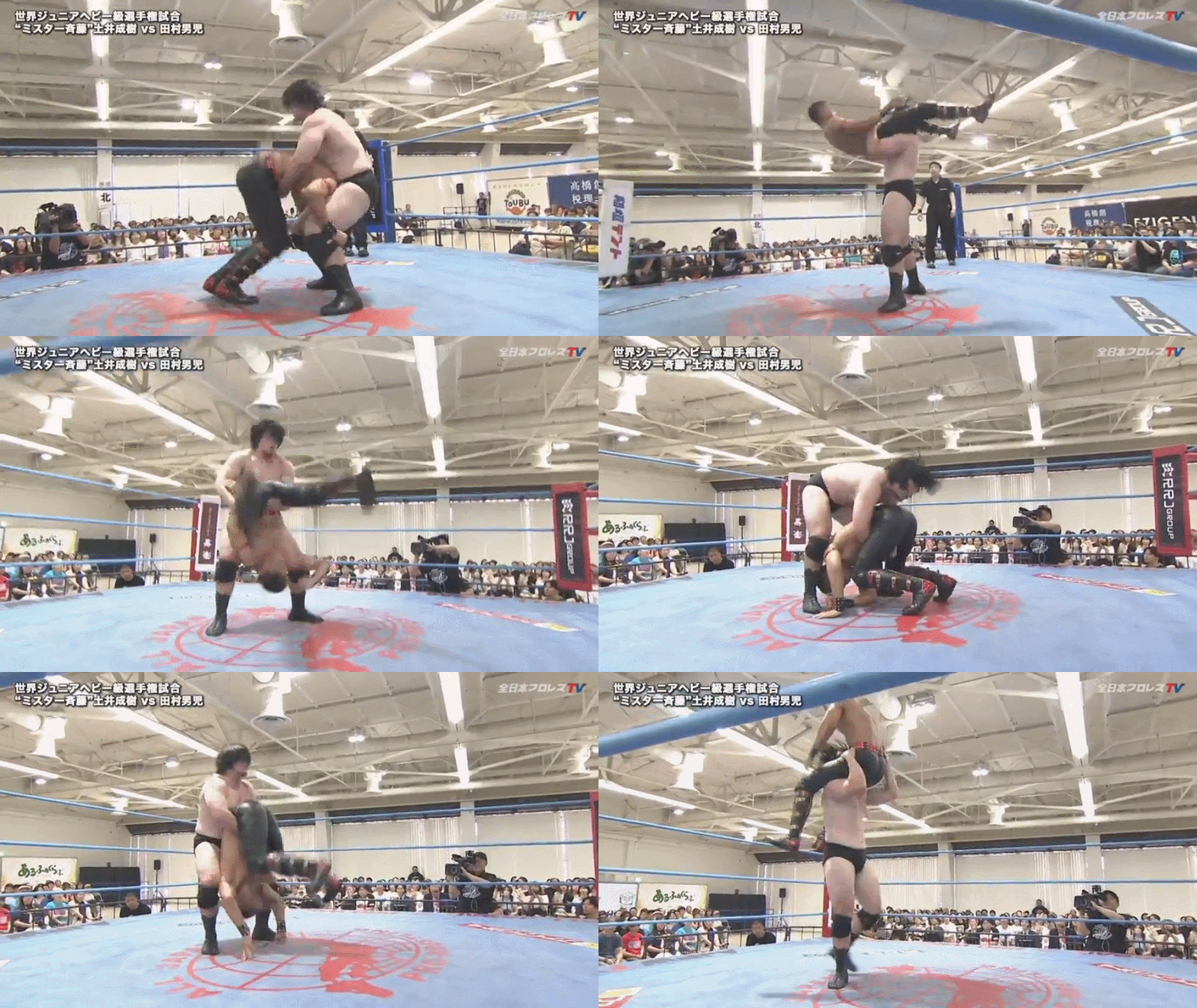
Tamura showed that he was nasty (but don’t say “balls nasty”) by blasting Doi with a lariat despite the pain. Doi showed that he couldn’t be dispatched so easily by reeling off a sunset flip bomb from the top turnbuckle, a Doi 555, and the Bakatare Sliding Kick for a nearfall. Sensing that Doi made the first motion for the Muscular Bomb, Tamura shoved Doi down by his foot and powerbombed him for a nearfall. Doi baited Tamura by eating a three course meal of lariats to trigger his V9 Clutch pin attempt, but that only energized Tamura. Tamura lifted Doi for a powerbomb, and Doi punched Tamura’s head as furiously as he could. Still, he still fell victim to Tamura’s powerbomb.
They didn’t have the cleanest outing, but the ending, starting when Tamura pounded Doi’s chest with his lariats, was very exciting. Just when the match felt dry, Doi would yell at the crowd to get their energy back up or Tamura would hit Doi very hard, so it mostly worked to entertain. I hope that Tamura’s other defenses in this run are a little cleaner though.
You can watch the match and the show on AJPW.tv.
El Lindaman (c) vs. T-Hawk
GLEAT 5th Anniversary Inaugural Event Sonic Wrestling in Ariake
July 1, 2026
Cagematch ranking as of 8/1/26: 557
Cagematch rating as of 8/1/26: 7.5
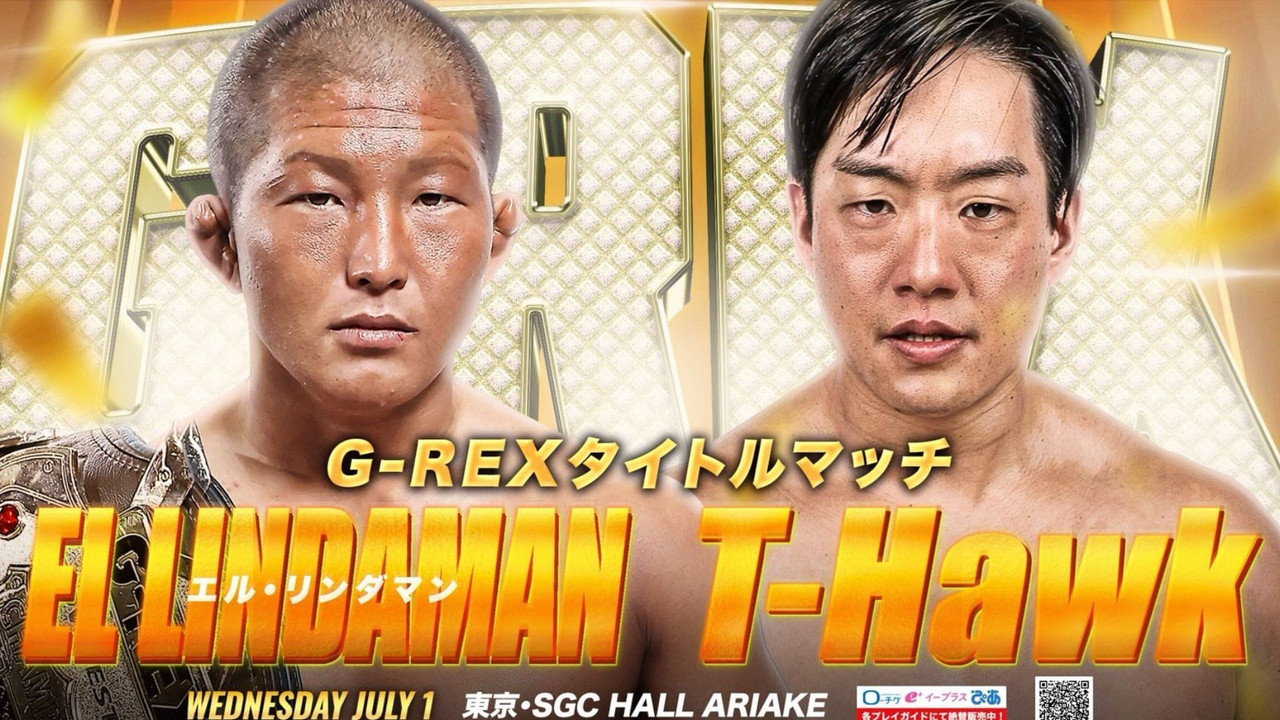
Sweet merciful crap, T-Hawk didn’t demand that GLEAT change the photo that made him look like he hadn’t slept in a fortnight. After beating Kaito Ishida to win the G-CLASS, T-Hawk faced his fellow STRONGHEART for a G-REX Championship that he held for 265 days as of the match. T-Hawk and El Lindaman were no strangers to each other as opponents from Dragon Gate and GLEAT, and T-Hawk held a winning record over El Lindaman.
To give credit where credit is due, GLEAT had a very classy video roll call of former G-REX Champions. However, the video lost some of its effect since the title had eight holders in three years: El Lindaman, Kaito Ishida, T-Hawk, Hayato Tamura, Soma Watanabe, Ishida again, Katsuhiko Nakajima, and El Lindaman again.
My hopes for the match were simple. I wanted T-Hawk and El Lindaman to hit each other hard and with intent, and if T-Hawk could win the match and get the champion’s purse to pay for a different promotional picture, all the better. I was certainly not expecting El Lindaman to abandon his nudest wrestler alive persona and wear some very colorful long boys for the match. His lack of familiarity with kneepads might explain why he had to pause so often throughout the match to adjust them.
A stare down and a handshake led to jockeying for position to almost complete silence from the crowd at SGC Hall Ariake. The fact that the crowd was blanketed in darkness and that GLEAT did not announce an attendance for this show hinted that things were not great for GLEAT. The grappling was respectful, respectable, and charitably described as methodical. (A less kind adjective would be staid or even bloodless.) T-Hawk started his melody of chops early, and Lindaman caught T-Hawk on a charge and flipped him with an Air Raid Crash, which got some applause from the crowd.
They tumbled outside, where T-Hawk continued his choppy tune. To my surprise, the crowd looked like it was pretty full about five rows deep on the hard camera side at least. Ready for the next verse, T-Hawk rolled Lindaman back inside only for Lindaman to launch himself back outside and onto T-Hawk.
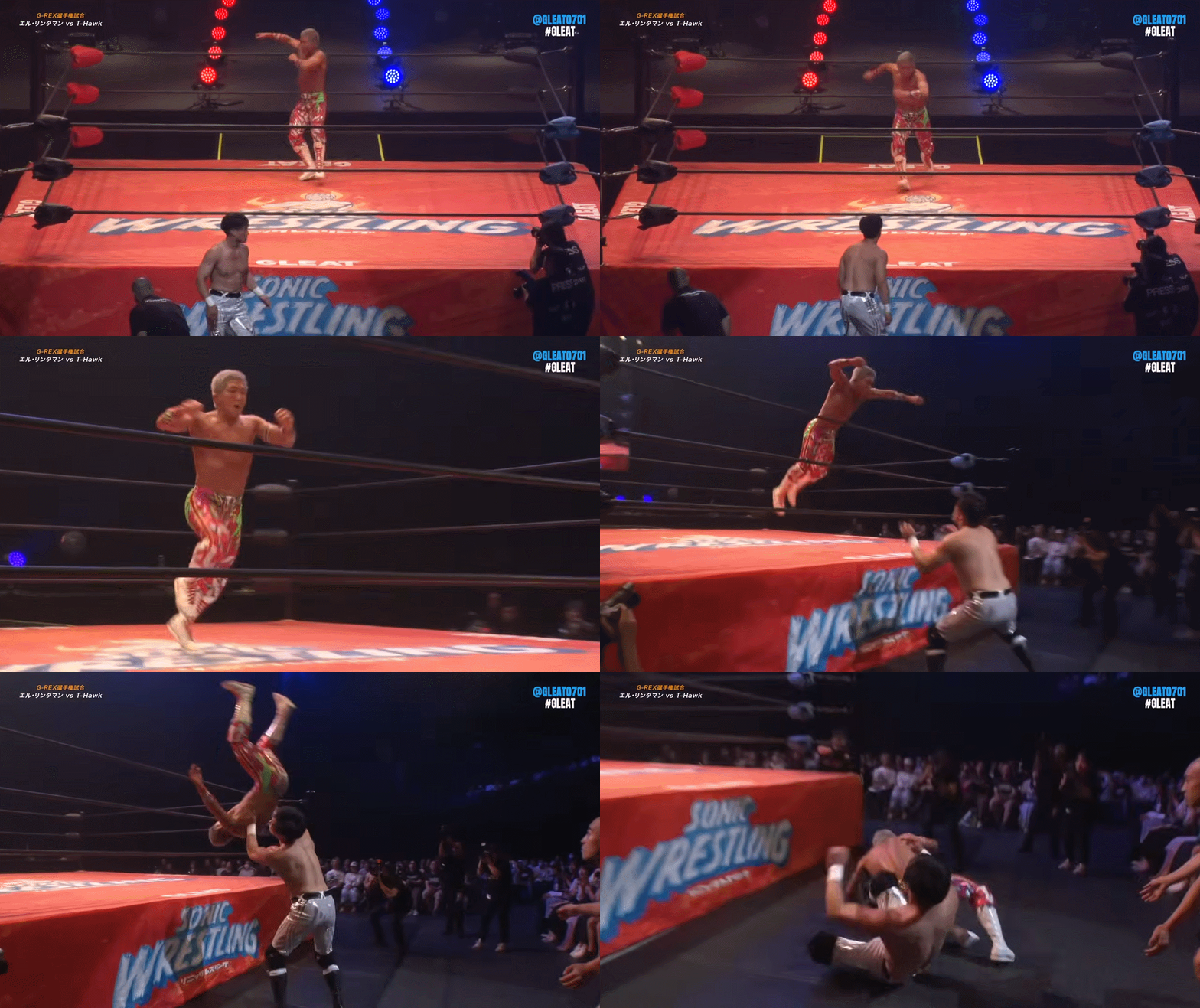
Returning to the ring, Lindaman teased doing something after T-Hawk’s kick-out on a pin launched him toward the ropes, but Lindaman just jogged around T-Hawk and then walked up to him to grab the supine T-Hawk’s ankle. It was a bewildering choice that puzzled me even after Lindaman bent T-Hawk’s leg into a single crab hold. T-Hawk was determined to stick to the chops and headlocks that he was used to. I don’t think anyone could accuse T-Hawk or Lindaman of moving too fast in this match. For example, after throwing Lindaman down with a pop-up powerbomb and receiving a two count on a pin attempt, T-Hawk backed away from Lindaman instead of pushing his offense.
Lindaman was a little more energetic. After running into T-Hawk’s boots on two charges, Lindaman got past T-Hawk’s defenses on the third and dropped him with a neckbreaker. He then pressed on with two charging elbows in the corner and a missile dropkick. For as energetic as Lindaman was, he also came across like a poor tactician, which undermined by interest in rooting for him. He stepped on T-Hawk as he ran from one corner to another, climbed to the top turnbuckle, chose that moment to appeal to the crowd for some noise, and promptly landed on T-Hawk’s raised knees on his splash dive. Even if their story was that Lindaman would overcome his losing record against T-Hawk, I would prefer that wrestlers not make themselves look like fools in the process of creating narrative obstacles that they would then overcome.
More admirably, Lindaman powerbombed his way out of T-Hawk’s triangle choke and asked the crowd for cheers as he stood his ground against T-Hawk’s monotonously blistering chops. They picked up the pace when Lindaman blocked T-Hawk’s second pop-up powerbomb and turned him over with an Exploder Suplex. Lindaman’s dropkick left T-Hawk gasping for air on the top turnbuckle, and he ultimately returned him to the mat with a super flying armbar. (Unfortunately, GLEAT’s production team did not get a good angle on Lindaman’s attack. The referee kept stepping into the camera operators’ shots, like when he blocked the handheld shot of T-Hawk’s release back suplex.)
T-Hawk also powerbombed his way out of Lindaman’s armbar, and he compounded the damage on Lindaman with a release back suplex (that we couldn’t see thanks to the referee). Lindaman picked that moment to ignore the damage and take down T-Hawk with a German Suplex so we could have the double down before the climax. I have to give T-Hawk credit for just punching Lindaman in the ear when they stood back up instead of getting into a tired forearm strike or chop battle. The resulting image of Lindaman bleeding from the ear was gnarly.
They increased the tempo to a fever pitch as T-Hawk tried the Cerberus and Aguila knee strikes and Lindaman responded with a backdrop driver. He took his turn with some German Suplexes that dropped T-Hawk right on his head, and they entered the endgame where Lindaman strived to lock T-Hawk’s arms for his Tiger Suplex. After a bit of struggle, Lindaman scored a two-count nearfall from the Tiger Suplex, which set T-Hawk off to swing wildly at Lindaman. T-Hawk scored one last chop on Lindaman and sank to his knees. To my disbelief, the match ended when Lindaman walked over, pushed an exhausted T-Hawk down, held his arms down, and laid on top of him to win the match even as T-Hawk feebly kicked his legs.
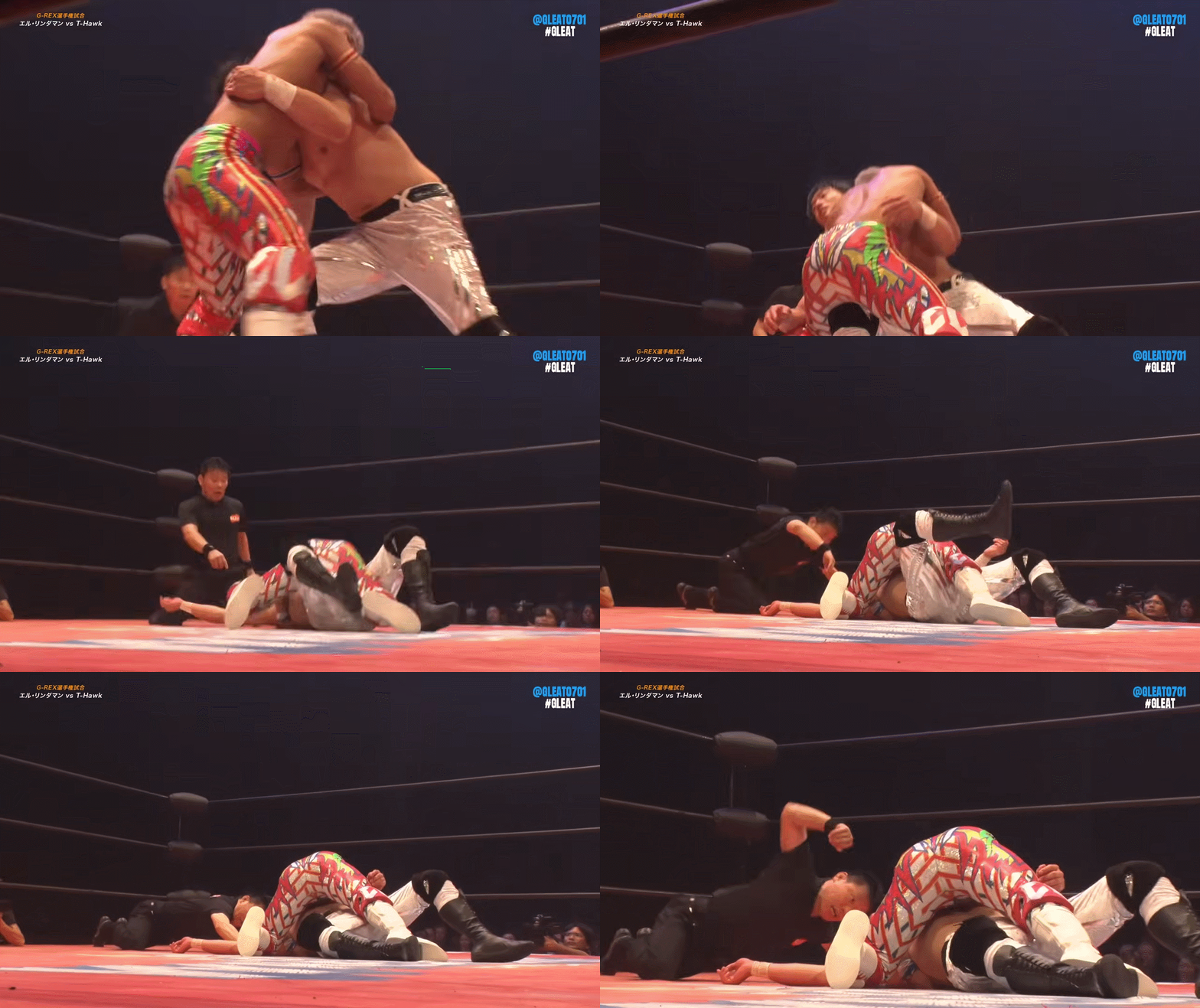
I get that they aimed to show that Lindaman could take T-Hawk’s best shots and wear him out. That ending left me flabbergasted because it was incredibly anticlimactic. If Lindaman had done something more than just fall on top of T-Hawk, it wouldn’t have felt so awkward. As it was, Lindaman’s win felt almost accidental. I wish I could give them credit for trying to subvert my expectations for how a mentee could overcome a mentor’s experience or strength advantage, but I think that would be beyond my capacity for charity. The languid pace of GLEAT’s major matches did not help matters; the bursts of activity around long stretches where Lindaman and T-Hawk stood or kneeled to show that they were catching their breaths consistently left their matches feeling choppy because they gave my attention many opportunities to turn elsewhere.
You can watch the match and the show on GLEAT’s YouTube page.
Genkai (c) vs. Kodai Nozaki
Kyushu Pro 18th Anniversary
June 27, 2026
Cagematch ranking as of 8/1/26: 199
Cagematch rating as of 8/1/26: 8.07
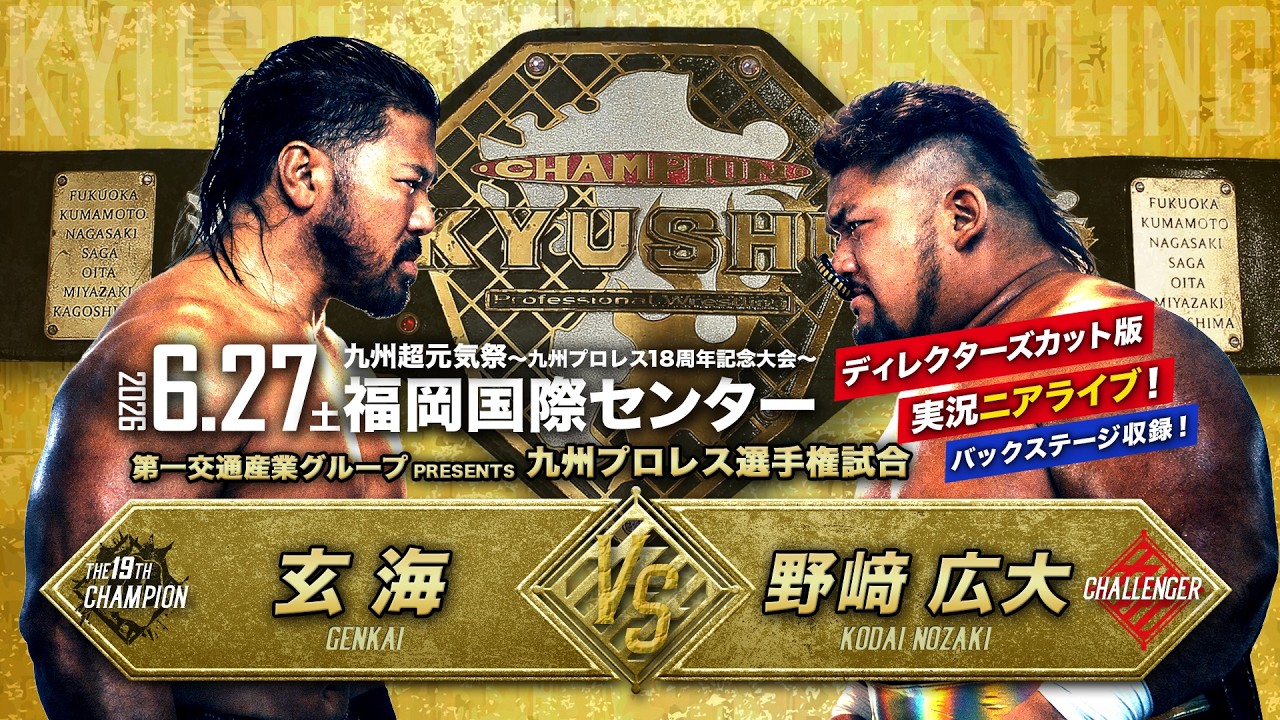
Kodai Nozaki was an honorable mention in the 30 Under 30 in 2025 and 2026, and he was involved in one of my favorite matches so far this year (even if his partner was more prominent in the match). Here, he took on the 49-years-old fellow multi-time Kyushu Pro Champion Genkai for the title. Genkai defeated Hitamaru Sasaki for the title in March for his 5th reign, but he had no defenses before this match. Last year, Genkai retired Mentai Kid in the 191st best match of 2025 according to the Cagematch Inmates and the 51st best match of 2025 according to Voices of Wrestling Match of the Year voters.
The pre-match video laid out the other times that Nozaki ended Genkai’s reigns as Kyushu Pro World Champion: in August 2022, Nozaki defeated Genkai in a singles match, and in August 2023, Nozaki stacked Genkai and Mentai Kid to pin both of them. This was the third time Nozaki threatened Genkai’s reign, and Genkai seemed to be sick of Nozaki messing with him.
As you’d expect, Genkai and Nozaki established early that Nozaki had a huge power advantage. Nozaki dominated the collar and elbow lock-up, and he threw the 209 pounds heavy Genkai as a father would throw their toddler while playing wrasslin’.
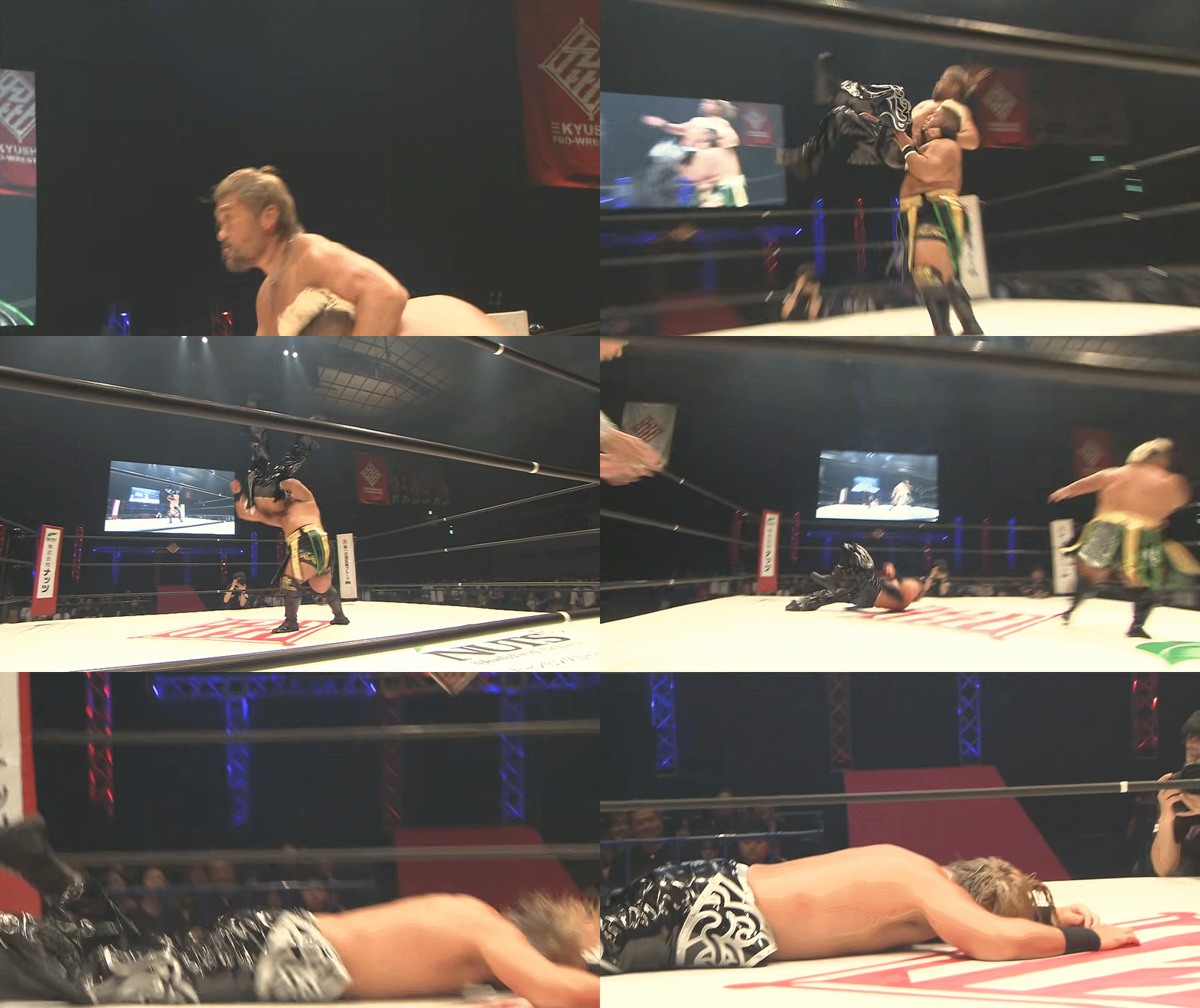
Though Genkai held a small advantage in technique over Nozaki, he decided to slug it out with the bigger man to bait Nozaki into charging at him. That opening gave Genkai the space for a combo (a headscissors, a Superman Punch, and a few short lariats) to take Nozaki down for a two-count. A running dropkick to the corner knocked Nozaki down, but Genkai could not capitalize because Nozaki was in the corner. He did, however, charge the crowd up with his chop battle with Nozaki and blocking Nozaki’s charge (even if we couldn’t see it because Kyushu Pro’s production team switched to the corner camera, which Genkai blocked with his body).
Luckily, we didn’t need the corner camera to see Nozaki knock Genkai off of the top turnbuckle to the floor.
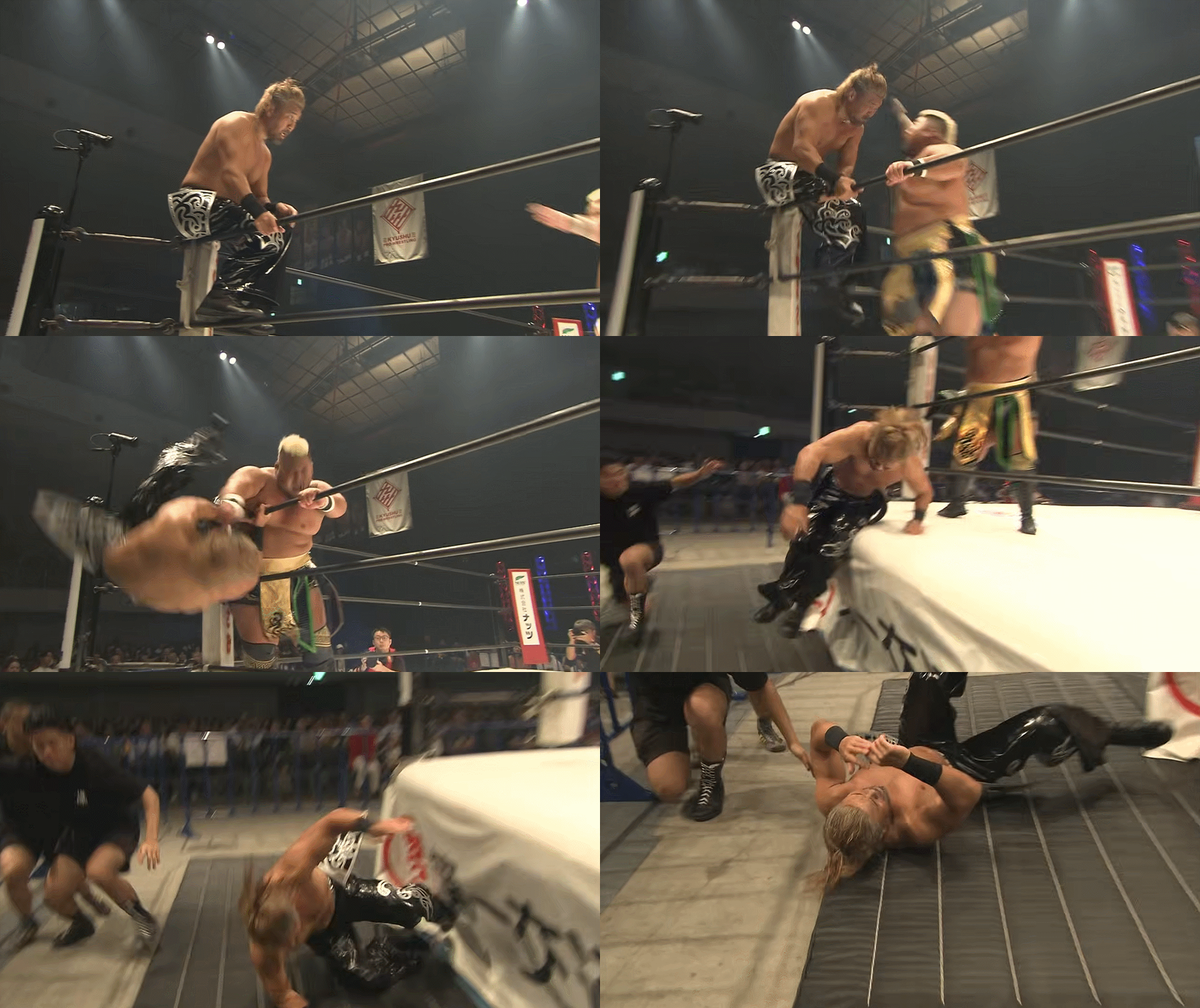
Nozaki and Genkai worked hard to make see Nozaki seem inevitable while keeping the match engaging. Genkai would use technique or luck to escape Nozaki’s grasp, like slipping off of Nozaki’s shoulders before Nozaki threw him headfirst into the ring post, and kicking him in the head to stun him. When Genkai took a long time to catch his breath and climb to the top rope again, Nozaki got back to his feet and dazed Genkai with a slap.
To prevent himself from coming across as the heel, Nozaki had to welcome Genkai’s offense to show that he could power through it. After rocking Genkai with a superplex and wearing him down with a sleeper hold, Nozaki dared Genkai to chop him down. Nozaki’s riposte made Genkai look like he regretted the series of decisions that led to that chop. And even when Genkai took Nozaki down with a back suplex, he was unable to do anything but catch his breath from Nozaki’s beating and his exertion. After forcing Nozaki to retreat to the outside with a Samoan Drop, Genkai’s running dropkick left Nozaki vulnerable and Genkai himself walking very gingerly.
Still, Genkai summoned enough from within to finally land a move from the top rope (an elbow drop) and a Pedigree (that Nozaki should have kicked out at one from) to score some two count nearfalls. All of that effort again left the 49-years-old champion drained, which gave Nozaki time to catch his own breath. Once Nozaki got back on his feet, he made Genkai pay with suplexes, and I was glad that Nozaki did not give an outsized, exaggerated reaction when the referee only counted to two on his pinfall.
Genkai made his last burst again based on technique. He rolled out of Nozaki’s path of pain and nicked him with a dropkick to the knees. A kick to the head brought Nozaki down, and Genkai transitioned right into an unconvincing submission hold when Nozaki kicked out. That presented Nozaki’s biggest challenge, and Nozaki again solved it with power by picking Genkai up and powerbombing him. Genkai used his wits one more time by slipping off of Genkai’s shoulders from another powerbomb attempt and shoving Nozaki back to create some space. Unfortunately for Genkai, that just gave Nozaki enough runway for a spear.
Despite suffering the spear, Genkai still had some fight in him. Nozaki and Genkai battled for position on the turnbuckle, and Nozaki again overpowered Genkai and threw him down with a twisting suplex. Genkai’s kickout was very weak, but he had enough juice left to jump up to counter Nozaki’s spear into a Pedigree. I appreciated Genkai’s desperation and fatigue on the pinfall after that Pedigree, which Nozaki had no problem kicking out of because Genkai was too tired to secure it.
Genkai’s end came as it had to from Nozaki’s overwhelming power. Genkai tried again to outslug Nozaki by hitting him with running lariats from different angles, but Nozaki just planted his feet and blasted Genkai with a lariat of his own. One spear couldn’t finish Genkai, but another, where Nozaki got a little more charge by running the ropes before he hit Genkai, led to Genkai’s third defeat at Nozaki’s hands in a championship match.
That was a very fun heavyweight match that stayed in its lane and avoided various wrestling tropes. We got no NXT faces, nor did we get badly timed one-count kickouts. Genkai and Nozaki told a clear, effective story about Nozaki’s inevitability and power and Genkai’s ultimately unsuccessful attempts to find a way to outsmart him. When Genkai was out of options, he tried to overmaster Nozaki, which he knew wasn’t a winning play. That gave Nozaki the opening to show Genkai what true power looked like.
Unfortunately, Nozaki lost the title to American journeyman Rob Drake not long after this victory at a free show in front of 612 spectators. Even so, this match was worth my time.
You can watch the match and the show on Kyushu Pro’s YouTube page.
Kosuke Sato & Ryuma Sekimo vs. Ali Najima & Minata Kasai
Fuminori Abe & Takuya Nomura Produce Kakuto Tanteidan V ~ One Last Dance Shinjuku
July 1, 2026
Cagematch ranking as of 8/1/26: 149
Cagematch rating as of 8/1/26: 8.16
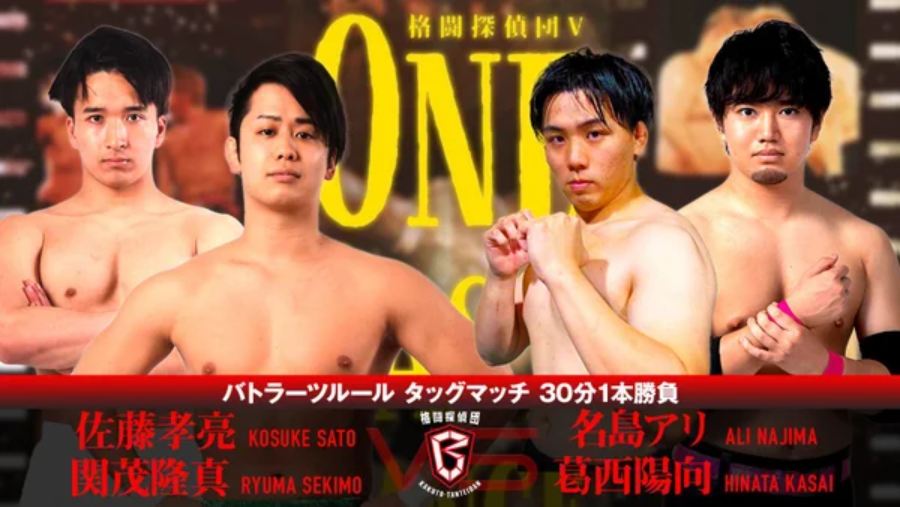
Before we go any further, let me exhort you to watch this match.
Ali Najima continued to be a fascinating figure for me. As a product of the NOAH Dojo and the Sportiva Dojo, he stood out every time I’ve checked him out for his hard-nosed grappling and his potential. So, pairing him with DDT’s Minata Kasai against Kosuke Sato, BJW’s Junior Heavyweight Champion at the time, and BJW’s Ryuma Sekimo, was an opportunity for Najima to sharpen his iron against others’ iron that I had hoped for the last time we looked in on Najima.
From the jump, it was interesting to see the difference in demeanors between the wrestlers on each team. Kasai, the DDT rookie, was a ball of enthusiasm. Sekimo, also a rookie for BJW, was loudly aggressive, slapping at Kasai’s offered hand before the match. Najima and Sato, both champions in their respective companies and possessing slightly more experience (2 years for Najima, 7 years for Sato) were more stoic. They stayed in their own corners without greeting their opponent.
Kasai and Sekimo started the match with some energetic but rudimentary grappling, but they deserved credit for making it looking competitive instead of cooperative. That quickly degenerated into a slap fight where Sekimo threw wild elbows from above in the closed guard, and they reset the match to Sato vs. Najima.
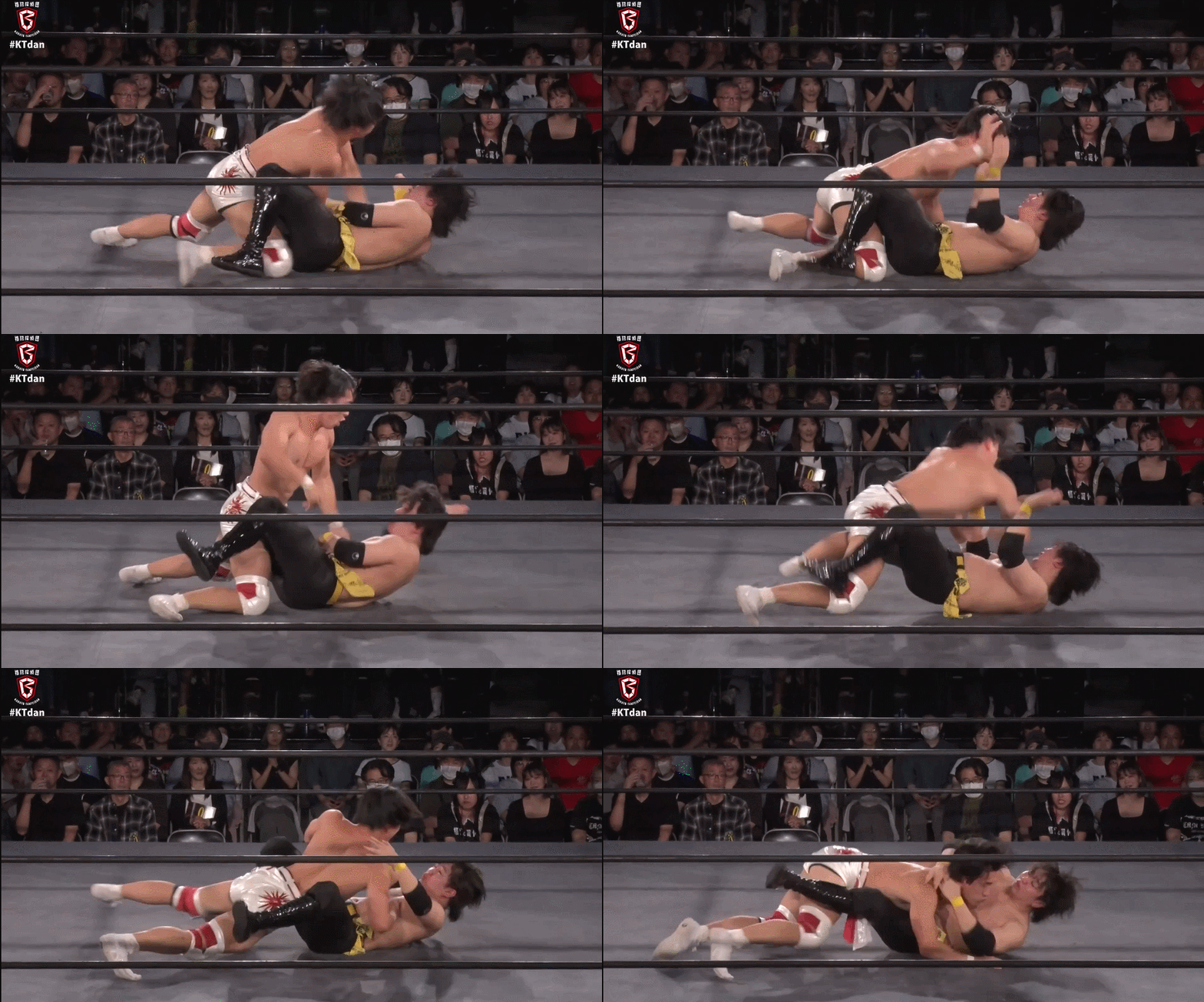
Najima seemed like he had to hunch over to account for his three inch height advantage over Sato, and his body seemed even thicker than a 22-pounds advantage would imply. Their respectful grappling was rewarded with respectful applause, and it was just friendly competition because pro wrestling is a competitive sport until you get flipped on to your fucking face.
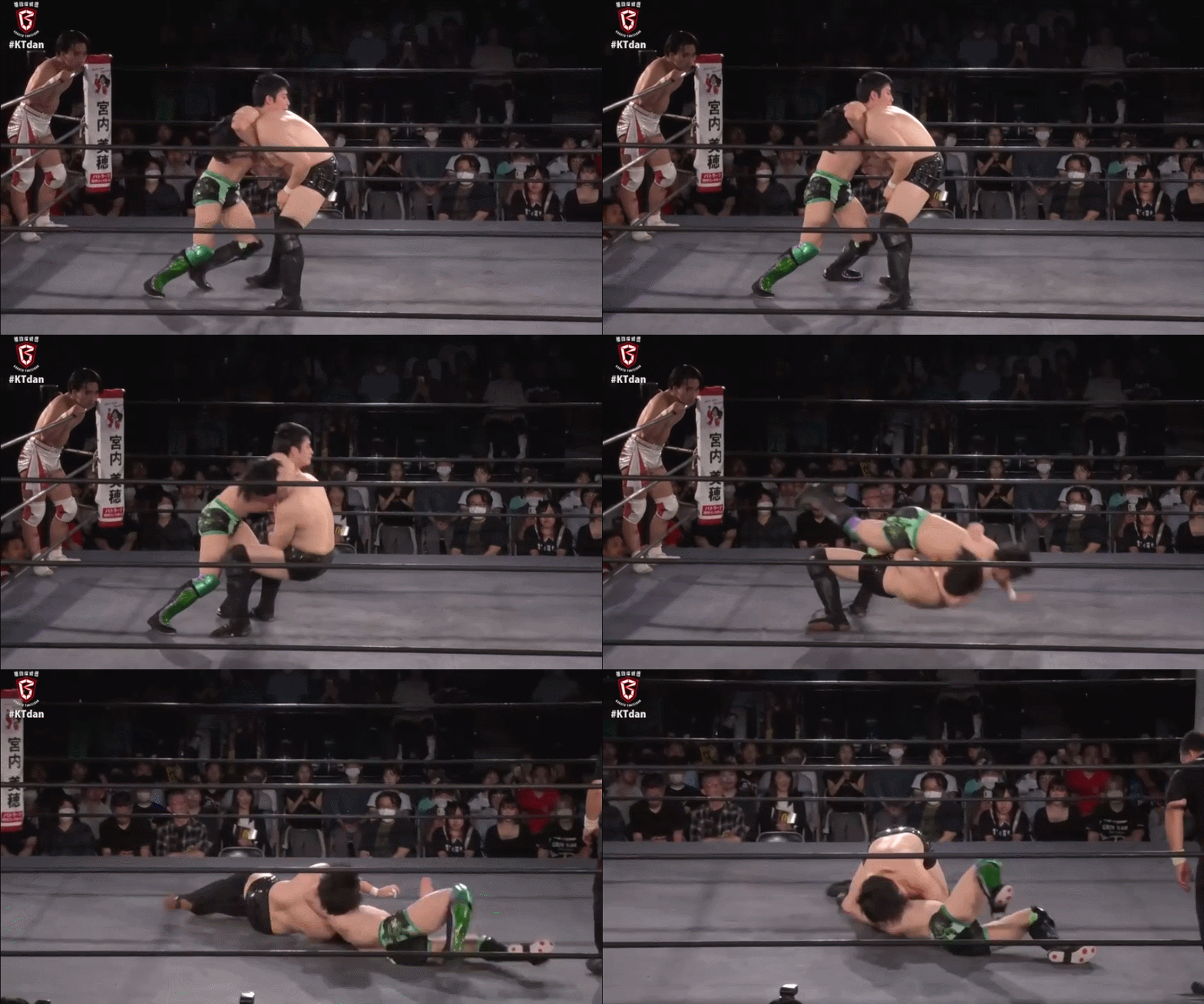
That definitely upset Sato, since he then mocked Najima after fighting out of an arm crank and kicking him in the back.
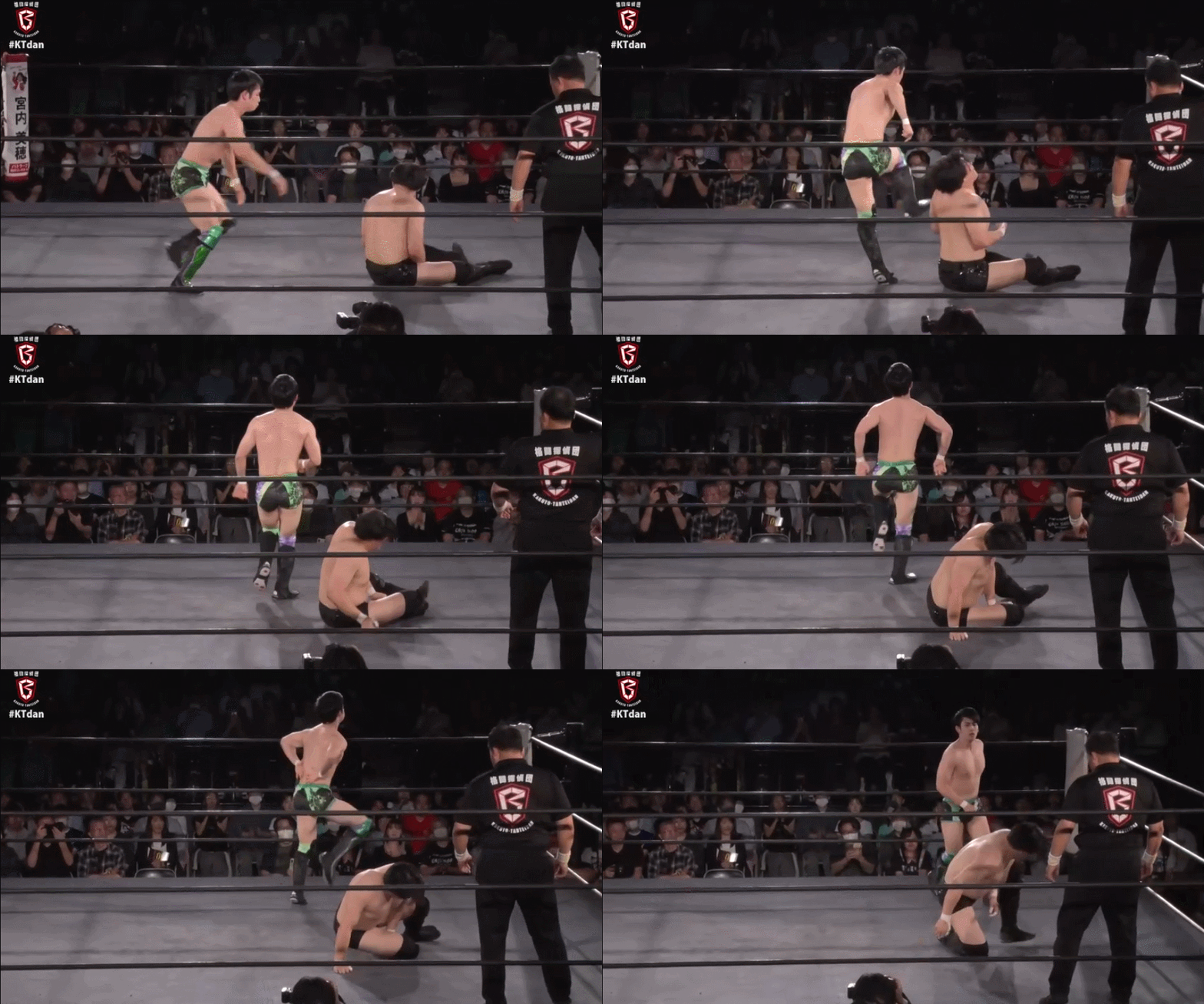
His disrespect earned Sato a slap to the face, a kick to the back, a kick to the face, a bunch of forearms to the face, and, for good measure, a forearm for Sekimo, who was on the apron. At the standing six count, Najima also kicked Sato in the head just as a final rejoinder to Sato’s diss. It was a great show of fire from Najima.
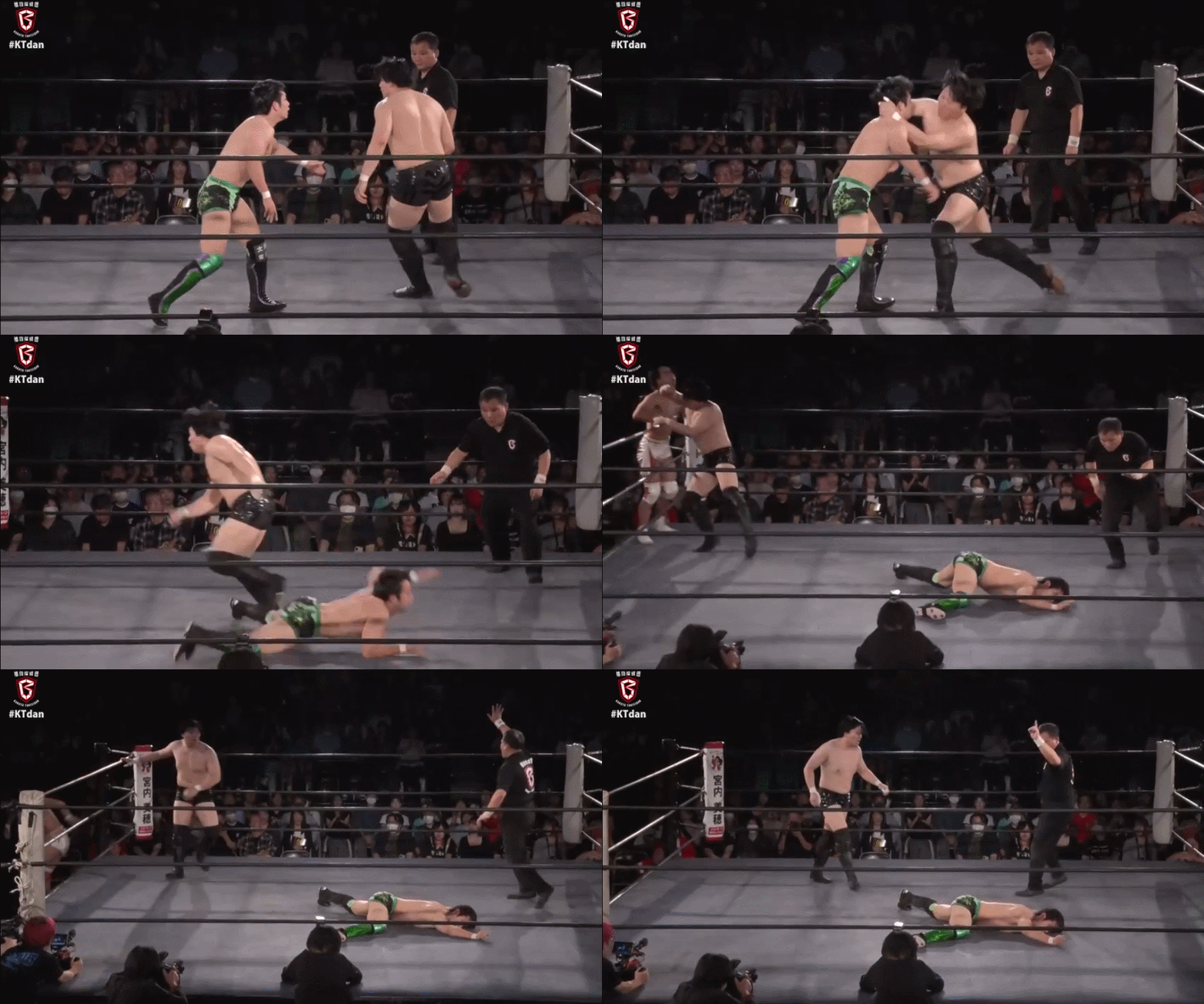
Kasai, clearly still feeling grumpy about Sekimo, tagged back in and took it out on Sato. He probably lamented that after Sato wrecked him with an elbow strike.
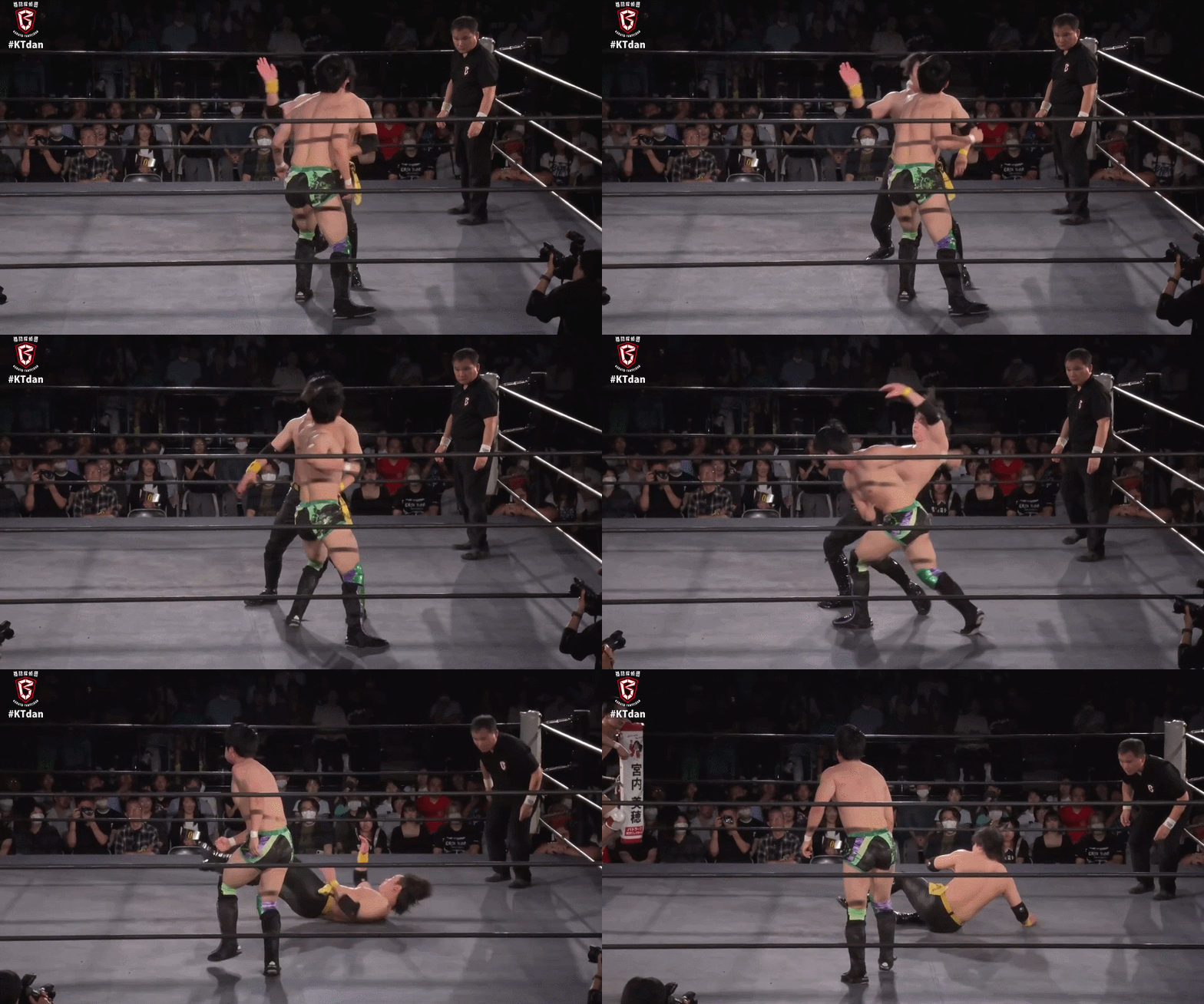
Sato tagged back out to Sekimo, who followed up Sato’s violent efforts by jumping on top of Kasai and resuming the beef. Trapping him in the Camel Clutch and then slapping his face and headbutting the top of his head indicated that Kasai obviously owed Sekimo money, honor, or possibly both since this was actually their first encounter. Najima had to make like Nelson Muntz and save Kasai, but Sekimo headbutted Najima and forced him to retreat.
Having gotten his satisfaction from Kasai, Sekimo let Sato get a taste. To his credit, Kasai still fought back until Sato tried to drive Kasai through the mat via elbows to the back of his neck. After escaping a guillotine choke via the bottom rope, Kasai and Sato stood back up , and Sato absorbed all of the kinetic energy from Kasai’s slaps into hateration and holleration. I cracked up with glee when Sato suckered Kasai into throwing a headbutt to catch him in a standing guillotine choke.
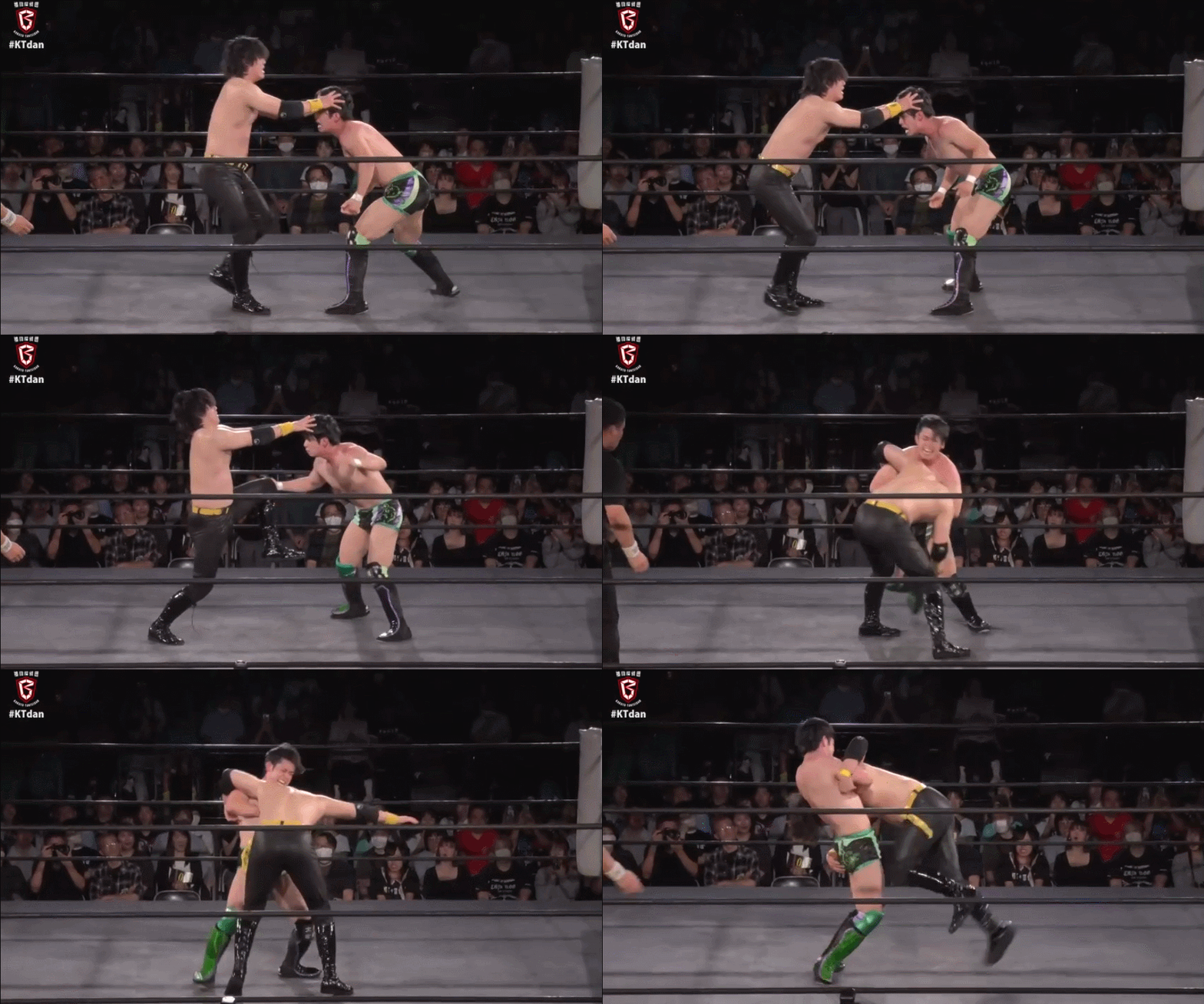
Najima saved his little buddy with a German Suplex to Sato, and Sekimo saved his teammate with a dropkick to Najima. Then, Sekimo did the thing I wish more tag teams would: he dragged Sato back to their corner so he could tag in to the match. Sekimo and Kasai beat the living tar out of each other, and Kasai had just enough energy to tag Najima. Unfortunately for Sekimo, Sato was still recharging after Najima’s German Suplex, so he was on his own. He did his best to trade with Najima, but Najima’s head was harder than Sekimo’s. Still, Sekimo caught Najima in a twisting suplex and a cross armbreaker, and Sato stomped Najima’s hands to force them apart so Sekimo could hyper-extend the arm. Unfortunately for Sekimo, Najima’s size let him roll his hips and stand to stomp Sekimo’s face until he released the hold.
Kasai trapped Sato outside, and Najima went to work. He rolled Sekimo forward into an ankle lock, but Sekimo slapped Najima to try to force a release. Instead, Najima rolled himself out of Sekimo’s reach and forced Sekimo to submit.
That was fucking rad. It was everything that I want out of professional wrestling: dudes taking things a little too seriously, hitting harder than they needed to, and exerting themselves to entertain the audience. Furthermore, they accomplished all of this in less than twelve minutes. This had shades of NOAH The Reborn, and it was quite the coming out party for all four men. Apologies to Bandido, Noisy Boy, Spider Fly, Zonik, Gringo Loco, Iron Kid, Turbo, and Vengador, but they’ve been supplanted in my personal running match of the year list.
When we last saw Ali Najima, I had mentioned that I wanted to test his might against “the likes of Abe, Aran Sano, and Ryunosuke Nagai.” I got exactly what I had wanted: Ali Najima looked great against higher caliber talent than what he usually faced in Sportiva. Sato, who impressed in his match against Satsuki Nagao in April, looked even better here. He demonstrated a nastiness that I didn’t sense in that match. Kasai and Sekimo were tremendously entertaining, and I can’t believe they’re just rookies. They demonstrated an understanding of passion and violence that veterans elsewhere have either suppressed, forgotten, or never understood.
You can and should watch the match and the show on Wrestle Universe.
Shuji Ishikawa, Fuminori Abe & Yuki Ishikawa vs. Daisuke Ikeda, Kazunari Murakami, and Ali Najima
Fuminori Abe & Takuya Nomura Produce Kakuto Tanteidan V ~ One Last Dance Shinjuku
July 1, 2026
Cagematch ranking as of 8/1/26: 353
Cagematch rating as of 8/1/26: 7.75
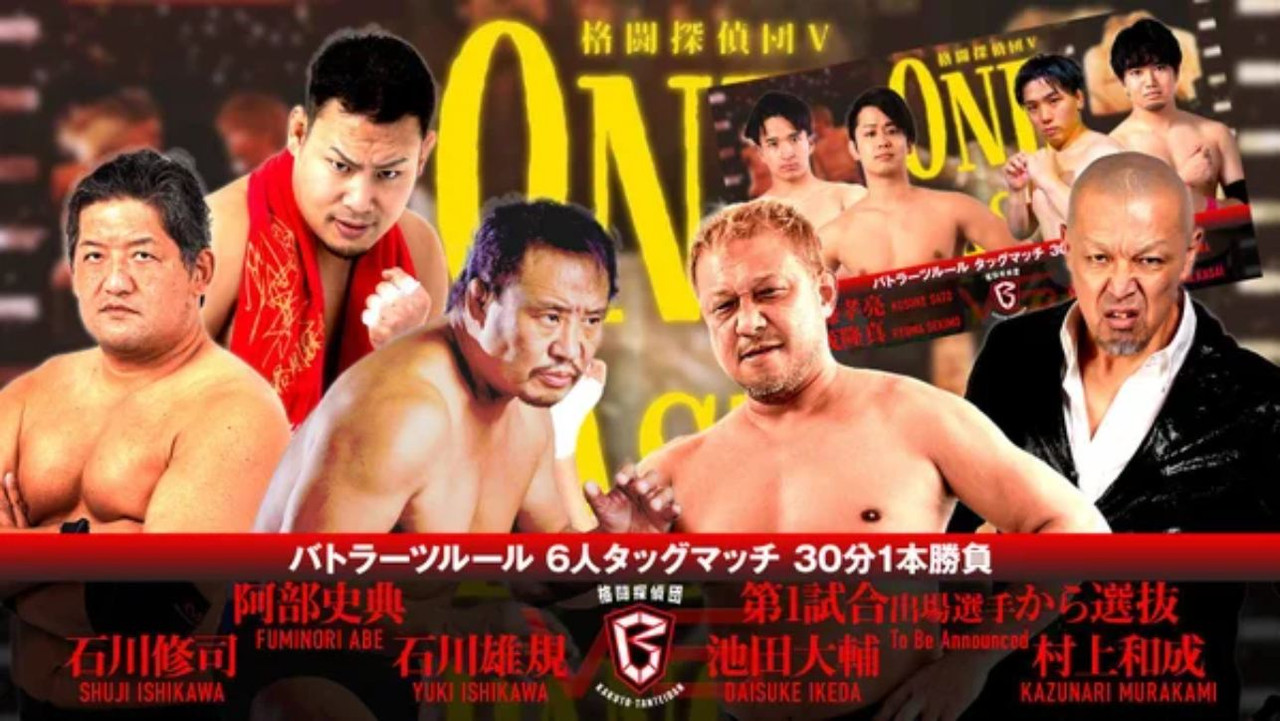
Originally, I had only planned to include Sato & Sekimo vs. Najima & Kasai in this column. However, after everyone’s performance in that match, I had to include the payoff. Because Ali Najima won the previous match, which had opened the show, he earned his way into the main event to team with Daisuke Ikeda and Kazunari Murakami. On the face of it (since the show was at Shinjuku Face), the teams seem severely unbalanced. Ikeda, Murakami, and Najima hardly seemed the equal, based on name recognition, of Abe, “The Big Dog” Shuji Ishikawa, and Yuki Ishikawa.
You don’t have to like it, but you have to respect that this was what peak graphic design skill looked like. Never mind using the graphic from the previous match to represent the last member of the team on the right; let’s focus on figuring out what the source of the lighting on these five men was supposed to be.
Najima, Ikeda, and Murakami immediately got my attention and my favor by coming out to Penpals’ “Tell Me Why,” aka the theme song from the 1997 Berserk anime. To me, using that song is laying out a mission statement, a vision of heroic, illogical struggle in the face of overwhelming odds out of loyalty to your friends and pride in yourself. In other words, if you’re going to use it, you had better represent the show, the manga, and the characters (Guts, Casca, Pippin, Rickert, Judeau, Gaston, and even Griffith but not Corkus).
If the last match was a coming out party for Sekimo, Sato, Kasai, and Najima as a group, then this match was the beautillion for Najima. He led his team and was the first to be introduced. The camera focused on him first when he entered the ring and reluctantly left him to show Ikeda and Murakami. He demanded to start the match over two men whose careers are older than he was so he could face Abe, his first professional opponent.
Najima and Abe had a fine bati-bati battle (which I think Nintendo adapted into Super Mario Bros. 2 in the US), and Shuji Ishikawa gave Najima a headbutt to think about when his dome was no longer ringing. S. Ishikawa and Abe anointed Najima with kicks, elbow strikes, splashes and dropkicks. At one point, S. Ishikawa and Abe had to take turns to beat on Najima, which made S. Ishikawa dance by himself until he could nail Najima with a dropkick.
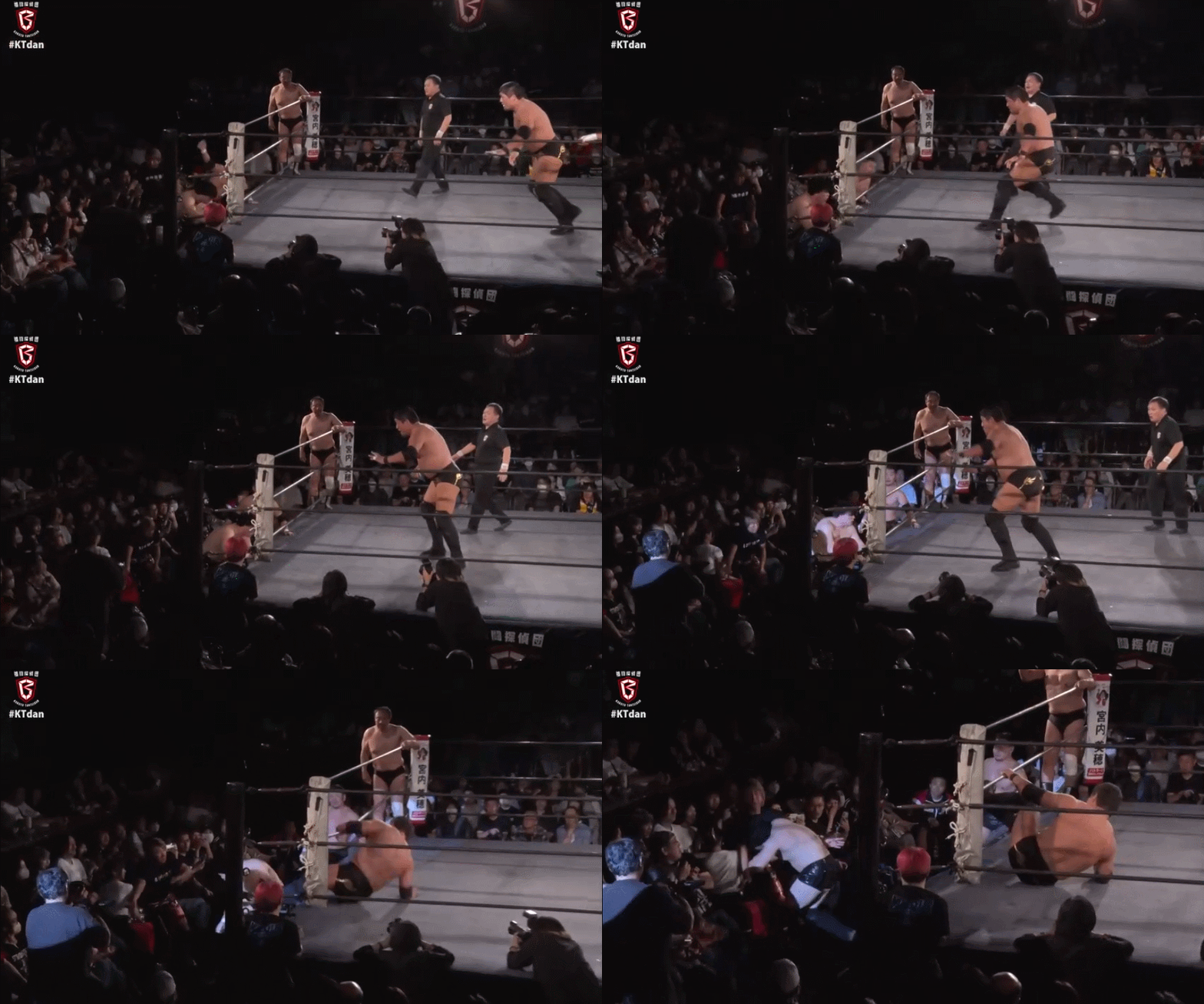
While Najima was struggling to catch his breath on the floor, Murakami, his own teammate, shoved him back into the ring to take some more punishment from their opponents. Perhaps this was more of a hazing than a beautillion. Yuki Ishikawa took over Shuji’s shift, and he grounded Najima down on the mat. Again, Ikeda interfered to save Najima, so Y. Ishikawa turned his attention to Ikeda, his longtime rival. Order broke down completely as Murakami paired with S. Ishikawa and Abe with Najima. I chuckled when Murakami nailed Y. Ishikawa with a kick to force him to release his chokehold on Najima even though Najima had already reached the ropes. Murakami had a very pleased look on his face.
Murakami saved Najima when Y. Ishikawa had captured his arm in a submission hold, and the match descended into chaos again when Murakami pushed Y. Ishikawa outside the ring to throw a chair on him. Ikeda paired with S. Ishikawa this time, and Abe and Najima fought on Shinjuku FACE’s steps. The match resumed when Murakami and Y. Ishikawa returned to the ring, but Abe and S. Ishikawa were still beating on Najima in the crowd. Abe paid Murakami back for all of his interference by stomping on his head when Murakami had Y. Ishikawa in an armbar, and Najima retaliated against Abe for his beating by punching him at the top of the skull. For good measure, Ikeda pulled Y. Ishikawa off Murakami by the nose when he had Murakami in an ankle lock.
This match was janky. Murakami definitely didn’t want to take any bumps, so S. Ishikawa’s back suplexes on him looked terrible. (I do not blame the 52-years-old Murakami for his reticence, but it certainly complicated the match.) Probably out of pity, the referee did not disqualify Murakami after a blatant mule kick to S. Ishikawa’s groin to escape S. Ishikawa’s German Suplex. S. Ishikawa and Ikeda decided to butt heads until one of them drew blood, and Abe joined the fun with a running headbutt.
Since it was now Abe’s turn, the match took a slight detour into the comically violent zone. Ikeda bit Abe’s hand to escape a hold, so Abe punched Ikeda’s forehead. That provoked Ikeda to chop Abe’s forehead and Murakami, when he re-entered the match legally, to bully Abe with kicks and downward punches. Abe got his revenge and the blood that he had been looking for with punches to Murakami’s forehead; I suppose we should have known since Murakami wore a white collared shirt (open to the third button) in the match. Murakami took a willing fall to the mat after Abe punched him in the jaw.
The match broke down again when Najima attacked Abe while Abe had Murakami in an abdominal stretch. S. Ishikawa entered to stop Najima, and Y. Ishikawa intercepted Ikeda. When order was restored, Abe held Murakami in a seated sleeper hold, so Murakami dug his fingers into Abe’s eye holes. Then, the match ended when Murakami knocked Abe out with a punch and a kick to the jaw.
With all the headbutts and punches to the head, this was CTE as a wrestling match. The flow was intentionally chaotic. Najima didn’t get the spotlight that I had hoped for, but I suppose that he did the hard work in the opening match and and that intention was to make him seem like the successor to the shoot style that Murakami, Ikeda, Y. Ishikawa, and Abe represented. I preferred the energy and focus of the first match.
You can watch the match and the show on Wrestle Universe.
Peter Tihanyi vs. Ricky Sosa
wXw Broken Rules 2026
July 11, 2026
Cagematch ranking as of 8/1/26: 1202
Cagematch rating as of 8/1/26: 7
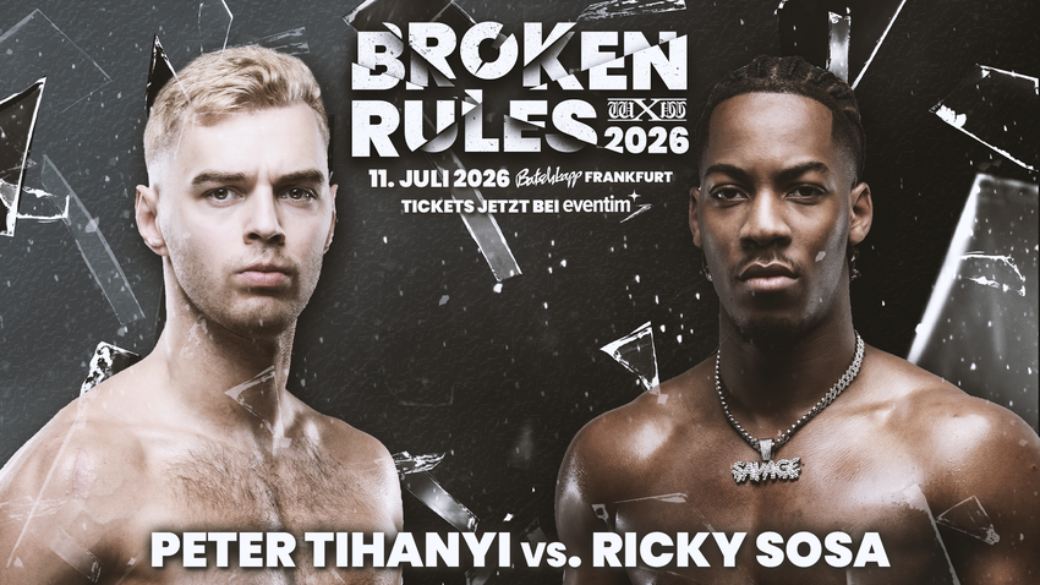
Peter Tihanyi made waves by advancing to the finals of this year’s 16 Carat Gold Tournament and became the company’s choice to face some prominent guests: Yota Tsuji at wXw True Colors in May, Eddie Kingston at wXw Drive of Champions in June, and Ricky Sosa at wXw We Love Wrestling – Live in Paderborn in April and wXw Broken Rules here. Sosa seemed raw but full of potential in his entrance vs. entrance match against Kuro in February and the party match from the last day of the 16 Carat Gold Tournament. TNA signed Sosa not long after the match against Kuro, so I was curious how much he developed in the interim.
As always, I would like to thank wXw for including an on-screen clock for its matches.
At 6’4″/194 cm, Sosa had a slight height advantage over the 6’2″/188 cm Tihanyi. However, Tihanyi had beaten Sosa in their three previous meetings in 2025 and 2026, though Sosa scored a win over Tihanyi in a tag team match in February. (Ahura, who beat Tihanyi in the 16 Carat Gold finals, teamed with Sosa.)
After Tihanyi showed him up during his much ballyhooed entrance and during a grappling segment at the start, Sosa slapped Tihanyi across the cheek. They both played to the crowd a lot, which slowed the match down. Sosa powered through Tihanyi’s chops, so Tihanyi stomped on his toes and kicked him in the head. Tihanyi mocked Sosa and held the ropes open for him to return to the ring, but Sosa attacked Tihanyi from behind as the referee walked Tihanyi away from the ropes. That made the messy dynamics between two cocky heels even muddier. The heel-leaning color commentator didn’t help clarify what we were supposed to take from this match.
For all of Sosa’s size, there was a surprising feeling of weightlessness to some of his attacks. A running boot to Tihanyi in the corner and an uppercut to stop Tihanyi’s dive felt soft. Sosa’s neckbreaker to the apron on Tihanyi, who was stuck on the middle rope, also felt meek.
After targeting Tihanyi’s neck, Sosa slowed the match down (way down) with a full nelson. Tihanyi broke the hold and broke it down to a double down with a Tornado DDT. Sosa cracked Tihanyi in the face with a sharp elbow; Sosa seemed in general to be tighter with stationary arm attacks. After Tihanyi’s superkick, Sosa had to scoot forward slightly to get into position for Tihanyi’s running double knee attack, so he still had to refine his positioning. From there, Sosa transitioned from a Blue Thunder Bomb to a Styles Clash, but Tihanyi survived it. Tihanyi pushed past Sosa’s boot to the face and plancha to the outside before putting him away with a surprise cutter counter to Sosa’s springboard attack and a 450 splash.
The match was a 40 degree (Farenheit) day. I appreciated that they didn’t go full pedal to the metal, though I felt like I was just on the good side of bored for the 11 minutes and 50 seconds of the match. I felt no connection to Tihanyi and Sosa, who both presented as heels to some extent.
You can watch the match and the show on IWTV and wXw’s YouTube page behind their subscription wall.
Ahura (c) vs. Kouga
GWF Summer Smash 2026
July 12, 2026
Cagematch ranking as of 8/1/26: 1204
Cagematch rating as of 8/1/26: 7
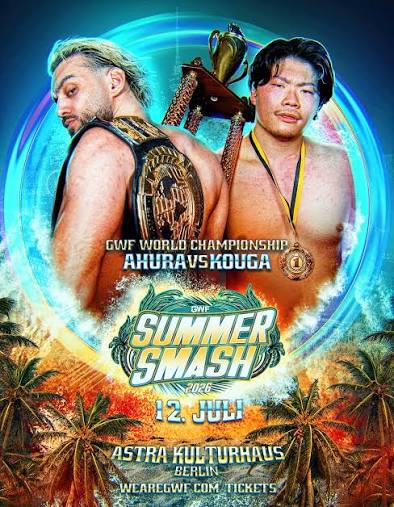
Kouga formerly known as Owadasan spent a year abroad (August 2025-2026) and wrestled 41 matches (according to Cagematch) during that expedition. He spent most of his time with PROGRESS (before they changed ownership themselves) and the German Wrestling Federation, which is where we last saw Kouga take on Ahura back in February. Last time, Kouga surprised Ahura with a pin and beat him for the GWF Berlin Championship. This time, a richer title, the GWF World Championship, was at stake.
This match took place before NOAH had announced that Kouga would return for their N-1 Victory tournament this year, so Kouga defeating Ahura for a second GWF title this year was still a non-zero though unlikely probability.
Well, I guess that Ahura didn’t retire after winning the 16 Carat Gold tournament this year after all. Instead, Ahura defeated Andrade El Idolo for the GWF World Championship in April, and he defended it against Axel Tischer in June. Now, he had back-up in the form of a large man with very skimpy tights.
Like before, the dynamics were very clear: Kouga was the confident, young challenger, and Ahura the cocky, veteran, and antagonistic champion. They stared each other down at the bell, and it occurred to me that they could have gone the Go Shiozaki vs Kazuyuki Fujita route. Luckily for the viewers and wrestling discourse, they started circling each other and got ready for action. Kouga showed the confidence built from his 71-days long reign as the Berlin Champion by messing with Ahura’s hair after a clean break against the ropes. While Ahura didn’t chop Kouga out of a rope break this time, he did threaten to mount the turnbuckles and punch him and swiped at his face after the break.
In their first match, Ahura led Kouga through the paces and engaged the crowd to keep them energized. Here, Kouga showed his growth in connecting with the crowd (even through the language barrier), and he was more aggressive on offense. Of course, they had some callbacks to the first match, like Ahura’s springboard dropkick and spinaroonie and Ahura’s kiss to the referee to distract him from the mule kick to Kouga’s groin.
Unlike the first match, where Ahura generally kicked Kouga around, they structured this match around Ahura attacking Kouga’s back to give Kouga a focal point for his pain performance. For example, Kouga teased a comeback starting with a front dropkick from the middle rope, but his weakened back prevented him from getting sufficient lift from his jump. So, he fell short of Kouga, who easily rolled him over for a Boston Crab. Unfortunately, they abandoned that narrative thread after that sequence until the very end of the match, when Kouga’s back pain prevented him from lifting Ahura once.
Ahura teased a Destino to taunt Kouga, but Kouga stopped it and countered by dropping Ahura on his face on the top turnbuckle. They traded boots to the face and elbows to the neck, and Ahura used the momentum from Ahura’s punch to launch himself for a Destino. We did not have a NJPW English commentator to confirm whether that was a faux or full Destino.
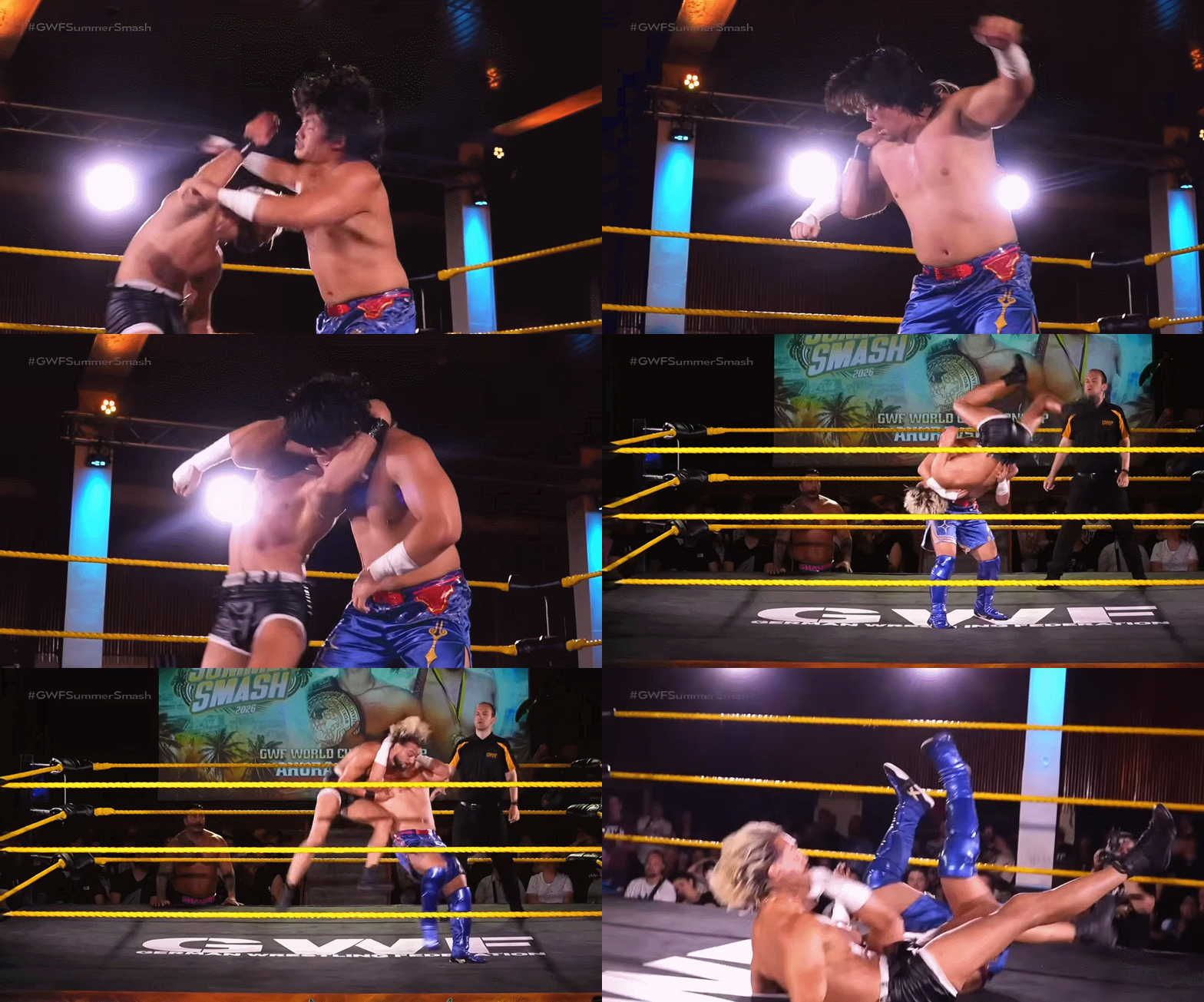
They teased an escalation in violence on the apron, but Kouga capped that by sending Ahura back into the ring with a fireman’s carry slam and a slingshot elbow. Kouga was too hurt to lift Ahura for a uranage, but he was able to lift Kouga’s large companion for one when he tried to interfere in the match. His plan foiled, Ahura rushed back to try to finish Kouga with his Salamandra, but Kouga squirmed out and rolled him up. Kouga went for a knee lift to Ahura’s face, which should lead to something interesting in this year’s N-1 Victory tournament since Kouga and KENTA were in the same bracket. I wish the setup were a little faster and the timing on the knee lift a little tighter though.
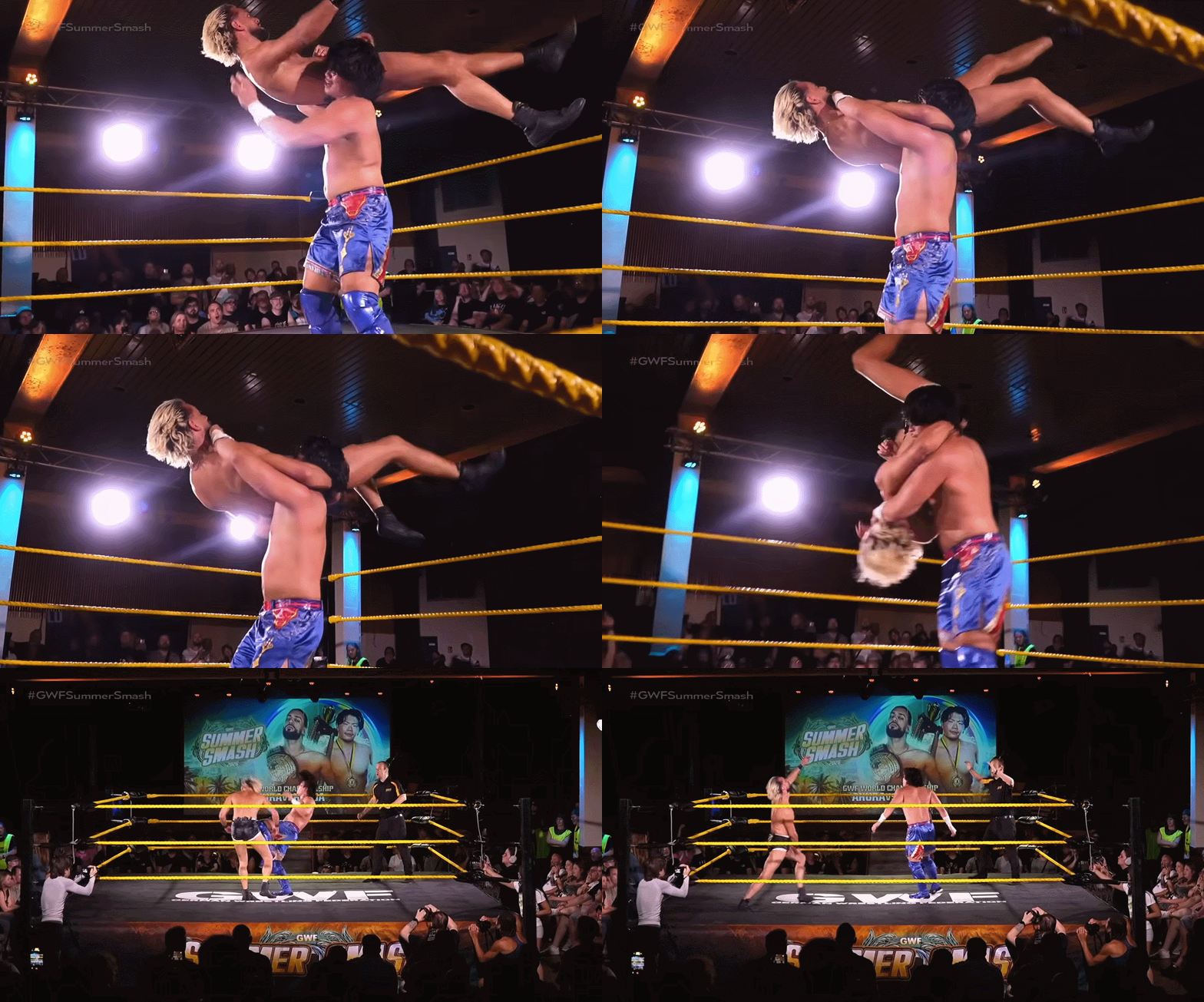
Ahura’s companion pulled the referee out of the ring before he could count the win for Kouga, so Kouga had him to give him a running kick from the apron. That enabled Ahura to kick the middle rope into Kouga’s groin when he tried to re-enter the ring without even a reprimand from the referee, who saw what Ahura did. Neither Kouga nor Ahura could land a last blow, and Ahura threw out an interesting neckbreaker counter to Kouga’s attempt for another knee lift.
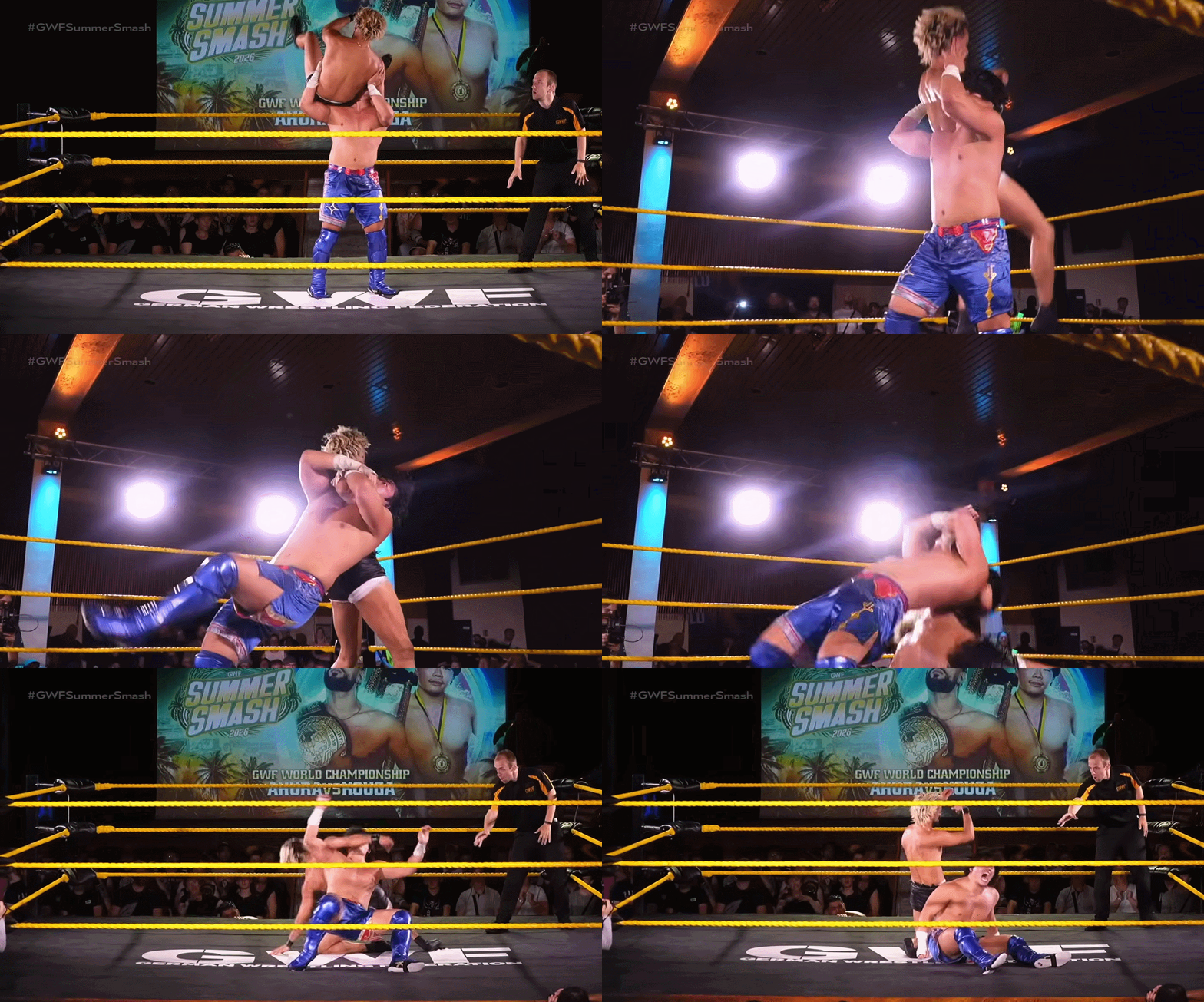
Unfortunately, Ahura and Kouga couldn’t quite get it together for Ahura’s Salamandra finisher, so the match ended awkwardly.
The match was a more conventional main event match, which had its pluses and minuses. It was structured to show that Kouga could wrestle at the main event pace, engage the crowd, and convincingly portray pain in a specific body part as long as he remembered to do so. He also showed that he had more impactful offense (the springboard elbow, the knee lift, the uranage) that should bode well for him in NOAH. On the other hand, he still showed his youth and inexperience in the inconsistency of his selling and the long setup for his knee lift.
Ahura showed that he could still rile up the crowd even if he wasn’t quite as flamboyant as he was in their first match. He got to try something new like the Destino, and his reaction to his companion’s failure to spear Kouga was entertaining. The unsuccessful attempt to turn Kouga around for the Salamandra was unfortunate, and I question the wisdom of attacking Kouga twice in the groin to little effect because it devalued that attack. (I would be willing to retract that complaint if Kouga later made having balls of steel his thing.)
You can watch the match and the show on GWF’s YouTube page.
Next time: In 2026, Chihiro Hashimoto has piled great matches on top of each other like a baker would pile thin layers of batter to make a baumkuchen. We’ll check in on two more of her major matches, as well as the Inaba sisters in action in JTO and mentor Mei Suruga and protege Miya Yotsuba’s showdown in ChocoPro.


