


Cash no longer rules everything around me. Instead, the aged do.
As Rich Kraetsch recently highlighted, WWE last crowned a male champion who was in their 20s in 2017. (For the moment, we’ll ignore my usual stance that WWE doesn’t count because they present sports entertainment content, not professional wrestling.) Similarly, AEW has anointed only one male AEW World Champion in their 20s, MJF, so far in its history.
The two titans of the conflict play industry have been dominated by Grumpy Old Men instead of Young Guns (and I’m not talking about the tag team of Ethan Allen and Luke Jacobs). Therefore, it was worth exploring the modern lineages of other championships to see if they’ve leaned Grumpier Old Men too or if they’re more aligned with Young Guns II. We can also try to untangle some of the common talking points around why professional wrestling companies (that primarily focus on male wrestlers) seem hesitant to crown younger wrestlers.
I. Responsibility to shareholders reinforce risk aversion.
WWE, as a part of the publicly traded TKO Group Holdings, must show relentless and endless growth. (That’s capitalism, baby!) Declines in revenue or even growth that was smaller than projected would bring the walls down around officers of the company, specifically WWE President Nick Khan and Chief Content Officer Paul Levesque. The process to create new stars is full of risks, and the conditions have disincentivized Levesque from taking risks. Instead, the company is incentivized to keep relying on performers who have proven track records either in the company or elsewhere (Roman Reigns, CM Punk, and Cody Rhodes, or the New Kliq, as Jesse Collings once described them).
In theory, that should give younger performers like Bron Breakker long runways to build themselves to be successors. However, that would mean that Breakker would need to usurp Reigns, Punk, or Rhodes for the throne before he became so familiar in the understudy role that it would be impossible to view him as the lead. That change would require the reigning headliners to allow themselves to be taken out of the limelight (and away from the biggest shares of the pie that they can snag as performers) or for the company’s officers to take the risk (and potentially upset the shareholders, who might then call for your head). It’s an existential balancing act that every wrestling promoter has faced, and some choose to face it with a fear-based mindset instead of a growth or opportunity mindset.
After we watched season two of The Pitt, we wanted to find something similar for our nightly one-hour drama slot. So, we started watching ER because we wanted to see Noah Wyle’s evolution from John Carter to Michael Robinavitch. We’ve reached the third season, which means that the major cast turnover will begin soon. Sherry Stringfield will leave the show this season. We’re two seasons away from George Clooney’s departure from the show. We’re three seasons away from the departures of Julianna Margulies and Gloria Reuben. In season four, the show tried out Alex Kingston, Maria Bello, and Paul McCrane to create a cushion for Clooney’s expected departure. It still took the alchemy of time, compelling stories, gripping acting, and interesting production and direction for Kingston, McCrane, and others to replace the familiar cast.
WWE has tried a number of wrestlers (Gunther, Drew McIntyre, The Usos, Sami Zayn, Randy Orton) as leading men, but they haven’t panned out. Folks who pay more attention to WWE could probably say more about why, but it’s clear that they’re perceived by the audience (and by management too) as temporary foils for Reigns, Punk, and Rhodes at best. It would be as if the directors, producers, and writers of ER tried to position Goran Visnjic (Luka Kovac) as Clooney’s replacement for half of season six and decided to throw money at Clooney to lure him back from making movies so he could play Doug Ross again for the seventh season.
At some point, injuries, exposure fatigue, internal drama, and/or the depredations of time will force Levesque’s hand to make a change. When he does, he’ll probably face the consequences of prioritizing the short term and leading from a fear-based mindset. Then again, he might wiggle his way out of those consequences too because accountability is apparently dead.
II. Wrestlers are now able to perform at higher levels later in life than they used to, so there isn’t as much pressure to replace them.
Because the wrestlers have learned to better preserve themselves, they can perform at higher levels later in life than their predecessors could. Since they’re proven commodities, the companies could continue to extract more value from them. After all, Bryan Danielson was still one of the best wrestlers in the world at forty three years old. Why shouldn’t AEW crown him as champion at that age?
The counterargument should be familiar: older wrestlers present a greater risk of injury due to damage to their bodies accumulated over time. Their recognizability might also be a drawback because familiarity breeds disinterest, if not contempt. Wrestlers can be creative artists who can reinvent their personas over time, but the shiny new thing usually has an undeniable charm. If there are only truly seven basic plots and if the characters don’t turn over, then companies quickly run out of combinations of performers and stories that still feel fresh.
III. Is this a phenomenon isolated to just American wrestling companies?
Kraetsch’s essay focused on WWE’s and AEW’s reliance on wrestlers 30 and years and older, and I wanted to widen the scope and examine whether this was also a trend across the industry.
First, let’s provide some caveats.
- I used April 1, 1987 for Cara Noir’s assumed birthday since their actual birthday was not publicly available.
- I excluded JC Thunder and Leroy Kincaide from the RevPro Undisputed British Heavyweight Championship’s history because their birthdays were not available.
- I used public sources (Wikipedia, Cagematch, the Puroresu System Wiki, etc.) for wrestlers’ birthdays.
- I combined the lineages of the NWA-TNA Heavyweight Championship, the TNA World Championship, and the GFW Global Championship into one lineage.
- I limited the Triple Crown Championship’s history to what most would consider its modern era, starting with Genichiro Tenryu’s return to AJPW and his championship win on October 28, 2000.
- Similarly, I limited the IWGP Heavyweight Championship’s history to what most would consider its modern era, starting with Hiroshi Tanahashi’s victory on July 17, 2006. Because NJPW has unified the histories of the IWGP Heavyweight Championship and the IWGP World Heavyweight Championship, I included IWGP World Heavyweight Champions under the IWGP Heavyweight Championship.
- I was advised to limit this data set to just CMLL’s Leyenda de Plata.
| Championship | Company | Number of Champions | Number of Unique Champions | Average Age of Wrestler at Victory | Average Age of Wrestler at Victory Since 2020 | # of Wrestlers Who Won Title in 20s | # of Wrestlers Who Won Title in 30s | # of Wrestlers Who Won Title in 40s |
| IWGP Heavyweight Championship | NJPW | 44 | 23 | 34.57 years | 35.51 years | 11 (25%) | 26 (59.09%) | 7 (15.91%) |
| GHC Heavyweight Championship | NOAH | 50 | 27 | 37.27 years | 38.78 years | 9 (18%) | 24 (48%) | 17 (34%) |
| Triple Crown Championship | AJPW | 51 | 28 | 37.71 years | 35.96 years | 7 (13.73%) | 27 (52.94%) | 17 (33.33%) |
| Open the Dream Gate Championship | Dragongate | 42 | 21 | 32.52 years | 31.02 years | 17 (40.48%) | 21 (50%) | 4 (9.52%) |
| KO-D Openweight Championship | DDT | 88 | 42 | 33.39 years | 34.98 years | 22 (26.19%) | 51 (57.95%) | 15 (17.05%) |
| CMLL Leyenda de Plata | CMLL | 21 | 16 | 33.54 years | 29.22 years | 7 (33.33%) | 10 (47.62%) | 4 (19.05%) |
| TNA World Championship | TNA | 86 | 46 | 36.89 years | 37.61 years | 7 (8.14%) | 57 (66.28%) | 22 (25.58%) |
| AEW World Championship | AEW | 18 | 10 | 37.36 years | 36.68 years | 2 (11.11%) | 10 (55.56%) | 6 (33.33%) |
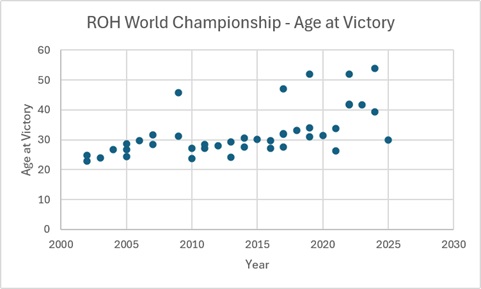
| ROH World Championship | ROH | 42 | 33 | 32.33 years | 39.17 years | 22 (52.38%) | 12 (28.57%) | 8 (19.05%) |
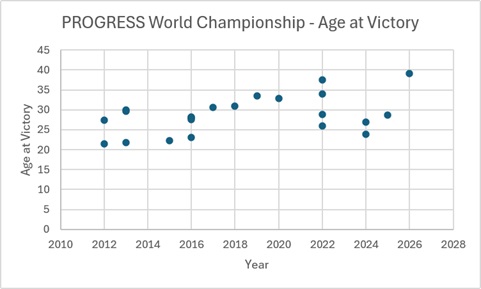
| PROGRESS World Championship | PROGRESS | 23 | 21 | 28.70 years | 30.86 years | 16 (69.57%) | 7 (30.43%) | 0 (0%) |
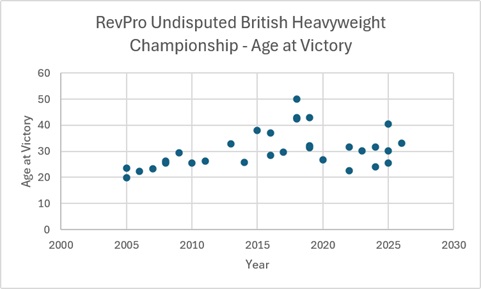
| RevPro Undisputed British Heavyweight Championship | RevPro | 31 | 21 | 30.68 years | 29.57 years | 16 (51.61%) | 10 (32.26%) | 5 (16.13%) |
In all but three companies that we examined, the majority of the companies’ main male champions won the championship in their 30s. This would align with the adage that wrestlers peaked in their 30s as they combined hard-won knowledge about how to optimize their athletic abilities and charisma with what remained of their athleticism. Nonetheless, we can also detect a recent creep upward in when wrestlers became champion. Specifically, six of these major male championships (IWGP Heavyweight Championship, GHC Heavyweight Championship, KO-D Openweight Championship, TNA World Championship, ROH World Championship, and PROGRESS World Championship) all showed since 2020 a higher average age of when wrestlers won the championship than their overall average. (For example, in the modern history of the IWGP Heavyweight Championship, the average age when a wrestler won the championship was 34.57 years. However, since 2020, the average age rose to 35.51 years.)
If we follow the old model of the tiers of Japanese wrestling companies and separate Dragongate and DDT from NJPW, NOAH, and AJPW, we can also see a contrast between the two groups of companies.
The Open the Dream Gate Championship was dominated by wrestlers in their 20s between 2004 and 2010 (CIMA, Ryo Saito, Susumu Yokosuka, Shingo Takagi, Naruki Doi, YAMATO, and Masato Yoshino) and between 2019 and 2025 (Ben-K, Eita, Shun Skywalker thrice, Yuki Yoshioka, and Madoka Kikuta twice).
DDT’s KO-D Openweight Championship wasn’t quite as dominated by wrestlers in their 20s, and the title’s rate of churn made it harder to draw conclusions. However, in general, it appears that the KO-D Openweight Championship still leaned younger than the IWGP Heavyweight, GHC Heavyweight, and Triple Crown Championships.
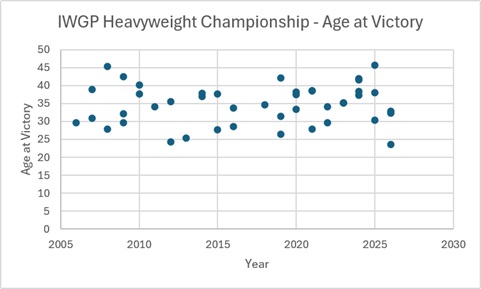
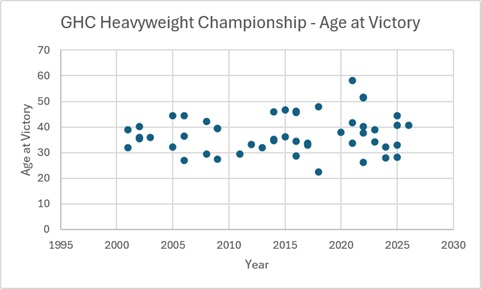
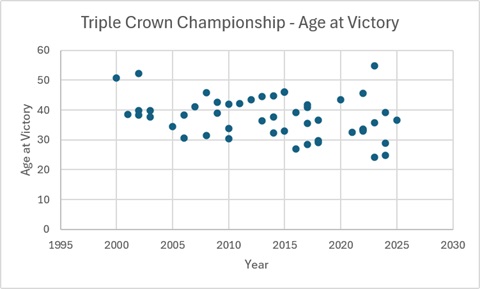
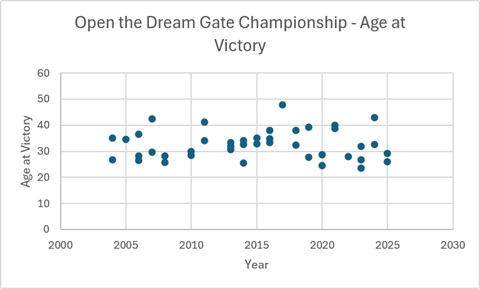
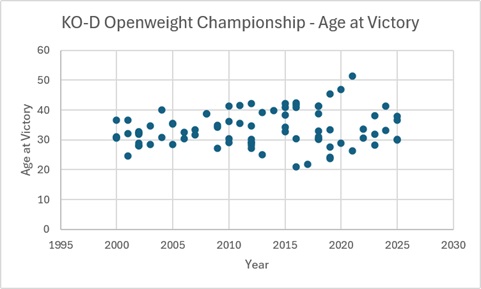
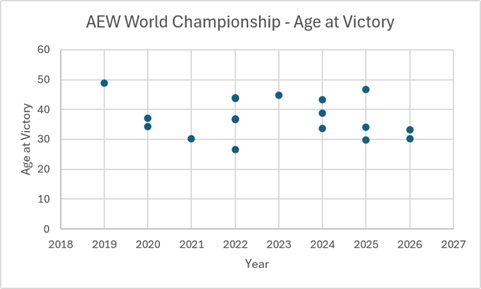
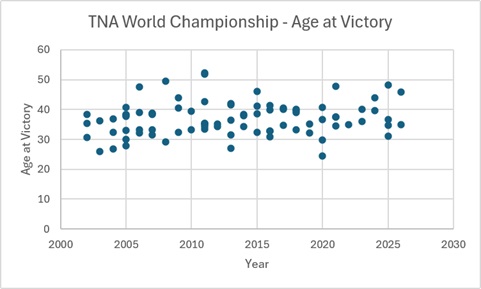
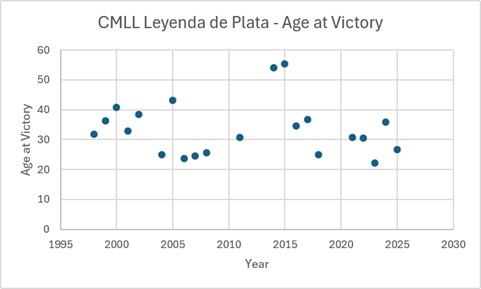
Finally, TNA deserved a shout-out for having more champions in their 40s than any other company that we examined. That was primarily a result of crowning some older wrestlers (Sting, Kurt Angle, Matt Hardy, Nic Nemeth, and Bully Ray) repeatedly, but it certainly activated my LOLTNA sensibilities.
| Championship | Company | Oldest Champion | Has Champion Born in 2000s? |
| IWGP Heavyweight Championship | NJPW | Keiji Muto (45.34 years) | Callum Newman |
| GHC Heavyweight Championship | NOAH | Keiji Muto (58.14 years) | No |
| Triple Crown Championship | AJPW | Yuji Nagata (54.82 years) | No |
| Open the Dream Gate Championship | Dragongate | Masaaki Mochizuki (47.67 years) | No |
| KO-D Openweight Championship | DDT | Jun Akiyama (51.35 years) | No |
| CMLL Leyenda de Plata | CMLL | Negro Casas (55.37 years) | Mascara Dorada |
| TNA World Championship | TNA | Sting (52.31 years) | No |
| AEW World Championship | AEW | Chirs Jericho (48.81 years) | No |
| ROH World Championship | ROH | Chris Jericho (53.96 years) | No |
| PROGRESS World Championship | PROGRESS | Cara Noir (39.09 years) | Luke Jacobs |
| RevPro Undisputed British Heavyweight Championship | RevPro | Minoru Suzuki (50.04 years) | Luke Jacobs |
It was also remarkable to see that NJPW and CMLL were the only major companies to have a main male champion who was born in this millennium. Luke Jacobs served as this millennium’s representative for PROGRESS and Revolution Pro.
IV. Are the indies also favoring older wrestlers? It would make sense that indies lean on younger wrestlers more. Those wrestlers then move on to the bigger companies and win the championships there.
Though Tony Khan currently owns Ring of Honor, we will include Ring of Honor as an indie because it was an indie from 2002 to 2011, when it was acquired by Sinclair Broadcast Group. ROH also presented the most interesting title history because the ROH World Championship was once dominated by the 20-somethings. The company’s first nine champions (Low Ki, Xavier, Samoa Joe, Austin Aries, CM Punk, James Gibson, Bryan Danielson, Homicide, and Takeshi Morishima) all won the ROH World Championship in their 20s. Here, we should acknowledge that the American indies at that time had an unusual bumper crop of talent due to WWE’s particular physical preferences and the demise of ECW and WCW. TNA brought on some, but not all, of this generation of wrestlers, which allowed ROH to build its foundation on them.
As ROH entered its Sinclair period, this focus on wrestlers in their 20s continued. Of the 21 champions during the Sinclair period, 10 were in their 20s (Eddie Edwards, Davey Richards, Kevin Steen, Jay Briscoe, Adam Cole thrice, Michael Elgin, Kyle O’Reilly, and Bandido). However, after Tony Khan purchased ROH, the company had only one champion in their 20s: Bandido.
Indeed, 5 of the 7 champions in the Khan period (Claudio Castagnoli twice, Chris Jericho twice, and Eddie Kingston) were at least 40 years old; Jericho was 51 and 53 at the time of his wins. Sinclair recognized its place in the wrestling landscape as a nationally televised and touring option for wrestlers to accrue experience before they left for a bigger company. Conversely, Tony Khan, seems to use ROH as a parking lot for wrestlers until he’s ready or able to incorporate them into AEW’s storylines.
Across the Atlantic Ocean, we can see that PROGRESS and RevPro mostly played their role in the wrestling ecosystem and featured younger local stars. The average ages of PROGRESS’s and RevPro’s main male champions were lower than all other champions that we checked, and RevPro even managed to buck the trend of crowning champions with a higher average age since 2020. As independent companies, they generally have to focus on developing new wrestlers, though RevPro went through a period of using prestigious older Japanese wrestlers (Tomohiro Ishii, Minoru Suzuki, and Hiroshi Tanahashi) to bring attention to the company between 2018 and 2019, the end of the last independent wrestling boom period. It was also remarkable that no wrestler in their 40s has yet to win the PROGRESS World Championship; Cara Noir, at 39 years old, was the closest.
IV. Well, it makes sense that companies’ main titles would be concentrated amongst wrestlers in their 30s. The companies have secondary titles for the wrestlers in their 20s, and the secondary titles can be their trial run.
Two caveats for this section:
- I did not include the IWGP Global Heavyweight Championship, the NEVER Openweight Championship, the STRONG Openweight Championship, or the NJPW World Television Championship in this study because they’re either tertiary championships or their lineages were too new.
- I also did not include TNA’s X-Division Championship or International Championship. The X-Division Championship was positioned as a different weight class; thus, it was not consistently a title for up-and-coming wrestlers. The International Championship only dated to 2025, so there wasn’t enough data.
Therefore, I focused on just secondary titles from AEW, NOAH, and Dragongate:
| Championship | Company | Number of Champions | Number of Unique Champions | Average Age of Wrestler at Victory | Average Age of Wrestler at Victory Since 2020 | # of Wrestlers Who Won Title in 20s | # of Wrestlers Who Won Title in 30s | # of Wrestlers Who Won Title in 40s |
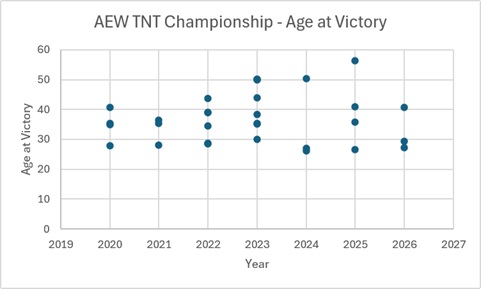
| AEW TNT Championship | AEW | 32 | 20 | 36.97 years | 36.97 years | 10 (31.25%) | 12 (37.50%) | 10 (31.25%) |
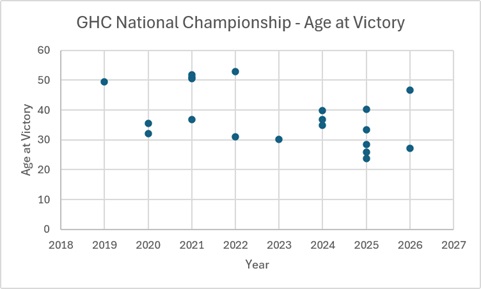
| GHC National Championship | NOAH | 20 | 17 | 37.87 years | 37.26 years | 4 (20%) | 9 (45%) | 7 (35%) |
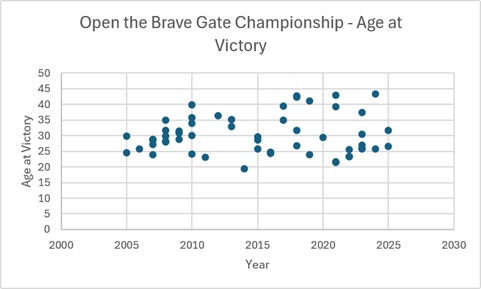
| Open the Brave Gate Championship | Dragongate | 55 | 38 | 30.13 years | 29.42 years | 32 (58.18%) | 18 (32.73%) | 5 (9.09%) |
If we accepted the assumption that the secondary championships should be the province of wrestlers in their 20s, then only Dragongate’s Open the Brave Gate Championship fulfilled the brief. The first GHC National Champion was Takashi Sugiura, who was 49.42 years old when he won the title, and 4 of the next 9 champions were in their 50s: Kazuyuki Fujita twice, Sugiura, and Masaaki Mochizuki. NOAH’s used the title as a launching pad for younger wrestlers more in 2025 (Ozawa, Galeno, Dragon Bane, and Alpha Wolf were all in their 20s when they won the title), but the current champion was Naomichi Marufuji, who was 46.61 years old as of this writing.
The AEW TNT Championship has had remarkable but brief reigns by younger wrestlers like Darby Allin in 2023, and AEW seems to have tried to use it to boost younger wrestlers again with the recent reigns of Kyle Fletcher and Kevin Knight. However, the two champions before Fletcher and Knight were Mark Briscoe and Tommaso Ciampa, who were 40 years old when they won the title.
V. What about the women wrestlers? We would expect joshi companies’ champions to lean younger because joshi wrestlers tend to start wrestling at a younger age and have shorter shelf-lives.
Two caveats for this section:
- I excluded Safire Reed from the EVE Championship’s lineage because her birthday was not publicly available.
- Though Shimmer Women Athletes has been inactive since 2021, I included it because it was the premier independent women’s wrestling company in the United States. Its lifespan overlapped with other companies in this study, and I felt that it was worth including.
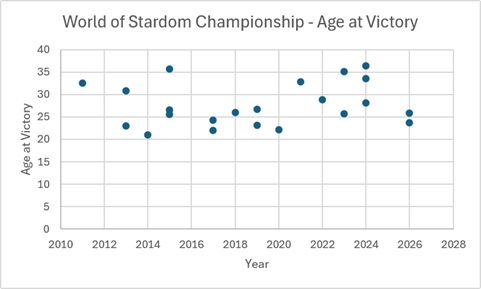
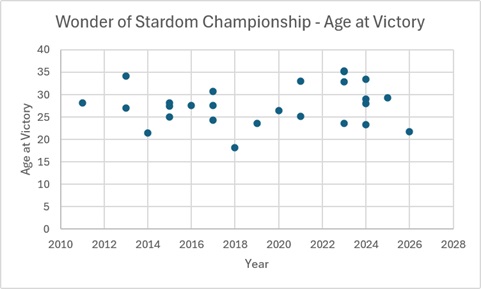
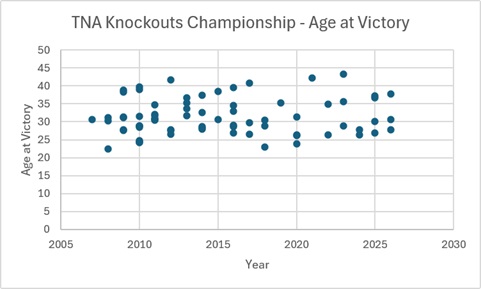
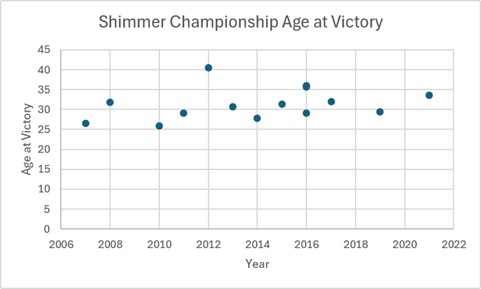
Indeed, the data seems to support that assumption. Of the major companies’ female wrestlers’ titles, only the TNA Knockouts Championship had any champions who were 40 years old and older (Tara, Gail Kim, and Mickie James). (It would make sense that TNA, as a minor player in the American and global wrestling scene, would have to rely on wrestlers who have been cast off due to age or other circumstances from other companies.) Stardom’s and TJPW’s championships were dominated by wrestlers in their 20s, while AEW’s and TNA’s championships were mostly held by wrestlers in their 30s. It was surprising that Shimmer’s champions also leaned older during the company’s history.
| Championship | Company | Number of Champions | Number of Unique Champions | Average Age of Wrestler at Victory | Average Age of Wrestler at Victory Since 2020 | # of Wrestlers Who Won Title in 20s | # of Wrestlers Who Won Title in 30s | # of Wrestlers Who Won Title in 40s |
| World of Stardom Championship | Stardom | 22 | 19 | 27.71 years | 29.24 years | 15 (68.18%) | 7 (31.82%) | 0 (0%) |
| Wonder of Stardom Championship | Stardom | 26 | 21 | 27.68 years | 28.95 years | 19 (73.08%) | 7 (26.92%) | 0 (0%) |
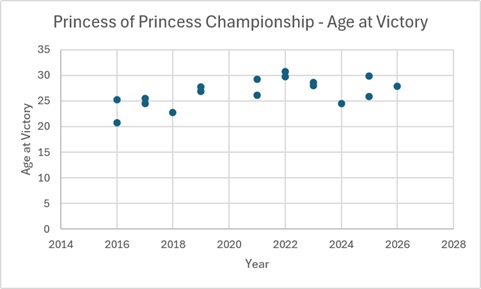
| Princess of Princess Championship | TJPW | 17 | 9 | 26.69 years | 28.05 years | 17 (100%) | 0 (0%) | 0 (0%) |
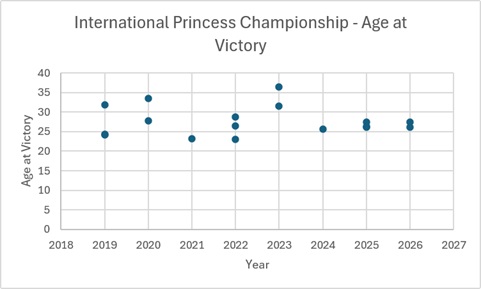
| International Princess Championship | TJPW | 17 | 15 | 27.61 years | 27.80 years | 13 (76.47%) | 4 (23.53%) | 0 (0%) |
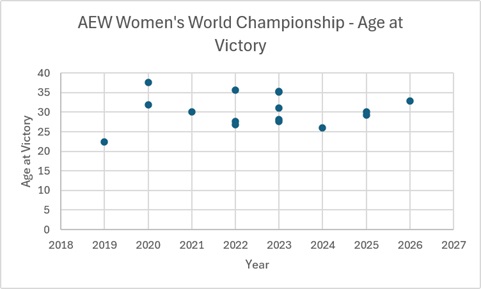
| AEW Women’s World Championship | AEW | 16 | 11 | 30.47 years | 31.01 years | 7 (43.75%) | 9 (56.25%) | 0 (0%) |
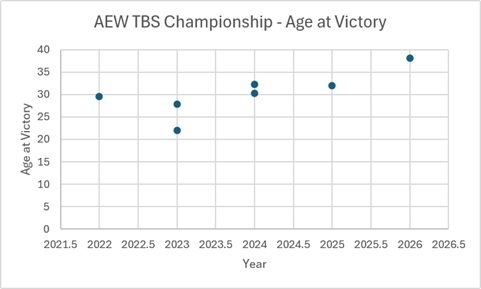
| AEW TBS Championship | AEW | 7 | 6 | 30.28 years | 30.28 years | 3 (42.86%) | 4 (57.14%) | 0 (0%) |
| TNA Knockouts Championship | TNA | 72 | 34 | 31.40 years | 31.59 years | 31 (43.06%) | 37 (51.39%) | 4 (5.56%) |
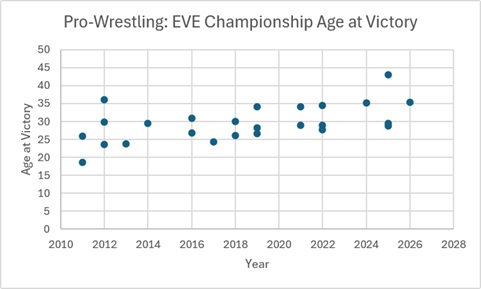
| Pro-Wrestling: EVE Championship | EVE | 25 | 20 | 29.60 years | 32.58 years | 15 (60%) | 9 (36%) | 1 (4%) |
| Shimmer Championship | Shimmer | 14 | 11 | 31.37 years | 33.55 years | 6 (42.86%) | 7 (50%) | 1 (7.14%) |
We can detect some of the same trends among the women’s titles that we saw among the men’s:
- Since 2020, there’s been a slight tick upward in age in Stardom’s, TJPW’s, AEW’s, TNA’s, and even EVE’s championships. This matched the uptick amongst most men’s championships.
- Neither wrestlers in their 20s nor or wrestlers who are younger than the main champions consistently held the secondary titles (the Wonder of Stardom Championship, International Princess Championship, and AEW TBS Championship). The World of Stardom Champion had an average age at victory that is only. 0.03 year greater than the Wonder of Stardom Championship’s average, though the difference was greater since 2020. The International Princess Championship actually had a greater average age than the Princess of Princess Championship, though that flipped after 2020. The AEW Women’s World Championship’s average age increased from 30.47 years to 31.01 years after 2020. As a result, the gap between the Women’s Championship’s average age and the TBS Championship’s average age grew.
- The Pro-Wrestling: EVE Championship, as the most prominent active women’s independent wrestling championship, had a lower overall average age than the AEW or TNA championships, but it too trended older after 2020.
| Championship | Company | Oldest Champion | Has Champion Born in 2000s? |
| World of Stardom Championship | Stardom | Tam Nakano (36.44 years) | Sayaka Kurara, Suzu Suzuki |
| Wonder of Stardom Championship | Stardom | Mina Shirakawa (35.33 years) | Momo Watanabe, Starlight Kid, Hanan |
| Princess of Princess Championship | TJPW | Shoko Nakajima (30.67 years) | No |
| International Princess Championship | TJPW | Max the Impaler (36.37 years) | No |
| AEW Women’s World Championship | AEW | Nyla Rose (37.53 years) | No |
| AEW TBS Championship | AEW | Hikaru Shida (38.06 years) | Julia Hart |
| TNA Knockouts Championship | TNA | Mickie James (43.37 years) | No |
| Pro-Wrestling: EVE Championship | EVE | Nyla Rose (43.06 years) | No |
| Shimmer Championship | Shimmer | Saraya Knight (40.41 years) | No |
As a result of joshi’s general lean toward using younger wrestlers, TJPW had the youngest oldest wrestler in Shoko Nakajima while Stardom had multiple champions who were born in the 2000s. The fact that all of TJPW’s Princess of Princess Champions won the title in their 20s was astounding. Finally, the fact that Julia Hart was the first AEW champion who was born in the 2000s will make for a great trivia question some day.
V. So, what does this all mean?
I’ve seen the response that we should focus less on the age of the wrestler when they hit the spotlight as much as how familiar the wrestling audience was with them. For example, Tim Storm was 51 years old when became the NWA World Heavyweight Champion in 2016, but he and the NWA were able to leverage Storm’s newness to the national audience and his sympathetic story to help NWA reach its peak in the attention economy.
I would encourage a follow-up analysis to determine if there was truly a correlation between an underexposed wrestler’s ascension and a company’s growth after one accounted for macroeconomic factors. (For example, it’s possible that AJPW saw growth when Kento Miyahara became the Triple Crown Champion, AJPW might have only seen limited growth when Yuma Anzai became champion due to the state of AJPW in 2024.) We can certainly point to Stardom’s commercial success after crowning Saya Kamitani its World of Stardom Champion, but I consider her an outlier for a number of reasons, starting with the fact that she worked tirelessly to expand her and Stardom’s name recognition during her reign, as David Hayter laid out here.


