


Last time, we analyzed the age of wrestlers in major companies around the world when they became their company’s champion and saw that there’s been a general upward trend in champions’ ages since 2020. The analysis centered on championships because they should be the primary motivators for and culminations of wrestlers’ work in wrestling companies. With all that talk about championships done, let’s return to AJPW and DDT to see how the winners of the Champion Carnival and the King of DDT tournaments fared in the championship matches that they earned. Let’s also take a look at the conclusion of this year’s G-Class tournament, in which the winner earned a shot at the GLEAT G-REX title. Finally, let’s check out Katsuhiko Nakajima’s independently produced show and how Ali Najima is doing in Sportiva.
In this edition, I covered:
- Kento Miyahara (c) vs. Hideki Suzuki (AJPW, June 18, 2026)
- Yuki Ueno (c) vs. Shinya Aoki (DDT, June 28, 2026)
- Kaito Ishida vs. T-Hawk (GLEAT, June 4, 2026)
- Masato Tanaka & Yuko Miyamoto vs. Hayabusa & Katsuhiko Nakajima (Katsuhiko Nakajima Produce, May 31, 2026)
- Ali Najima vs. Masanori Kanu Watanabe (Sportiva, June 17, 2026)
Kento Miyahara (c) vs. Hideki Suzuki
AJPW Super Power Series – Day 6
June 18, 2026
Cagematch ranking as of 7/1/26: 303
Cagematch rating as of 7/1/26: 7.74
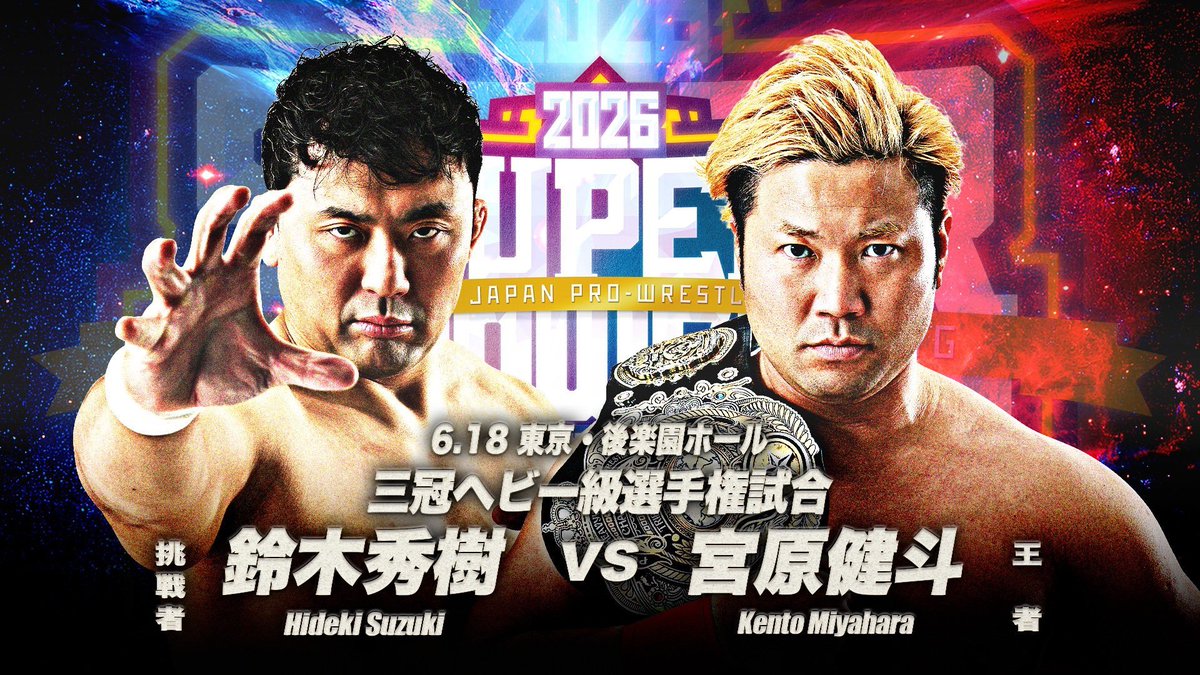
I was surprised that Kento Miyahara, the beast who fed on the crowd’s cheers, didn’t force the 1,504 fans to restart their rites of adulation at his entrance to this title defense against Hideki Suzuki. Korakuen Hall was full, but the fans’ cheers were underwhelming by the standards of crowds’ typical reactions to Miyahara’s arrival for a major Triple Crown Heavyweight Championship defense.
Hideki Suzuki won this shot at Miyahara’s title by overcoming Go Shiozaki in the Champion Carnival finals, and he was as stoic as ever in the face of Miyahara’s magnetic charisma. Miyahara had “Best of the Best” emblazoned on the back of his robe, and Suzuki seemed like he would be the kind of person who would say that if you have to proclaim that you’re the best, then you’re just a pretender. And Miyahara would probably tell Suzuki to say that to his face.
This was the third year in a row where Miyahara faced Suzuki in a high stakes singles match. In 2024, Miyahara beat Suzuki in the Oudou Tournament in the first round. In 2025, Suzuki evened the score with a win in the Champion Carnival. Miyahara and Suzuki started on the mat, as you’d expect. Miyahara capped his one-upsmanship with Suzuki on the mat with an impressive neck bridge to rise up from Suzuki’s pin, which allowed him to suplex Suzuki.
As usual with Suzuki, he allowed his opponent to take his first shot. Miyahara’s boot sent Suzuki outside the ring to regroup, and Miyahara, also as usual, stayed aggressive. Suzuki had tweaked Miyahara’s left leg and hip earlier on the mat, and I suppose that’s why Miyahara decided to headbutt Suzuki multiple times on the floor. Suzuki channeled “Ol’ Ironhead” Fujita and shrugged Miyahara’s headbutts off. He attacked Miyahara’s little head with a kick low enough that it was just on this side of a foul, and Suzuki started to dissect Miyahara by focusing on his back. (Shinsuke Nakamura would be disappointed that Suzuki didn’t more full-throatedly attack Miyahara’s groin.)
The grapplefuck afficionado in me greatly appreciated the plot structure of Suzuki’s matches. In the first section, Suzuki usually would take some punishment from his opponent while he worked out his route of attack. Then, Suzuki would target a body part and inflict the totality of his physical powers on that target. Against Shiozaki, Suzuki targeted the already injured ribs. Against Miyahara, Suzuki worked the body, worked the body, and he made sure that he (in story) hurt Miyahara’s body, specifically his ribs and back.
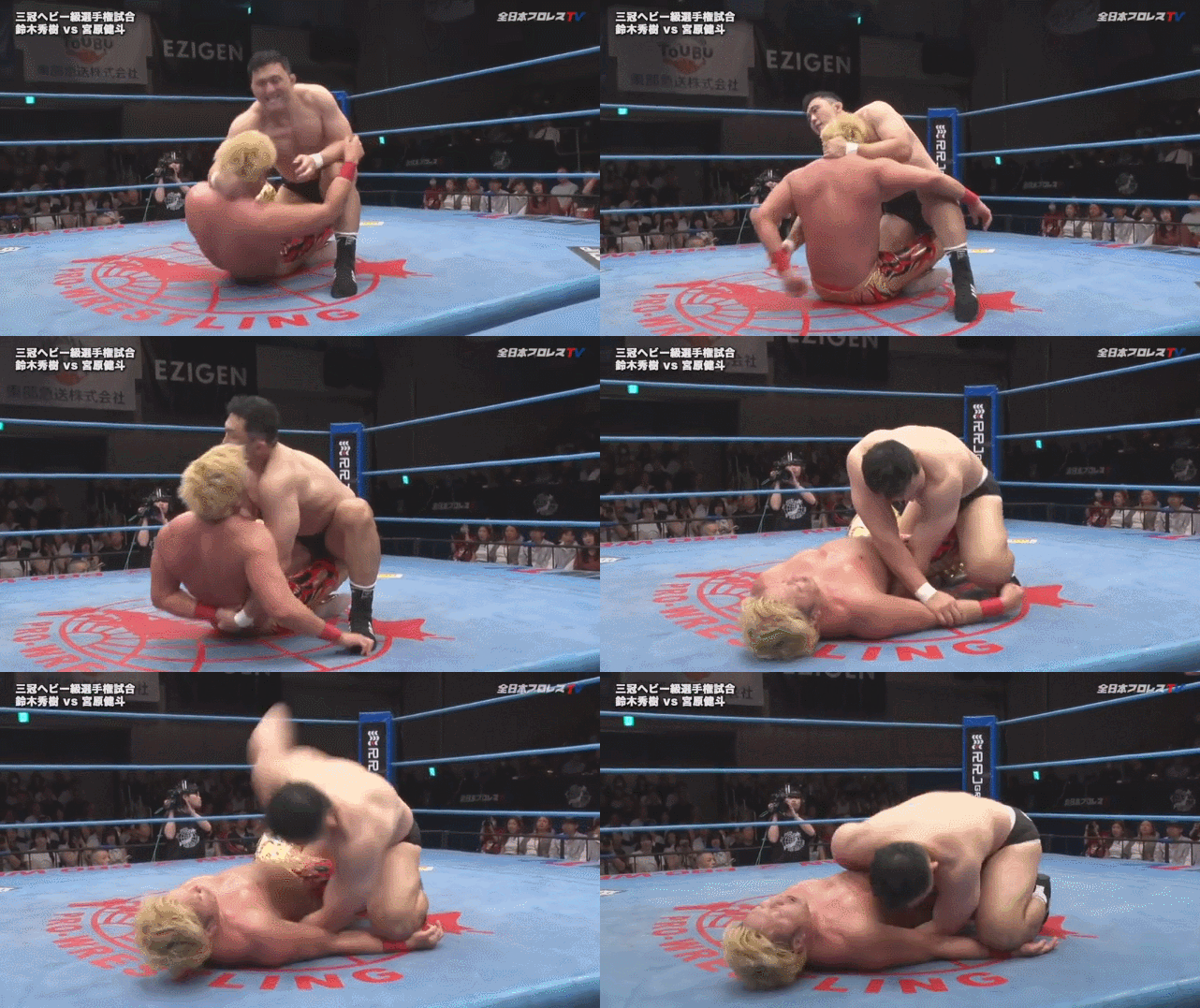
Suzuki was never flashy, but he found a much better balance between being methodical and hard-hitting to deflect the accusations from earlier in his career that he was boring.
Unfortunately for Suzuki, while he might have been a single-minded machine of obliteration, he was fighting the irresistible force that was Kento Miyahara. One could reasonably level a critique against Miyahara that he did not factor any of Suzuki’s attacks to his ribs or back into the second half of the match. He certainly didn’t move like he had his chest and back tenderized inside and out of the ring. The idea that Miyahara tended to wrestle “the Miyahara match” usually didn’t bother me, but it did annoy me here. If Miyahara had taken greater care to show the effects of Suzuki’s attacks, the transition to the usual climactic sequences in a Miyahara match wouldn’t have felt so jarring. To no surprise, Miyahara clamped on the Shutdown German Suplex and pinned Suzuki to retain his title.
I have considered myself a great admirer of Miyahara’s skills and talents, but I came away from the match with the impression that this didn’t land fully because of Miyahara. It felt like watching the 2018 Houston Rockets where James Harden would take his turn to lead the team’s offense, and then it would be Chris Paul’s turn. Or it felt like watching the 2020 Brooklyn Nets where James Harden would take his turn to lead the team’s offense, and then it would be Kevin Durant’s or Kyrie Irving’s turn. Or it felt like watching the 2025 Cleveland Cavaliers where James Harden would take his turn to lead the team’s offense, and then it would be Donovan Mitchell’s turn.
Those teams didn’t play aesthetically beautiful basketball because of the “my turn-your turn” setup, and this match suffered the same rough transition from Suzuki’s section to Miyahara’s section.
You can watch the match and the show on AJPW’s streaming service.
Yuki Ueno (c) vs. Shinya Aoki
DDT King Of Kings ~ Tenka Tairan ~
June 28, 2026
Cagematch ranking as of 7/1/26: 64
Cagematch rating as of 7/1/26: 8.5
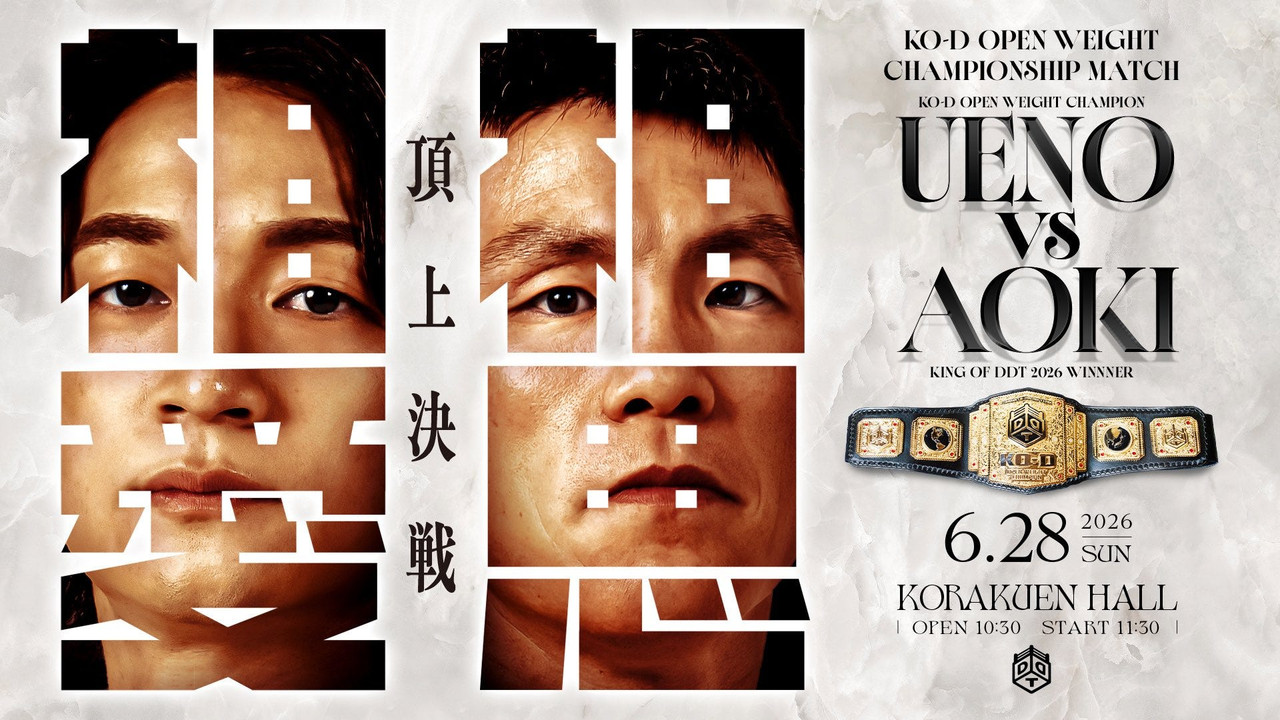
In the pre-match video, Shinya Aoki had the voice of someone who smoked three packs a day since they were twelve after working 14 hour shifts at the steel mill. However, he also had the glasses of someone who moved to Williamsburg in 2017 to open a sake distillery in Industry City and scoffed at anyone who moved to Williamsburg in 2021 as a fraudulent gentrifier. It was quite the contrast.
Aoki won the right to challenge to challenge Ueno for the KO-D Openweight Championship after defeating KANON, HARASHIMA, Minoru Suzuki, and MAO in the King of DDT 2026 tournament. This was Yuki Ueno’s 8th defense after winning the title from Kazuki Hirata in September 2025, and most recently he beat a fellow Yuki, Yuki Iino, in April. As JamieOD posted on their post about the show, Aoki had beaten Ueno for this title in 2024, so we the viewer were invited to think that Aoki had a shot at unseating Ueno again based on historical precedent and from the wrestlers Aoki overcame to earn this shot.
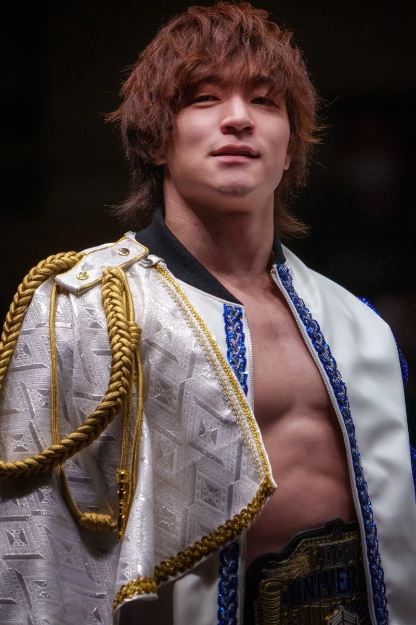
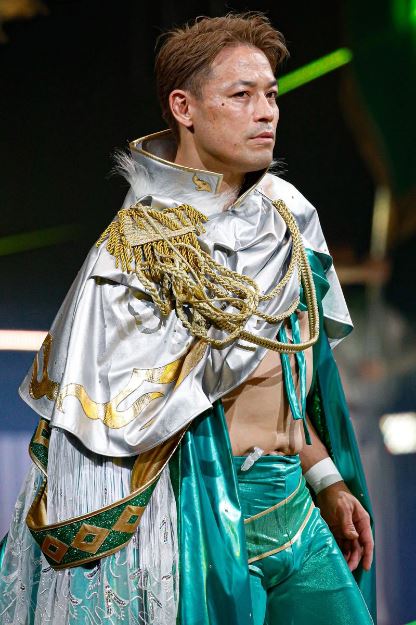
Apparently, Yuki Ueno and Go Shiozaki shared a tailor since they both have entrance outfits with shoulder capes and cords that emulate infantry shoulder cords. At least Shiozaki can claim that he was part of the AXIZ powers and the Special Assault Team. I don’t think the DDT Sauna Club quite earned Ueno the honor of the shoulder cord.
Ueno vs. Aoki made for an interesting contrast with Miyahara vs. Suzuki. Both matches opened with mat grappling that forced the champion to escape the challenger’s pinning attempts, and both Miyahara and Ueno used a neck bridge to avoid a pin. However, Ueno seemed to be more willing and prepared for Aoki’s game, using a neat little counter to swap control with Aoki and enter the full mount. They couldn’t quite pull off the bit where both of them rose to stand on their heads with their legs intertwined, but they deserved credit for salvaging the bit as best as they could.
Aoki, not Ueno, moved the match to its more explosive and athletic segment by teasing a dive to outside the ring, but Ueno, the younger wrestler, beat Aoki to the metaphorical punch with an explosive leg lariat.
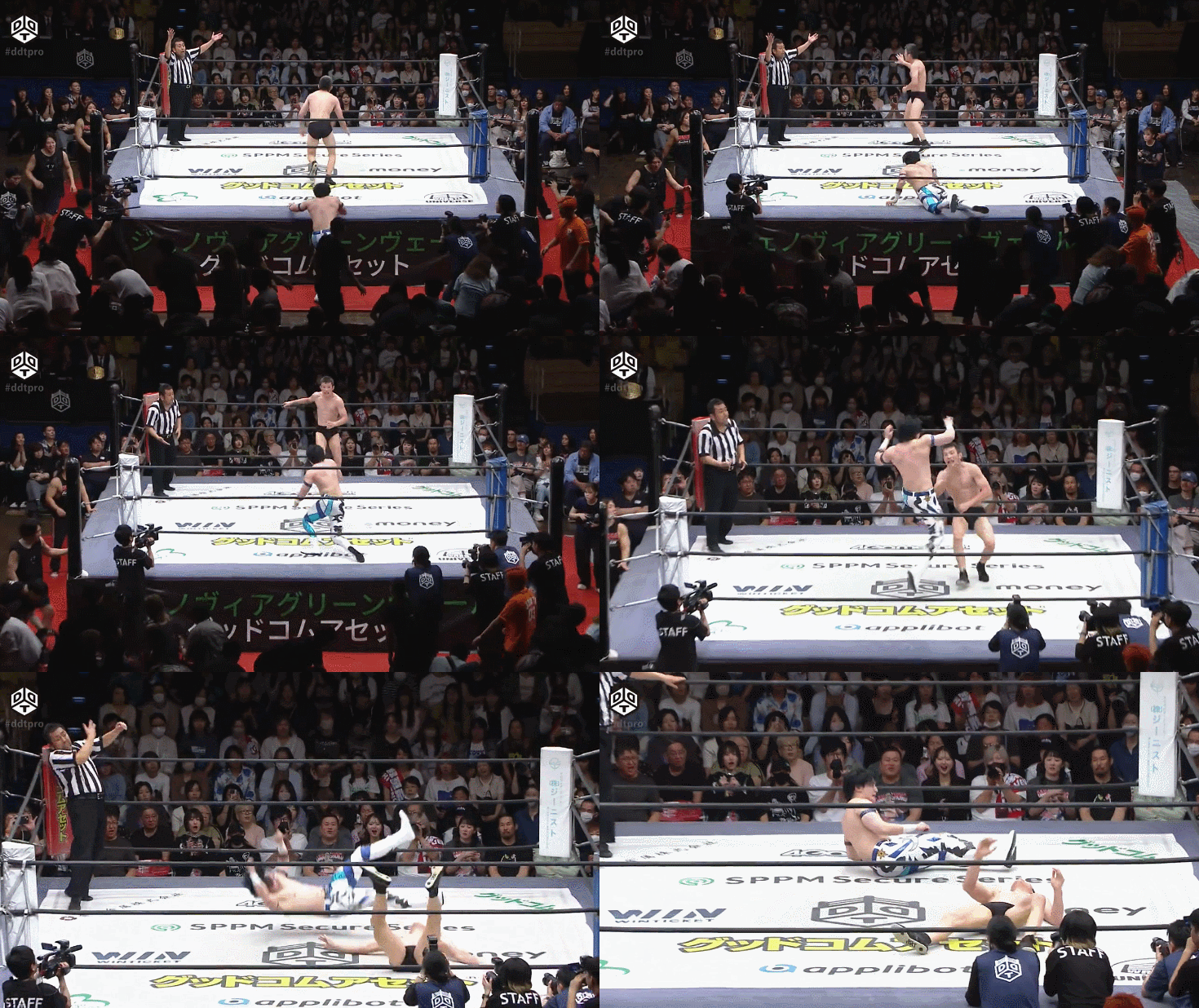
Aoki quickly took control by catching Ueno on a dive and wresting him to the ground by the arm, which then became the focus of his attacks. It was unique, and it mostly made sense since you could reason that Ueno was stunned that he missed Aoki completely on his dive. Aoki projected a sense of playfulness as he looked for ways to wrench and twist Ueno’s arm, which was different than Suzuki’s beefy and sturdy stoicism, Timothy Thatcher’s cranky sadism, or Zack Sabre Jr.’s whimsical intellectualization of violence. All of them cast the idea that their violence was improvisational and that they’re working the margins, which is what separated the great grapplefuckers from the mediocre.
Ueno was also game to play along with Aoki. It was critical that Ueno presented resistance throughout the match to make it seem less cooperative than it actually was. So Ueno, his arm trapped by Aoki, tried to roll Aoki for a pin or tried to trip Aoki even as Aoki dragged him from the corner. Ueno also tried to convince us of his pain when Aoki bent his legs into a Figure Four, but I wasn’t very convinced when he threw Aoki onto the apron chest-first after they rolled out of the ring.
Ueno’s split-legged double knee drop was cool though.
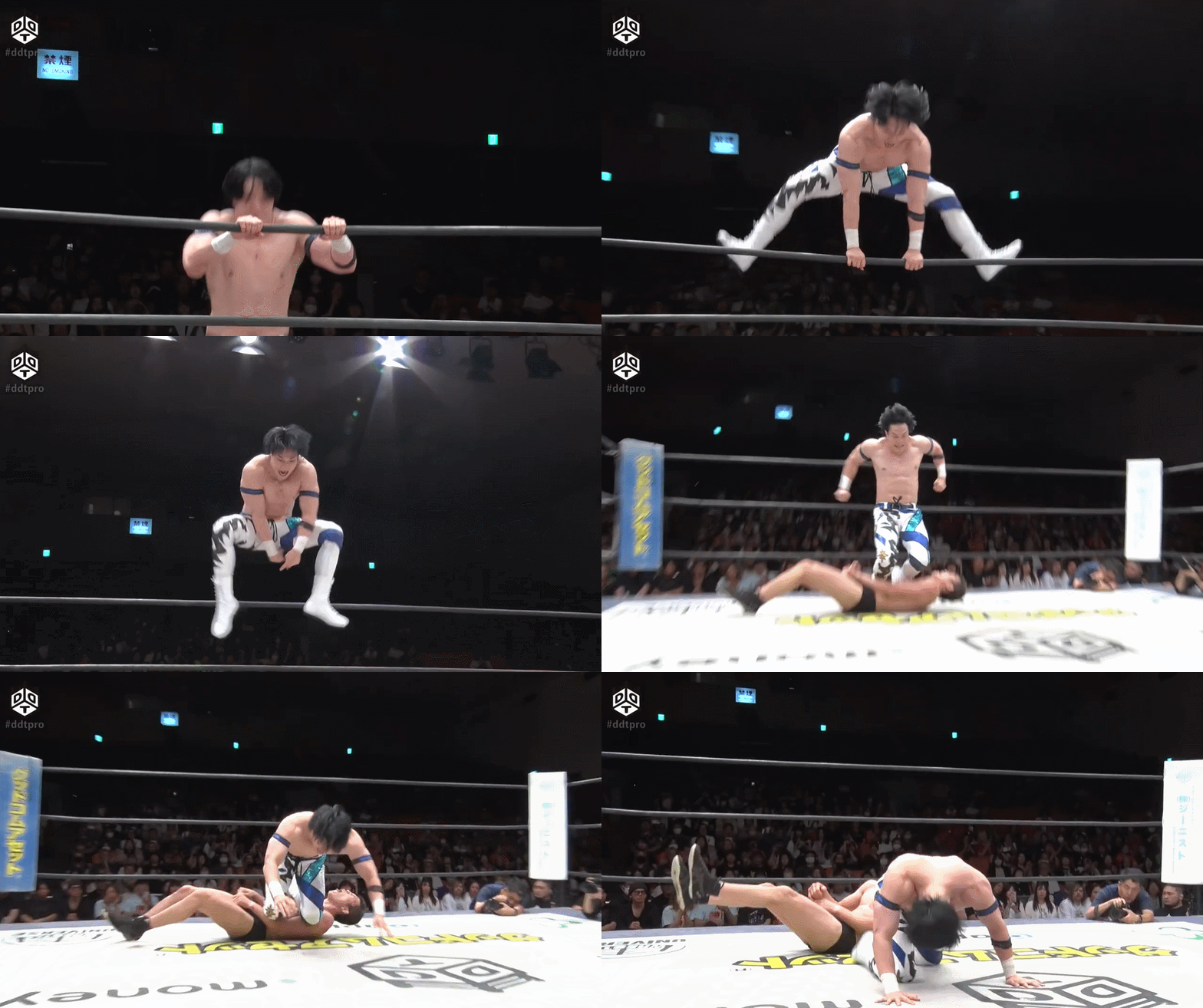
Aoki continued to attack Ueno’s arm in a well-executed armbar section where it felt like both men had to struggle. And I really liked when Aoki continued his attack even after absorbing a big powerbomb from Ueno’s shoulders.
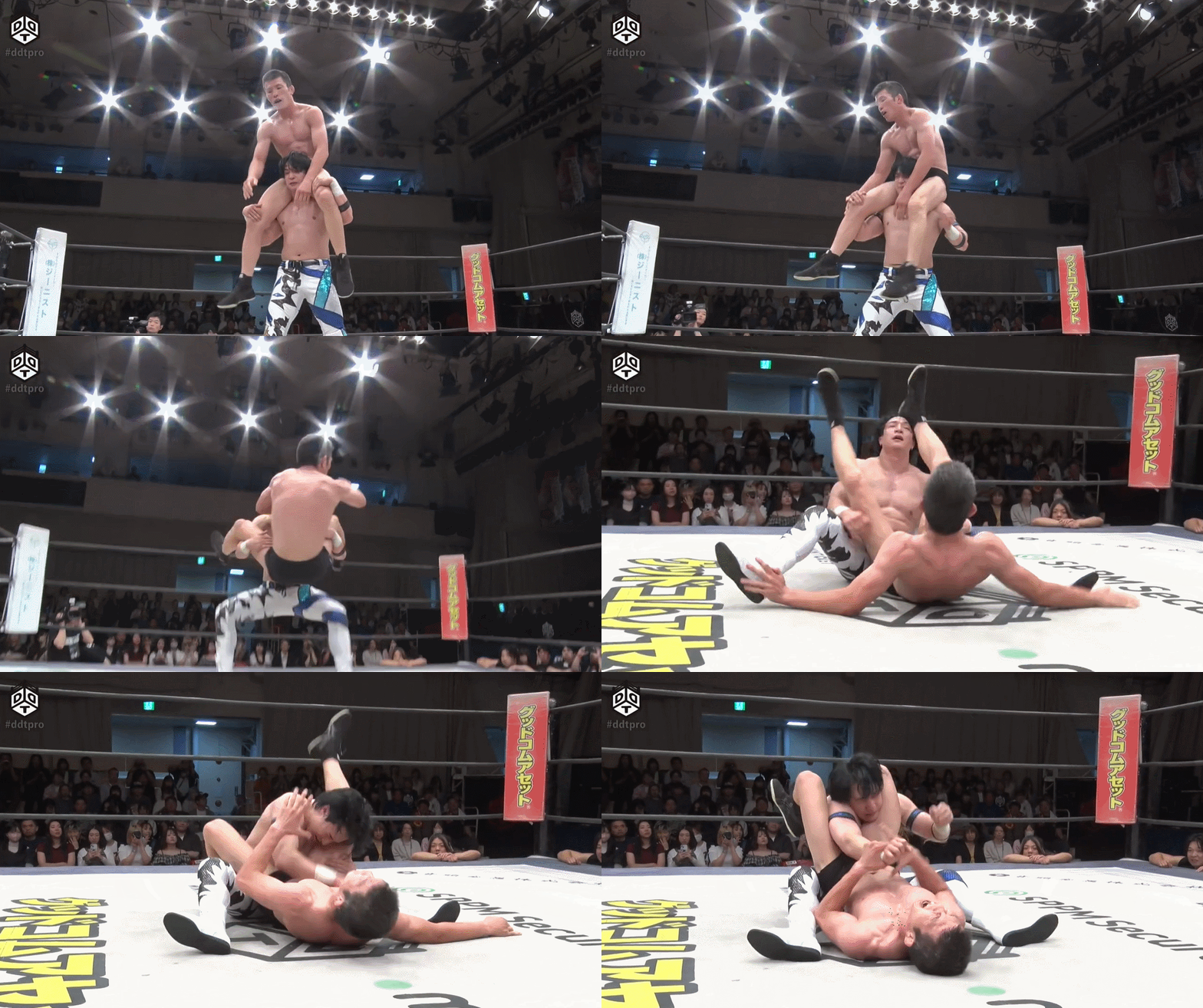
Aoki forced Ueno to figure out escapes again and again, which made the match very entertaining. I also appreciated that Aoki and Ueno went back to a collar and elbow lock-up when they got back to their feet after Ueno reversed Aoki’s attempt at a vertical suplex. Most wrestlers would have thrown punches and/or forearm strikes from the double down to show that the match was entering its endgame.
Aoki got his burst in with his tope suicida, diving knee drop, enzuigiri, and Aoki Clutch, but Ueno had enough pep in his step to wiggle out of the Aoki Clutch and crash on to Aoki with a frog splash. Here, Aoki proved his own resilience by kicking out and probing Ueno’s defenses until he locked in and brought Ueno to the ground. He then cranked Ueno’s shoulder like it was that Soulja Boy and his name was actually Shinji Ikari.
I appreciated the way Aoki’s and Ueno’s styles meshed in this match. Unlike Miyahara vs. Suzuki, which felt like a couple of wrestlers taking turns, Ueno showed that he was able to play Aoki’s game from underneath. The match ended with Aoki’s submission to Ueno’s simple seated chokehold. Aoki made such an understated resolution work because he had a look of resignation in his eyes. Given his background, Aoki should have been able to figure a way out of a rear naked choke. However, we’ve seen the rear naked choke become an equalizer in MMA upsets like Juliana Pena vs. Amanda Nunes, Nate Diaz vs. Conor McGregor, or Miesha Tate vs. Holly Holm. (Indeed, it’s not like Aoki himself was free from upsets, as he lost via KO/TKO to Eduard Folayang at ONE Championship: Defending Honor even though he was a 98% to 2% favorite in Tapology.)
I don’t think the match reached greatness, but I enjoyed it more than Miyahara vs. Suzuku. You can watch the match and the show on Wrestle Universe. For an alternate perspective on the match, check out the inimitable JamieOD’s post on about the show on Dramatic DDT.
Kaito Ishida vs. T-Hawk
GLEAT G-Class 2026 Final
June 4, 2026
Cagematch ranking as of 7/1/26: 698
Cagematch rating as of 7/1/26: 7.22
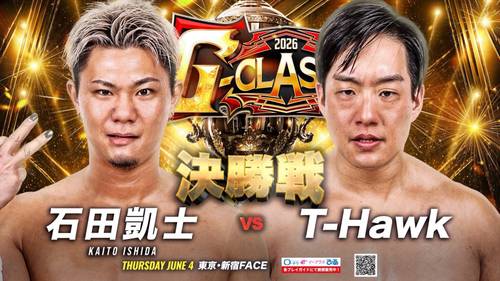
Sweet merciful crap, T-Hawk, what happened to you, and why would you allow GLEAT to use that photo of you? The look on Kaito Ishida’s face squarely captured my reaction to how T-Hawk looked in this advertisement for the match.
Ishida, T-Hawk, and the bags under T-Hawk’s eyes met in the finale of the 2026 G-CLASS tournament, wherein T-Hawk told Hayato Tamura and Ryuichi Kawakumi to G-G-G-G-G-G-get their asses in the car and go home. Ishida defeated KAZMA SAKAMOTO and Takehiro Yamamura. I hope Ishida also told KAZMA SAKAMOTO that it was hard to hear him over how loud his all-caps name was.
Luckily for Ishida, T-Hawk either got a better tanning treatment or some sleep because the bags stayed home for the actual match. GLEAT, like every other company, had a black t-shirt wearing, rules flouting villainous group. In GLEAT, it’s called Black Generation International, and Ishida happened to be its leader. Of course, the Shinjuku FACE crowd chanted for the leader of the black t-shirt wearing, rules flouting villainous group at the start of the match. At some point, promoters will realize that the idea that such a group would consistently draw a wrestling crowd’s ire instead of admiration, or at worst a tired, resigned sigh, was long past its expiration date.
The fine folks at GLEAT took great care of its trophy, which looked fairly hefty.
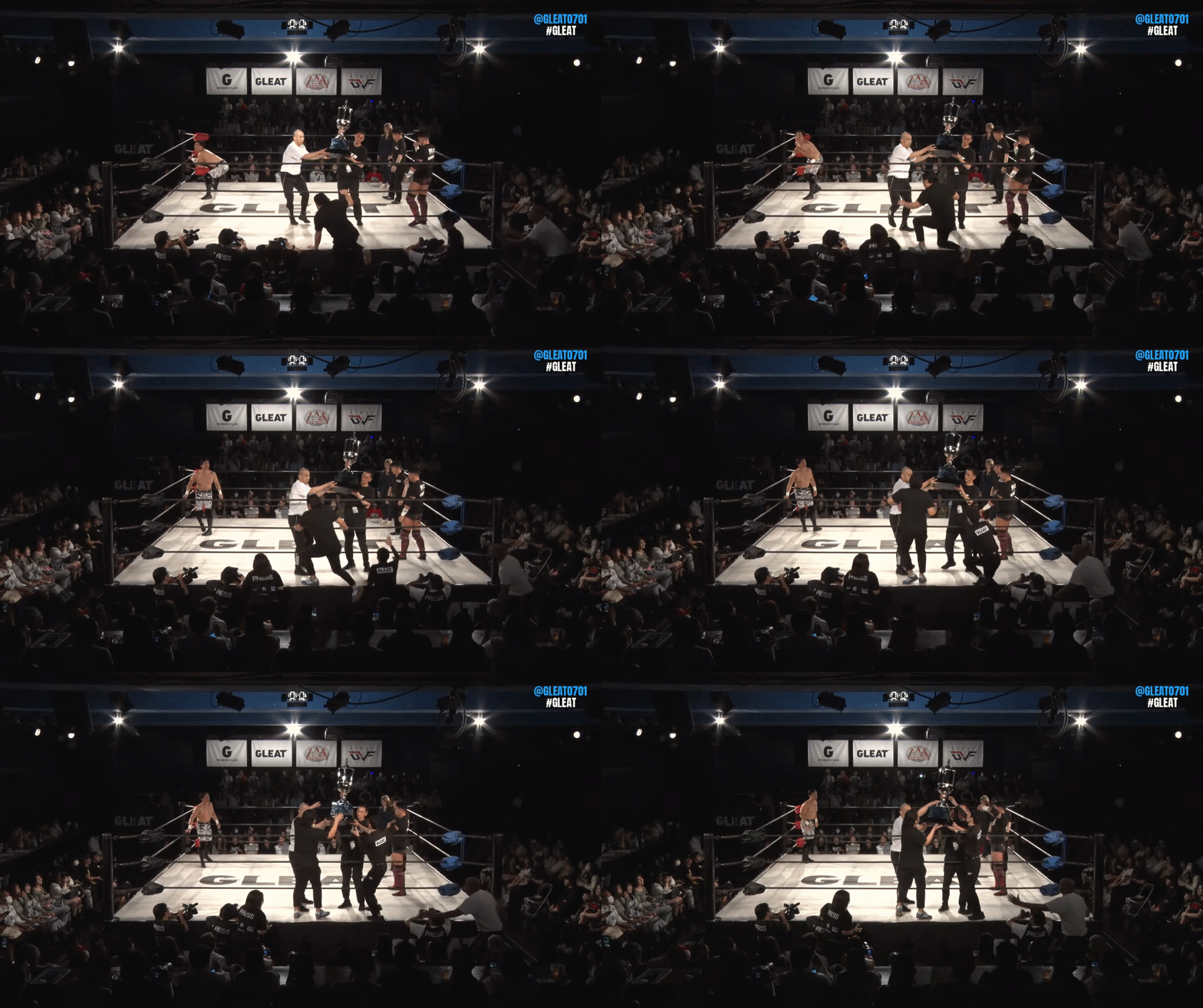
Ishida and T-Hawk opened with some weirdly playful and low-energy grappling. As a result, I was glad when Ishida tried to ambush T-Hawk with a head kick out of a break against the ropes. However, even when Ishida and T-Hawk picked up the pace, T-Hawk tried to be dramatic by posing on his knees for his close-up after Ishida kicked out of a pin attempt that came from T-Hawk’s shoulder block. It was unnecessary, and it made the match’s pace feel stuttering.
They picked it up again by throwing strikes at each other, and T-Hawk projected malice in his chops and slap to Ishida’s face.
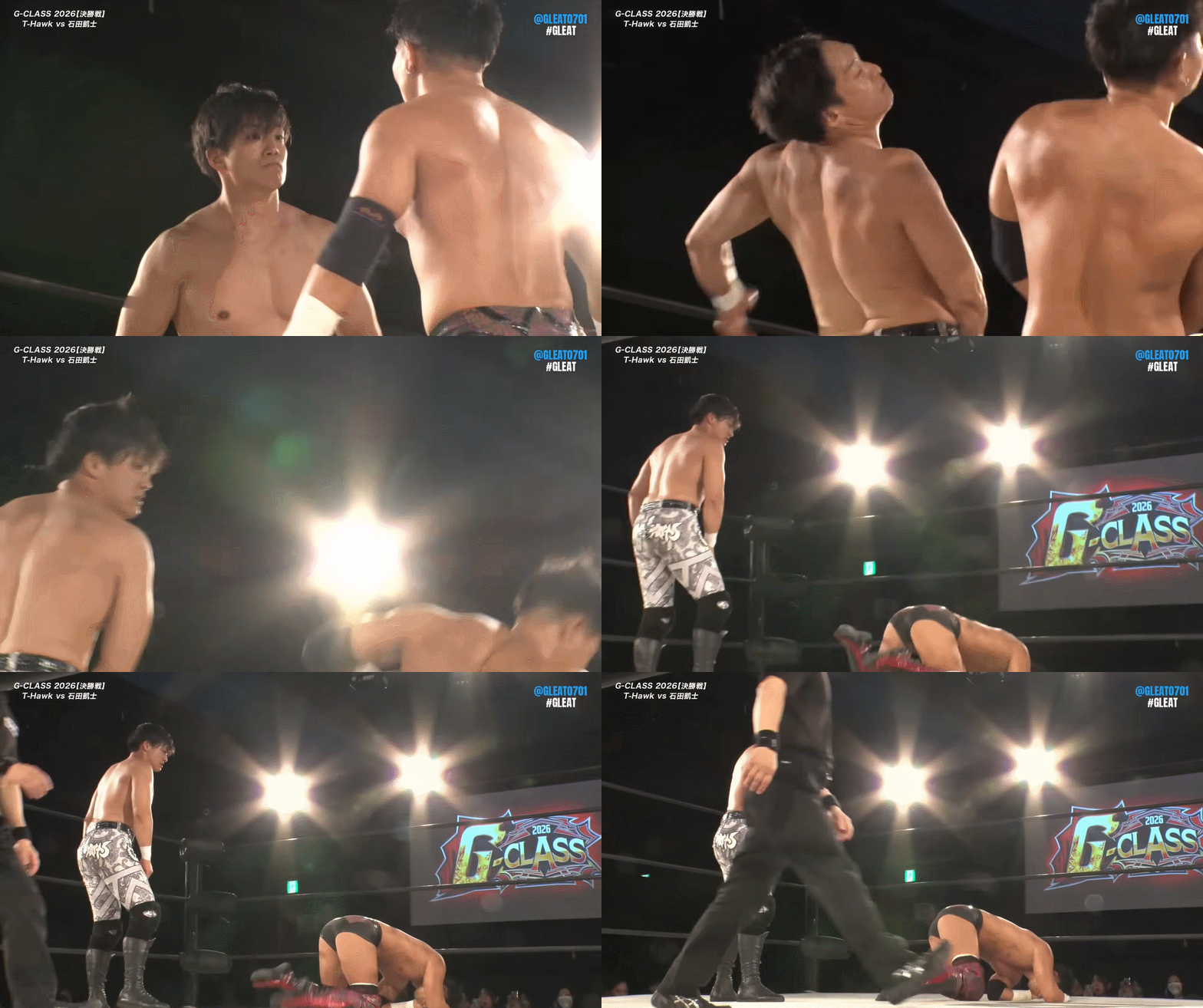
That said, there was just something about T-Hawk’s casual stroll around the ring that irked me. It and the easy-going grappling attempts at the start implied a lack of urgency in a tournament final even though his strikes looked impactful. The smile on his face while he waited to chop Ishida in the corner implied an admirable sadism that felt contradictory to his lackadaisical ambling in the ring.
Despite the fervor of the sole T-Hawk fan’s chants, Ishida took control with a sharp Dragon Screw of T-Hawk’s leg while he had his legs wrapped defensively around the middle rope. Ishida displayed a similar lack of urgency as he forced T-Hawk to stay back and protect his leg, but at least he taunted T-Hawk with a swipe at his head every now and then. T-Hawk forced a recovery period by heaving Ishida over with a suplex and laid the groundwork for the incremental toll that Ishida’s attack on his leg took by clutching at his knee after sprinting to chop Ishida in the corner.
The keyword of the match was “choppy” both for T-Hawk’s chops and for how there would be action and then downtime until the next bit of action. T-Hawk clutched his knee while Ishida leaned against the middle rope to recover from T-Hawk’s running chop to break the action again. Perhaps my expectations that they would have a go-go-go pace were wrong. The G in G-Class might not have stood for “gunning it.”
Since GLEAT still proudly displayed the AAA banner between its own banner and the Lidet banner, did it mean that GLEAT was also a part of the WWE sphere of influence?
Entering the climax, T-Hawk and Ishida traded control of the match. (T-Hawk had it after chopping Ishida off of the top turnbuckle and his super brainbuster, and Ishida claimed it after attacking T-Hawk’s leg again. Ishida did everything but point to his temple after he took T-Hawk down, and I almost wish that he did.)
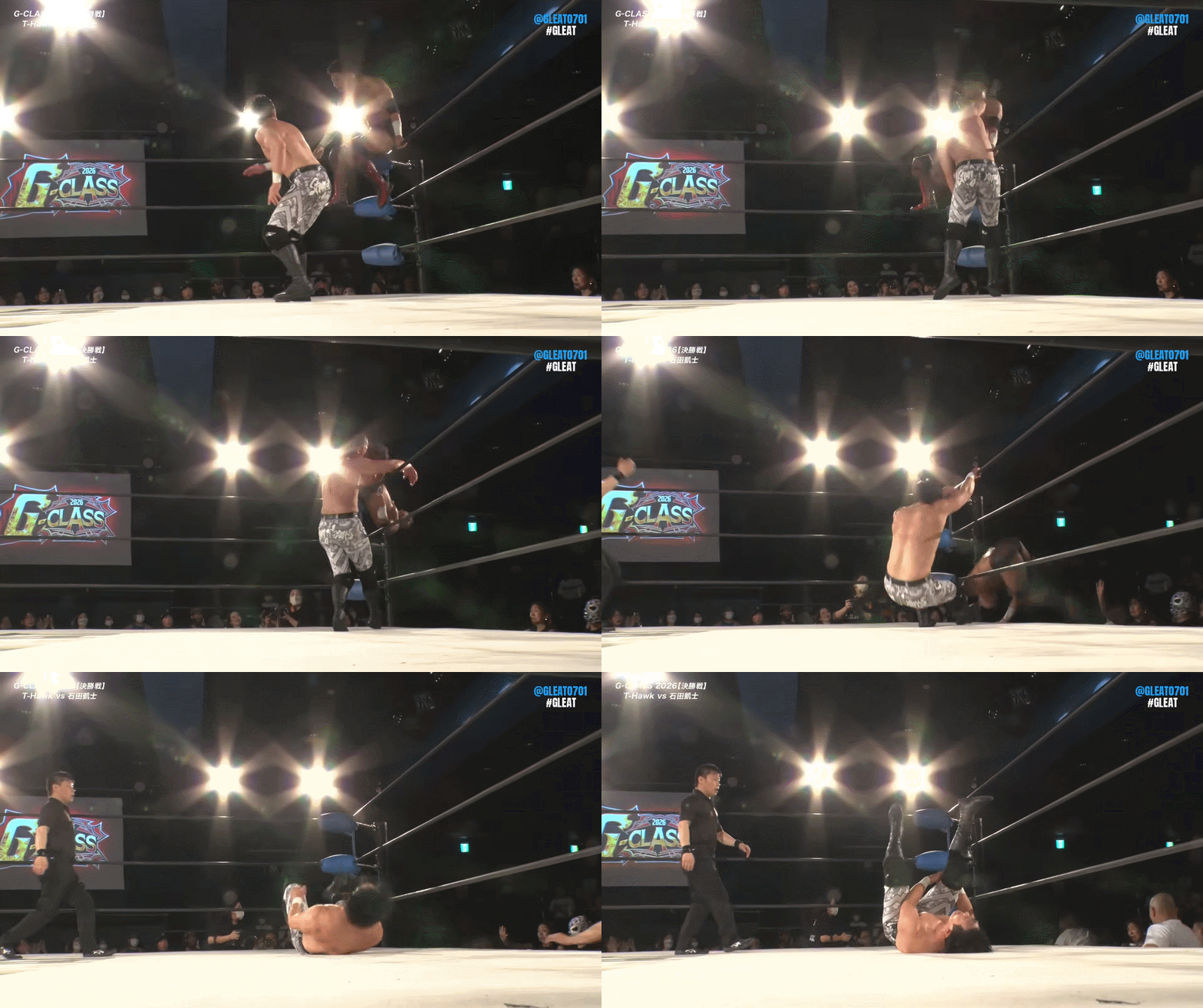
The match escalated, as much as it could, into a chop vs. kick to the leg battle. T-Hawk paid off the story of Ishida’s attacks on his leg with a grimace after kneeing a running Ishida in the gut. He overcame his pain (if we want to be generous in our interpretation) and hoisted Ishida for a BT Bomb that scored a nearfall. This was the last time the leg pain came into play. They turned the pace dial up at the end with a quick half crab and a couple of pin reversals. They even almost fooled me when T-Hawk finally hit the Night Ride after multiple attempts. It was strange that T-Hawk put Ishida down for good with a series of chops, and I suppose we’ll have to chalk it up to T-Hawk depleting Ishida’s life meter with those last heavy chops.
The ending stretch was fairly exciting, especially in contrast to the 15-18 minutes that preceded it. One could be generous again and say that this was a more classically paced match that made the audience anticipate the burst of energetic violence at the end. Ishida and T-Hawk tried to craft a story where T-Hawk overcame his trouble with his leg. However, he didn’t do enough to get me to buy it. For as much as they made Ishida’s sweat fly around Shinjuku FACE, the chops weren’t a convincing conclusion to the match.
Finally, it was sad to see that no one’s bothered to update Ishida’s or T-Hawk’s Wikipedia entries to include a paragraph about their years in GLEAT.
You can watch the match and the show on GLEAT’s YouTube page.
Hayabusa & Katsuhiko Nakajima vs. Masato Tanaka & Yuko Miyamoto
Katsuhiko Nakajima Produce XX STYLE ~ IT’S SHOW TIME
May 31, 2026
Cagematch ranking as of 7/1/26: 51
Cagematch rating as of 7/1/26: 8.59
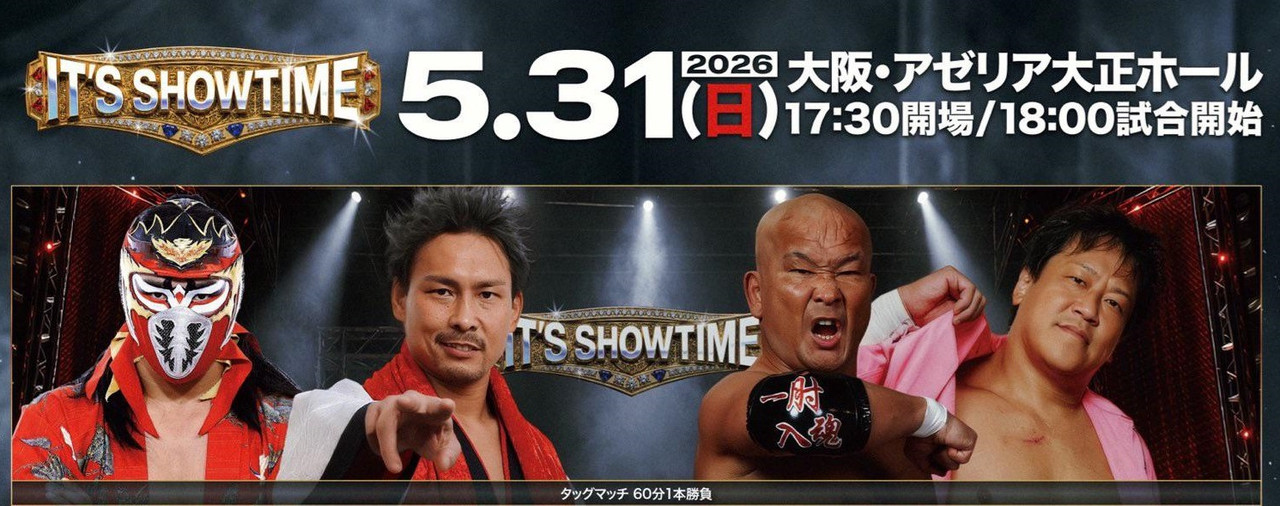
Where were you in 2004? The original Hayabusa wrestled his last match in 2001. Masato Tanaka was in the middle of his 94 matches for ZERO-1 (and 8 matches for HUSTLE) that year. Yuko Miyamoto was in his second year as a wrestler. Shingo Suzuki, the man rumored to be the new Hayabusa, was 18 years old and hadn’t even made his amateur MMA debut yet.
Katsuhiko Nakajima, on the other hand, was a year past his MMA debut at 15 years old for Riki Choshu’s World Japan and had just made his professional wrestling debut against Tomohiro Ishii. The wunderkind Nakajima wrestled his first match in New Japan Pro Wrestling against Jushin Liger in 2004 at 16 years old. He even wrestled in that year’s Best of the Super Juniors tournament and scored his only win against Curry Man. And he won his first pro wrestling title, Michinoku Pro’s MPW Tohoku Tag Team title, with Kensuke Sasaki that year.
Consider for a moment the fact that six years separate Miyamoto and Nakajima and that both were wrestling veterans with 22 years of experience as of this match. Now, consider the reputation that Nakajima earned over the years about being a difficult and unsafe coworker (as Tetsuya Endo and Kinya Okada would attest to) and the bridges that he supposedly burned at every stop in his career. Could one reasonably draw a correlation between how Nakajima spent his formative years and who Nakajima grew up to become?
It’s Nakajima’s party, and he’ll have a rapper serenade him on the way to the ring if he wants.
The opening grappling here made for a good contrast with what Kaito Ishida and T-Hawk tried. Ishida and T-Hawk tried to really space out each segment. One could charitably say that they tried to give everything that they did at first some space to breathe and ultimately make the viewers want to see the pace pick up. That felt almost punishing to me as a viewer, but I will admit that it made me appreciate when they picked up the pace. Here, Nakajima and Miyamoto executed their grappling with speed and intensity from the start, even if it was nothing groundbreaking.
If we assume that Shingo Suzuki was indeed behind the Hayabusa persona, then his part of the opening grapple-off (grapple-down?) with his familiar foe Masato Tanaka fell right into his wheelhouse. Similar to what Nakajima and Miyamoto presented, it was a perfectly perfunctory struggle on the mat. And so we got each possible variation (Miyamoto and Nakajima, Tanaka and Nakajima, Tanaka and Hayabusa, and finally Miyamoto and Hayabusa) to round off this segment that inspired very respectful applause.
The match moved up a step when Nakajima fought Miyamoto over some bodyslams. Then, they started brawling around Osaka’s Azalea Taisho. Again, none of it felt lazy since everyone moved with intent, but it was very formulaic. It was enough to dull the senses, but then Nakajima grabbed Tanaka in a defensive headlock after Tanaka dropped an elbow on his left knee.
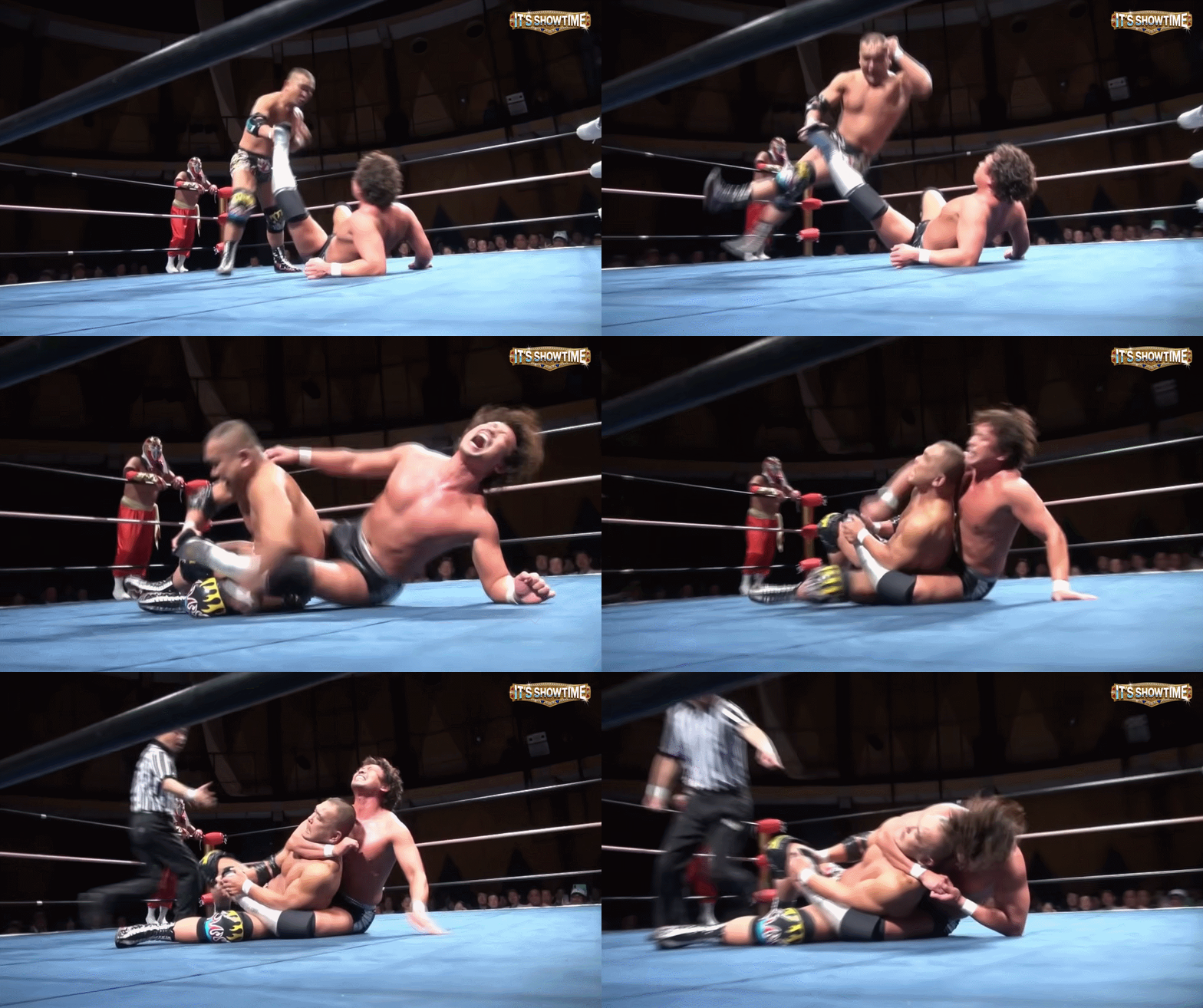
Tanaka targeted Nakajima’s left knee, so obviously the knee became the focus. The pain made Nakajima’s infamous kicks less effective against Tanaka, and Miyamoto was able to show off his very fancy knee twister.
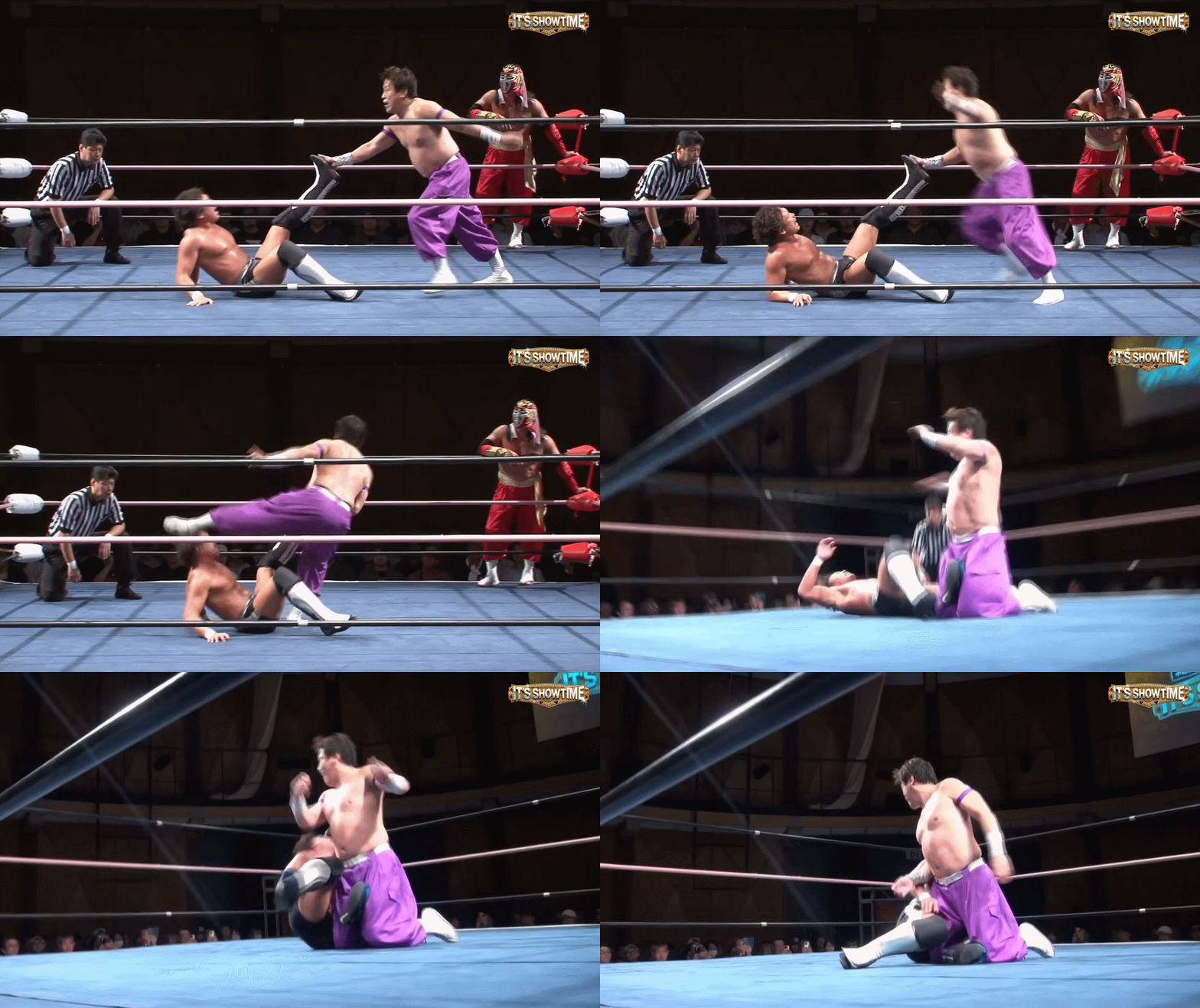
Nakajima found the gumption within to reel off a low dropkick to Tanaka’s leg, an enzuigiri, and and a Dragon Screw to take Tanaka down and get a lukewarm tag out to Hayabusa. Hayabusa looked stockier than the last time I saw him. And he deserved credit for how clean this flip senton was, even if it felt antiseptic. It just didn’t have the frisson of danger, the line between Matt Sydal’s crisply executed dives and Jack Evans’s potential to land on his fucking head and still walk away, that you’d want from a wrestler cosplaying someone as captivating as Hayabusa was.
The way Hayabusa landed for Tanaka’s DDT was closer. It would fit the middle frame in the “Show me perfection” meme.
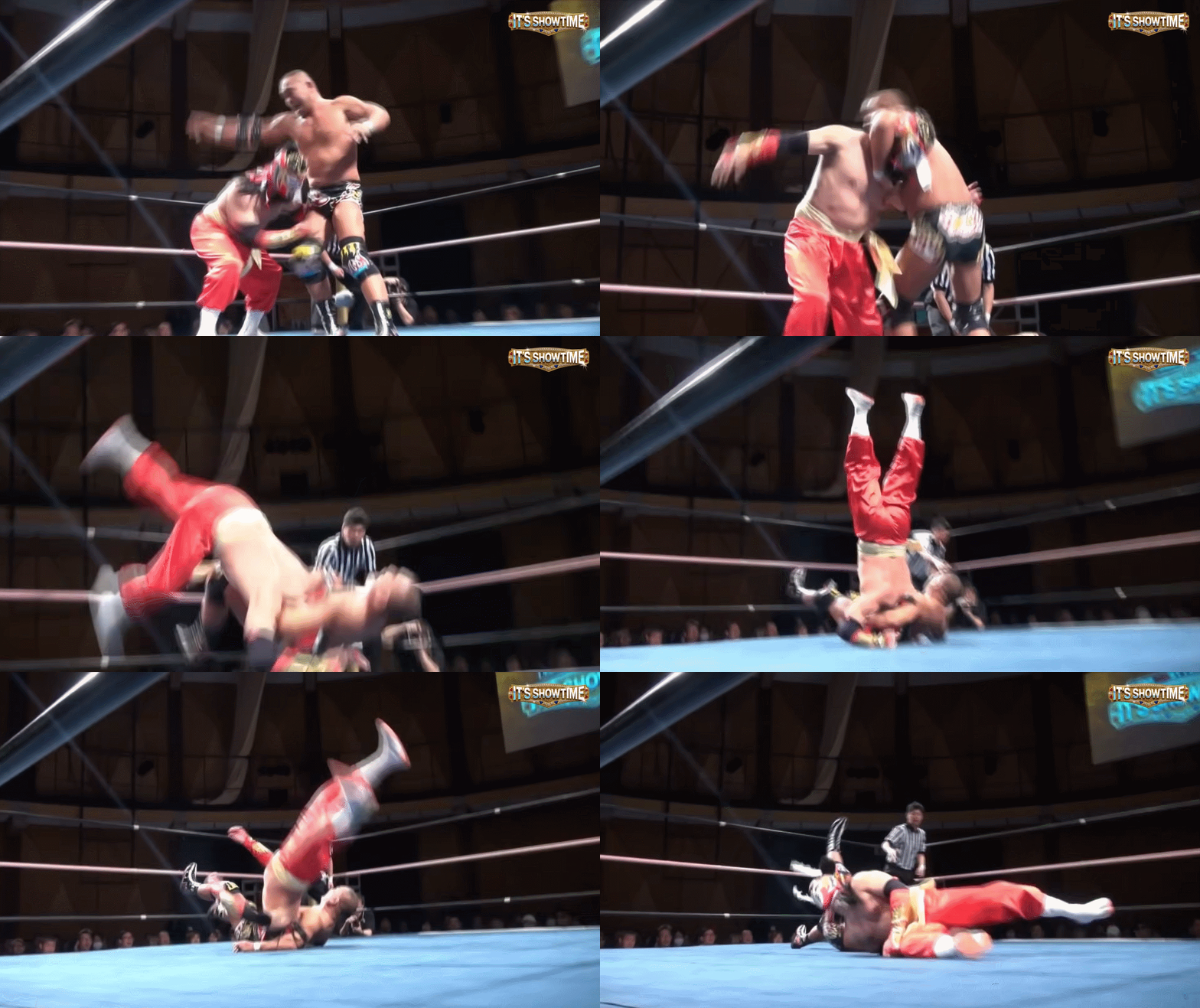
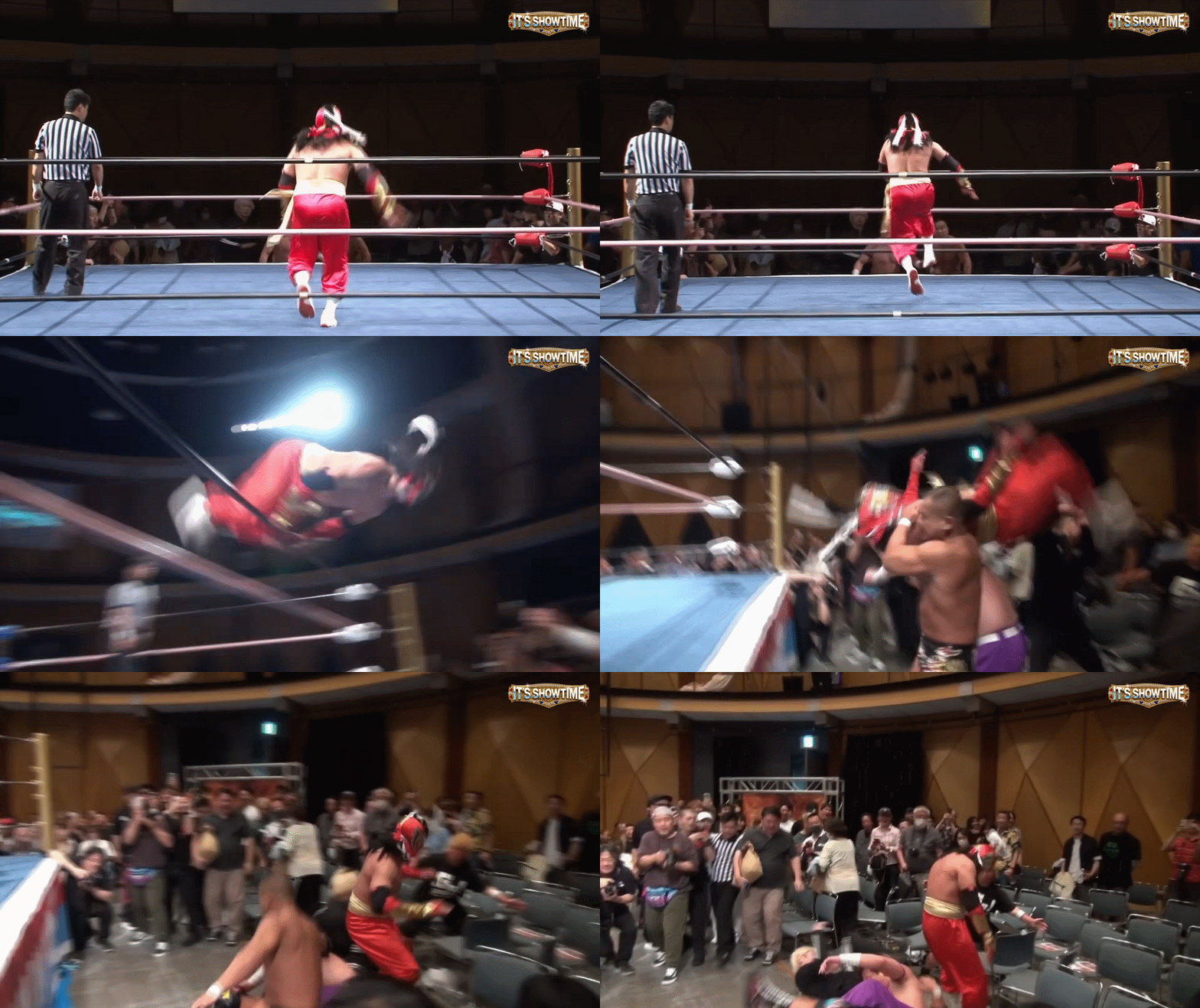
Hayabusa and Miyamoto paired off so that Hayabusa could get his moment in the sun before Nakajima reclaimed the leading man role in the main event of his independently produced show. The less said about some of Miyamoto’s kicks, the better. Nonetheless, he and Hayabusa did enough to prime the pump for Tanaka and Nakajima to return to the match. They got their timing mixed up for Tanaka’s running elbow, but they recovered well enough that it wasn’t too noticeable.
Tanaka and Nakajima laid into each other as hard as they could. However, Nakajima was clearly the star since he was able to take out Tanaka and Miyamoto on his own when Miyamoto tried to save his teammate. Hayabusa played an indubitable supporting player on his team, much like Jaylen Brown will this year on the Philadelphia Sixers despite his wishin’ and hopin’ and thinkin’ and prayin’ after the team signed LeBron James this offseason. By the end, Hayabusa and Miyamoto disappeared. The match became a potential preview of the finals of the 2026 ZERO1 Fire Festival as Nakajima and Tanaka squared off.
Not surprisingly, Tanaka and Nakajima presented a gnarly, bruising fight that was highlighted by Tanaka’s brainbuster. One could argue that Hayabusa’s interference cost Nakajima the match since he was doing just fine alone against both Tanaka and Miyamoto. That could set up Nakajima and Hayabusa’s match in the Fire Festival. Furthermore, it would have compounded the drama from Hayabusa’s loss to Nakajima in March. In the end, a great looking Sliding D spelled defeat for Nakajima.
Sometimes, you just want to see a formula executed well, and these four wrestlers delivered a perfectly cromulent tag team main event. It showcased Nakajima as a leading man, helped ZERO1 by giving a platform for four participants in the Fire Festival, and gave the fans a pretty good closing segment. It was also a pretty low-calorie endeavor and not one that will likely stick in my memory.
You can watch the match and the show on K-FORCE’s YouTube page.
Ali Najima vs. Masanori Kanu Watanabe
Sportiva Wednesday Curry Pro Wrestling
June 17, 2026
Cagematch ranking as of 7/1/26: N/A
Cagematch rating as of 7/1/26: N/A
Masanori Kanu Watanabe was something you probably wouldn’t see in other, larger companies: he was a 34-years-old sophomore. He made his debut in May 2025 against Hikaru Sato, and he honed his wrestling craft in Sportiva since. We actually saw him in January in his tag team match with Yuta Oya against Najima and Ryutaro Ono. At the time, I wasn’t impressed with Watanabe’s strikes. It seemed to me like he, as a former MMA fighter, had a hard time throwing strikes that worked in professional wrestling.
I keep coming back to Ali Najima because I was intrigued by his potential. In my scouting report for the 30 Under 30 project, I had noted that he was intense and focused, and he engaged my sympathy. In their blurb for Najima’s honorable mention, Chris Gascoigne was even more praiseful, describing Najima as “one of the fastest rising stars on the Japanese independent scene” and “an outstanding technician whose style is perfectly suited to the demands of Bati-Bati wrestling.”
Those who profess a desire to see more matches in the style of Young Lions’ bouts would probably see their appetites satiated by this match. There was a lot of yelling and hitting, and Najima and Watanabe kept the match very simple. Najima defeated Watanabe with a nifty little reversal into a pin.
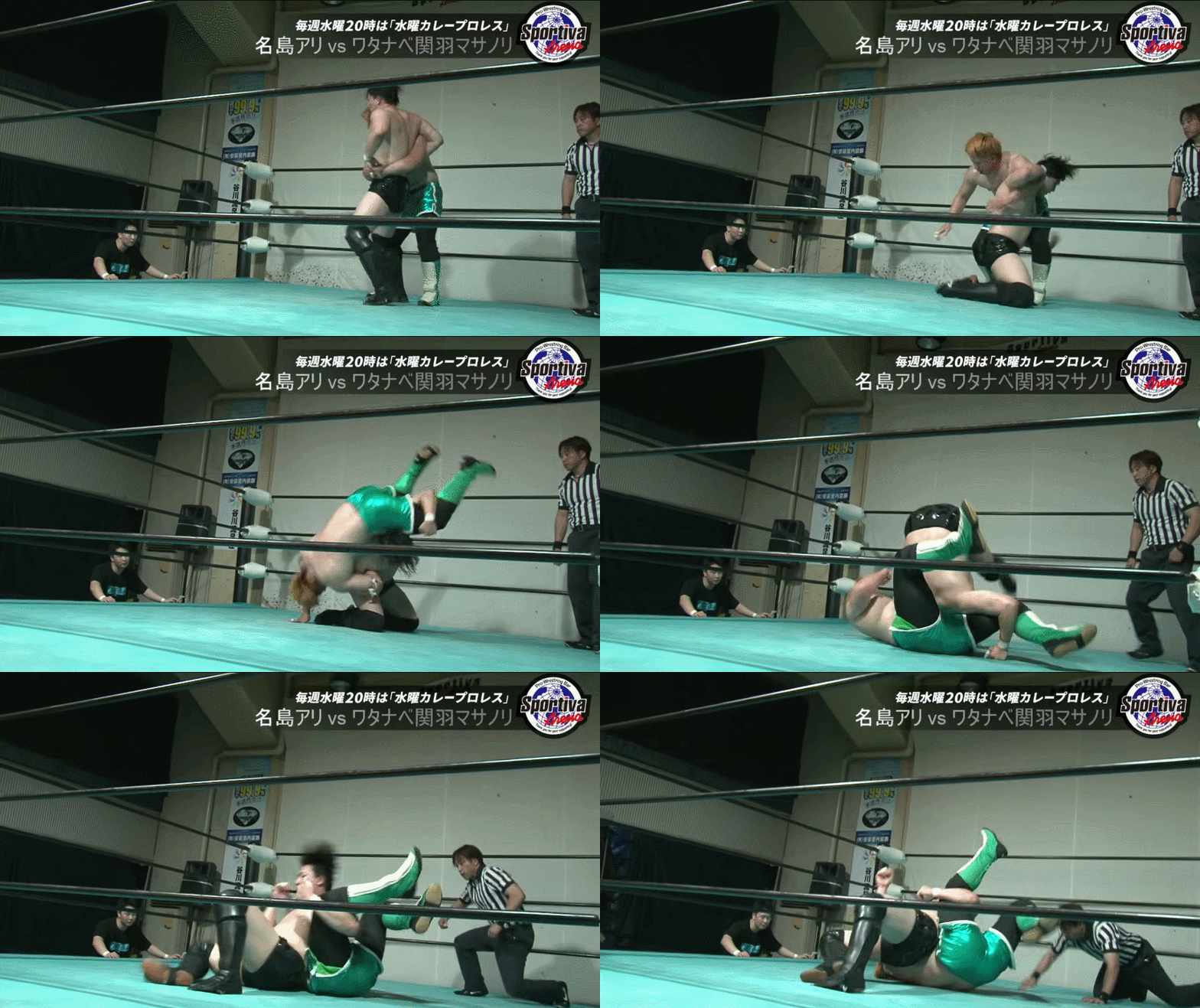
Given his experience edge over Watanabe, Najima never seemed like he was in danger of losing the match. As the more experienced wrestler, he exhorted Watanbe to hit harder and to keep fighting. That made this match feel more like a hazing ritual or a training session than a match where the stakes mattered. Watanabe’s forearm strikes looked better in this match, and his kicks were good when he wasn’t holding back. However, his knee attacks still looked too soft and tentative.
Najima made his professional wrestling debut against Fuminori Abe in 2024, and I hope we get a rematch soon. In general, I want to see Najima stretch beyond Sportiva Arena and try his hand against other junior heavyweight wrestlers. As the saying goes, iron sharpens iron, and I want to see Najima hone his mettle against the likes of Abe, Aran Sano, and Ryunosuke Nagai.
You can watch the match and the show on Sportiva Entertainment’s YouTube page.
Next time: You call this a set of cool wrestling matches? This is a collection of cool matches, namely from
- Australia, where we’ll revisit Dan Archer, Randy Chambers, and Aysha,
- Canada, where we’ll see check on Sinner and Saint (Judas Icarus and Travis Williams) and Casey Ferreira, and
- the United States, where we’ll see Jeremy Wyatt, Adam Priest, Jesse Funaki, Erick Stevens, Jonathan Gresham, and Masashi Takeda in action.


