


In 2025, we observed the tension between the old guard and the next generation permeating wrestling companies worldwide. From NJPW to Dragongate to NOAH to ZERO1 to PWA, we saw how companies responded to the need for succession planning and shifted their focus from veterans to up-and-comers. Some (PWA, ZERO1, and Dragongate) handled it with more intentionality than others (NJPW), who were left scrambling to figure out who could take the baton.
As 2025 closed and 2026 opened, we saw some more of that tension play out.
- AJPW: The 36-year-old Kento Miyahara fended off the 26-year-old Yuma Anzai’s challenge for the Triple Crown Championship and defended the title against the 34-year-old Talos.
- Marigold: The 35-year-old Miku Aono beat the 27-year-old Utami Hayashishita for the Marigold World title in October and defended it against fellow 35-year-old Mai Sakurai.
- NOAH: The 33-year-old Yoshiki Inamura retained the GHC Heavyweight Championship against the 29-year-old OZAWA.
We’ll see some battles between wrestlers of different generations and how the tension between the old guard and the (comparatively) younger generation played out in cherry-picked examples from the undercard of GLEAT, NOAH, and DDT.
Masakatsu Funaki vs. Takanori Ito
GLEAT Ver. 22
January 10, 2026
Cagematch ranking as of 2/1/26: 87
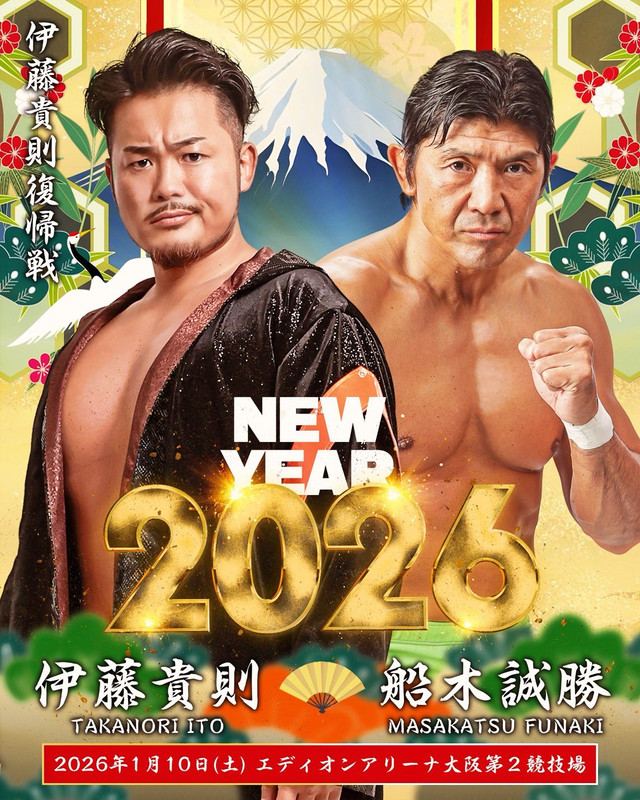
The 56-year-old Masakatsu Funaki, one of the co-founders of Pancrase, was part of the same generation of wrestlers as his New Japan dojo classmates, Jushin “Thunder” Liger, Shinya Hashimoto, Minoru Suzuki, and Masahiro Chono. The 32-year-old Takanori Ito seemed like a youngster by comparison, though he would fit better with the old guard that we would cover in the other matches. Be that as it may, the fact that this was still a generational clash made it fit the dialectical structure of the old guard vs. the next generation.
Ito, who had a black belt in karate, was involved in a traffic accident in August 2025. This accident incapacitated him due to injuries to his left knee, right elbow, left elbow, back, hip, and right ankle. After recovery and rehabilitation from knee surgery, Ito asked for Funaki to be his opponent in his return match.
Both men seemed prepared for a fight, but Ito seemed determined to make a statement about his own health from the start. He struck first with a boot to the face, a German suplex that dumped Funaki on the back of his head, and a disrespectful kick to the forehead that sent Funaki seeking respite outside.
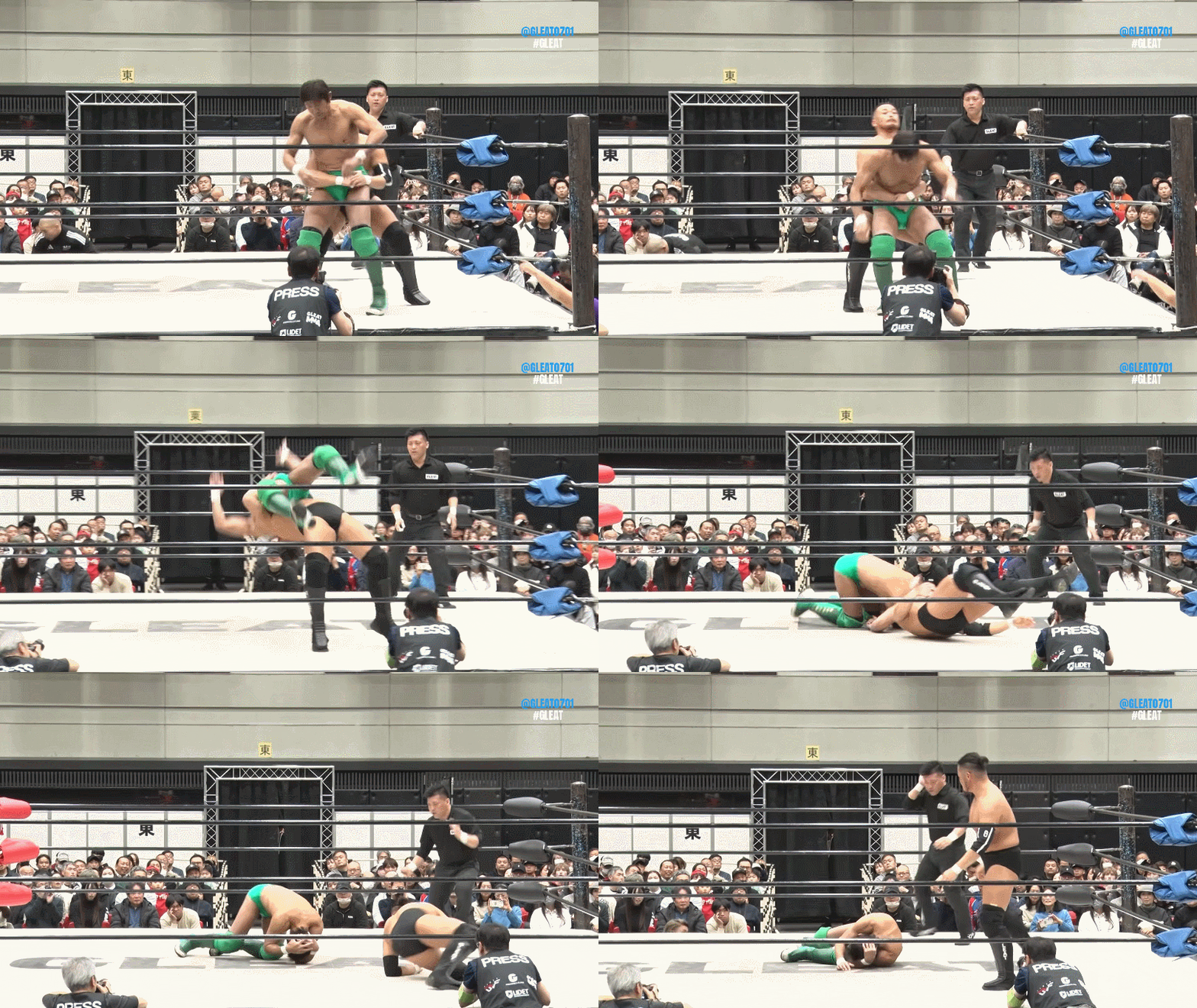
Funaki addressed Ito’s presumed disrespect by slapping Ito around and throwing a couple of empty front row chairs at Ito’s back and chest. Back inside the ring, Funaki got into a slap vs. European uppercut battle and ground Ito down with some holds; my favorite was the variant of the arm triangle choke that Funaki applied from rear control where he held Ito’s arm against his own throat.
After getting dominated on the mat, Ito tried for a knockout jumping roundhouse kick in the corner that just resulted in his getting stuck on the top rope.
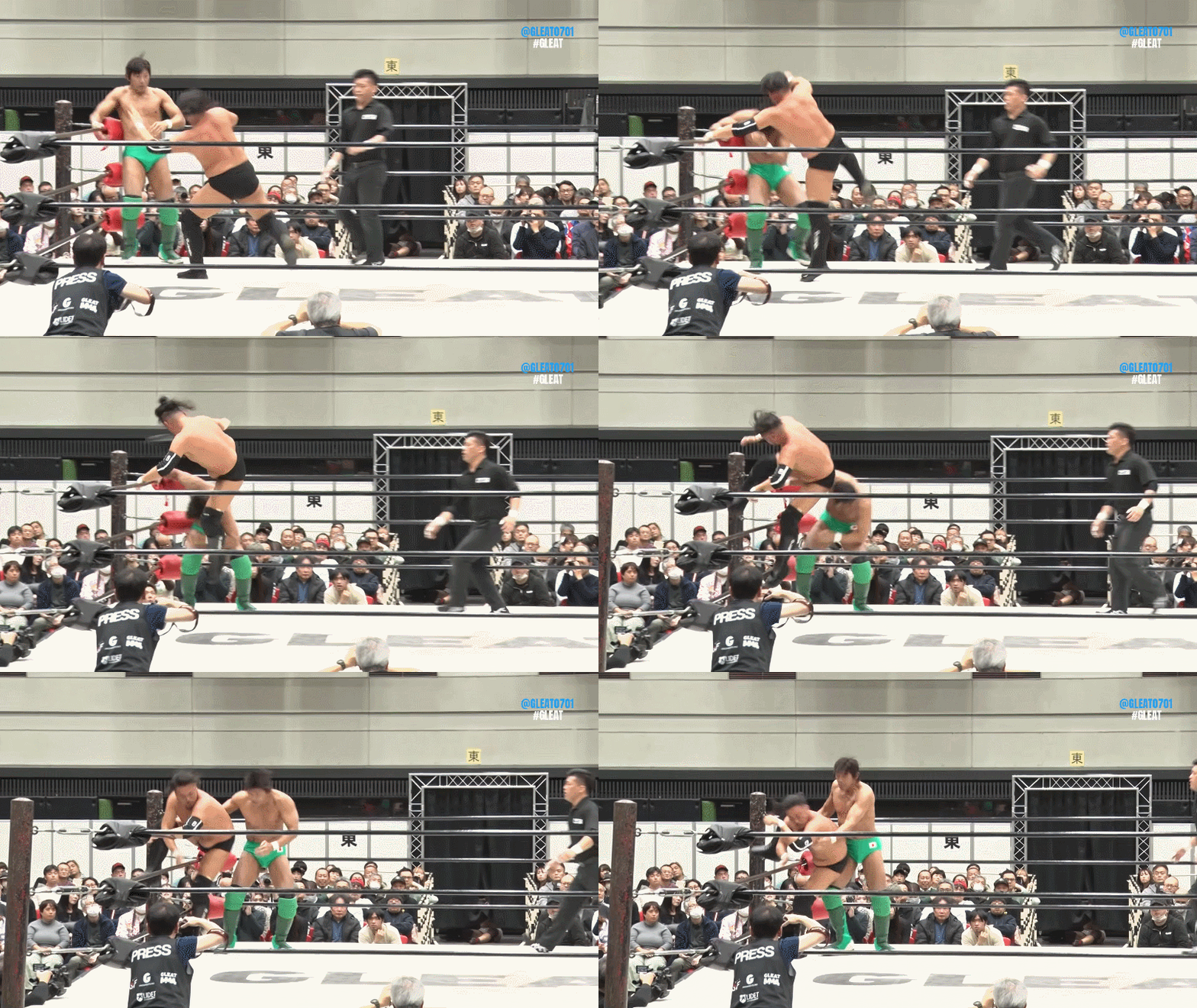
With Ito trapped, Funaki punished him some more in the corner, but Ito knocked down Funaki with a spinning heel kick in the corner. Overall, it’s decent, grounded shoot style wrestling, which made Ito’s spinning heel kick a bewildering inclusion. Knowing that the referee had to end the match after Funaki was injured after Ito’s half nelson suplex made seeing Funaki grasp at this head after every fall before that moment foreboding. Did he start hurting from the opening German suplex, and the pain became unbearable after the half nelson suplex? Was he just selling on the previous suplexes and really did just get injured by the half nelson suplex?
In the end, the high ratings that the match received puzzled me. Ito’s fire to prove himself after his injury was clear, and Funaki’s stoicism and the grumpiness that would seep out were admirable. Given the ending, I don’t see the match’s substance that would raise it above “fine.”
You can watch this match and the show on GLEAT’s YouTube page.
Hiromu Takahashi (c) vs. AMAKUSA
NOAH The New Year 2026
January 1, 2026
Cagematch ranking as of 2/1/26: 10
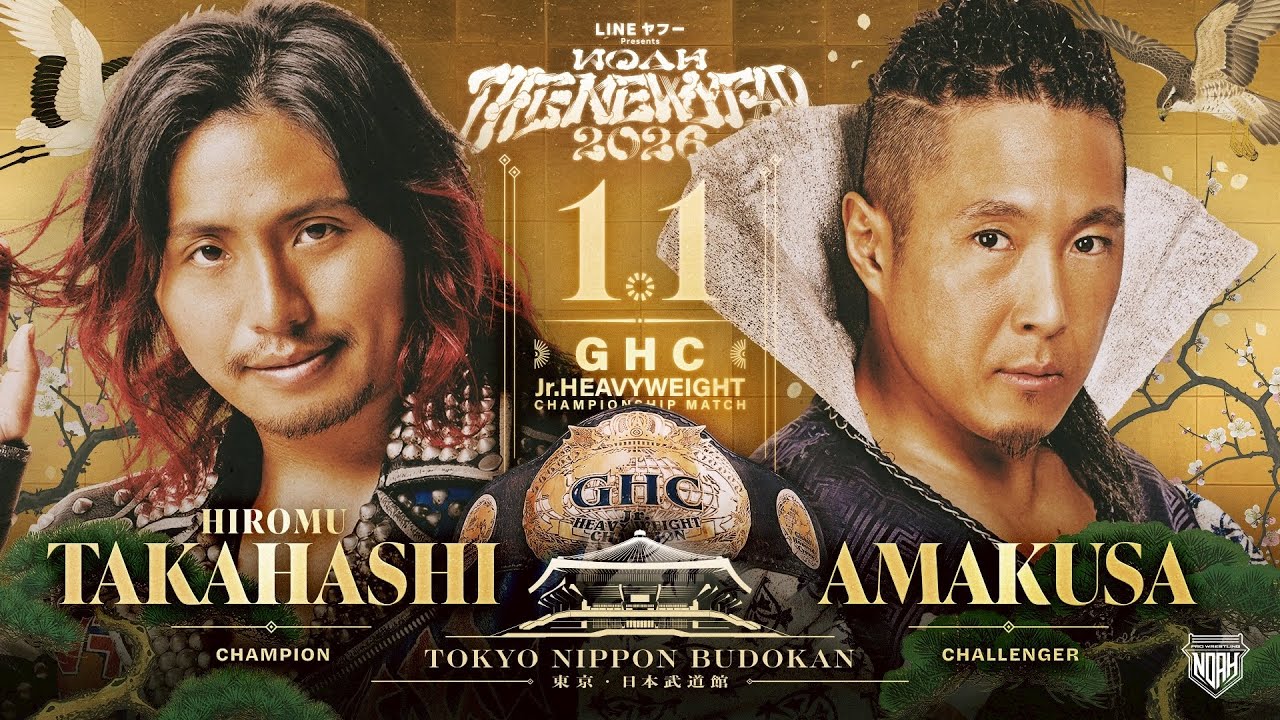
The adage in wrestling is that wrestlers should present their actual personalities at 110% for their in-ring personas. So, what does that mean for AMAKUSA and Hiromu Takahashi? Is Takahashi a flamboyant weirdo who really loved his family of stuffed cat dolls? (At the very least, he probably loved the meals that the merchandise dollars those dolls bought him.)
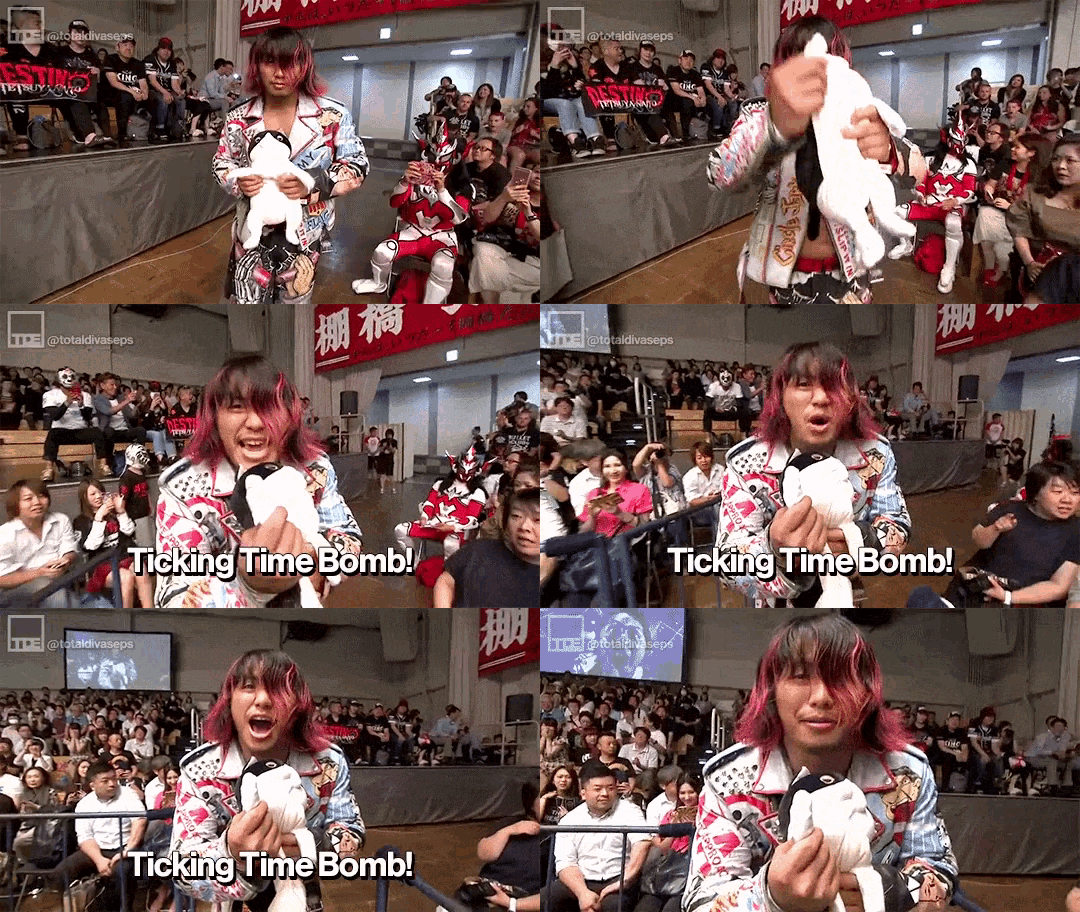
What about Yuki Sato, who was certainly creative in crafting their AMAKUSA, Haoh, and Kenbai gimmicks if we believe Wikipedia?
As Amakusa, named after Amakusa Shirō, Sato’s gimmick is that of the last remaining energy left from the Shimabara Rebellion in the Shimabara Peninsula in what is now Nagasaki Prefecture, where 37,000 Japanese Christians (Kirishitans) were killed by the Tokugawa shogunate. He had become vengeful and sought a human form, seeking to rid of the past of the conflicts during and after the rebellion. As Haoh, alongside Hiroki Tanabe, who portrayed Nioh, he is represented from Niō entrance guards in Japanese Buddhist temples. As Kenbai, he is of Iwate origin, and is inspired from a Buddhist ritualistic dance.
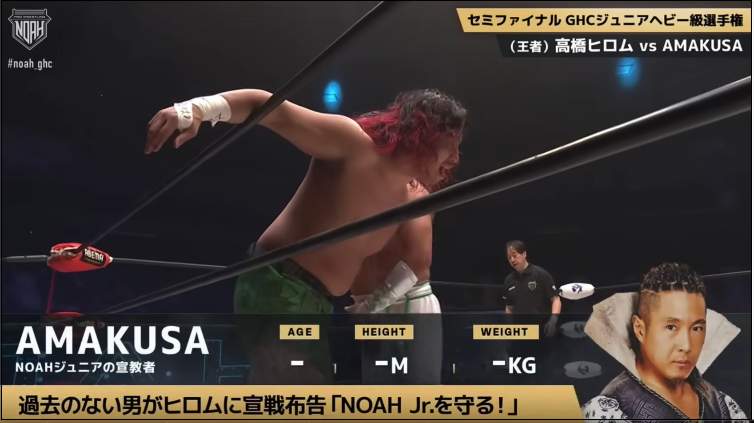
That said, you have to admire AMAKUSA’s and NOAH’s commitment to the bit since NOAH listed neither age, weight, nor height for him in their on-screen graphic. No corporeal manifestation of vengeful spirits need to concern themselves with keeping to the junior heavyweight weight requirements. (Of course, this gimmick doesn’t really pass the refrigerator test; why would the corporeal manifestation of angry spirits compete in a wrestling match for a junior heavyweight championship? Why would a meat bag for a bunch of ghosts even feel pain? Sometimes, acting like a garbageman or the physical incarnation of angry spirits who happen to wrestle might be more trouble than it’s worth.)
To take our minds off of metaphysical questions, AMAKUSA and Takahashi started their match with a quick chop battle and high speed offense. AMAKUSA capped the opening moments with this nifty twisting tope.
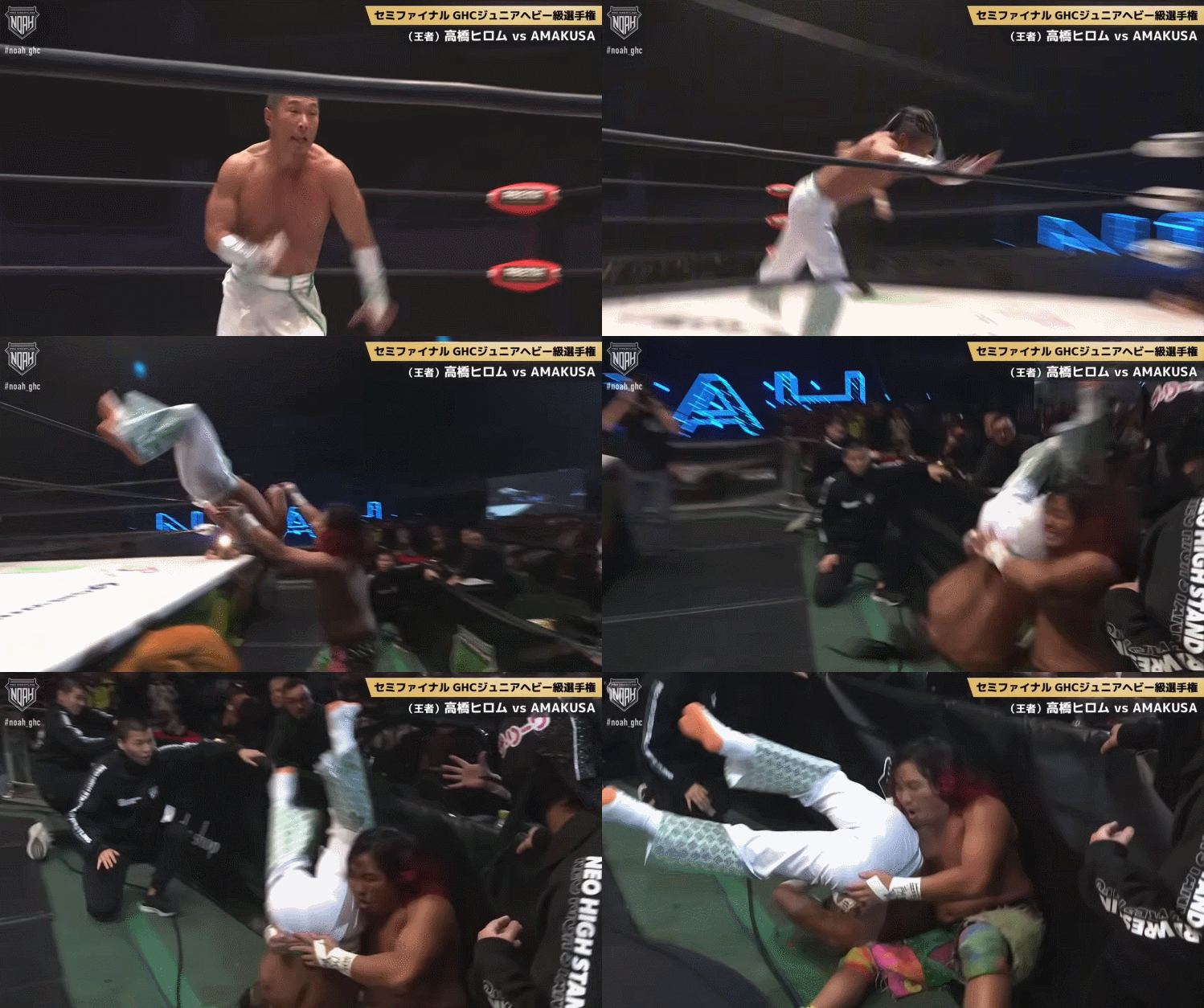
Unfortunately, being the avatar of 37,000 restless spirits did not make AMAKUSA invulnerable to knee pain.
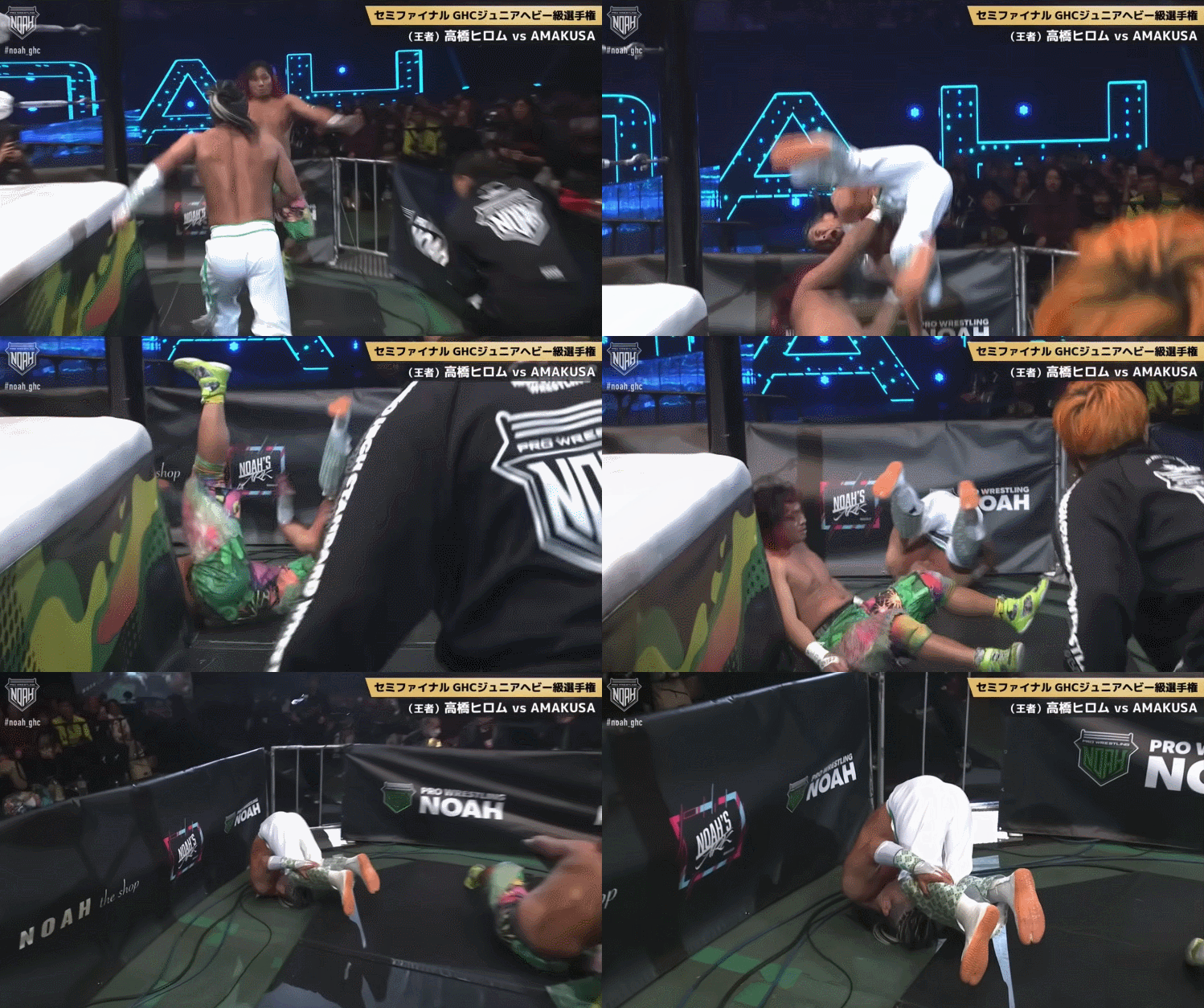
Takahashi pressed his advantage by punishing AMAKUSA’s vulnerability to metal barricades, whipping him forcefully into and over them around ringside. Takahashi and AMAKUSA returned to the ring, where Takahashi’s attacks culminated in a Falcon Arrow. After kicking out of Takahashi’s pin attempt, AMAKUSA drove Takahashi back with a dropkick and a downward chop from the top turnbuckle. AMAKUSA’s top turnbuckle Frankensteiner rocked Takahashi, but he still had enough good sense to destabilize the top rope that AMAKUSA was perched on, causing him to fall crotch first on to the turnbuckle. Luckily for AMAKUSA, this is a match in NOAH, so there are actual turnbuckles and not just buckle pads.
Based on the pace and the fact that neither wrestler milked pathos from the damage that they’ve taken, the match felt like a sprint. A positioning battle led to AMAKUSA’s neat leg-capture German suplex.
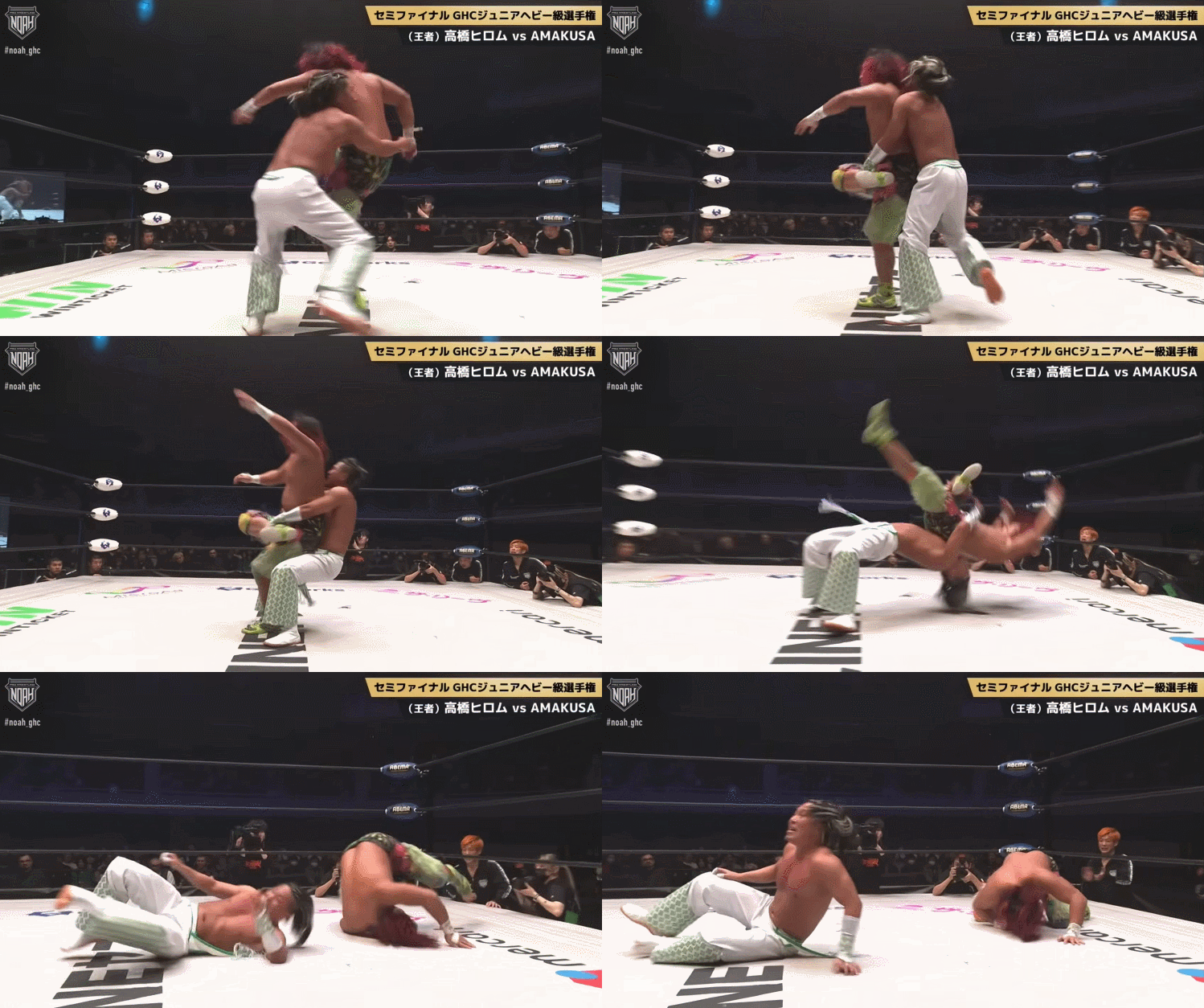
Not even halfway into the match, Takahashi hit the Time Bomb; based on AMAKUSA’s blank stare, it didn’t seem to faze him that much. Later, AMAKUSA stunned Takahashi with a throw from the apron to the floor and brought him back inside to try to win the match. In a nasty little segment that I really enjoyed, AMAKUSA pulled Takahashi up from a pin at the two count to slap him in the face before pinning him again.
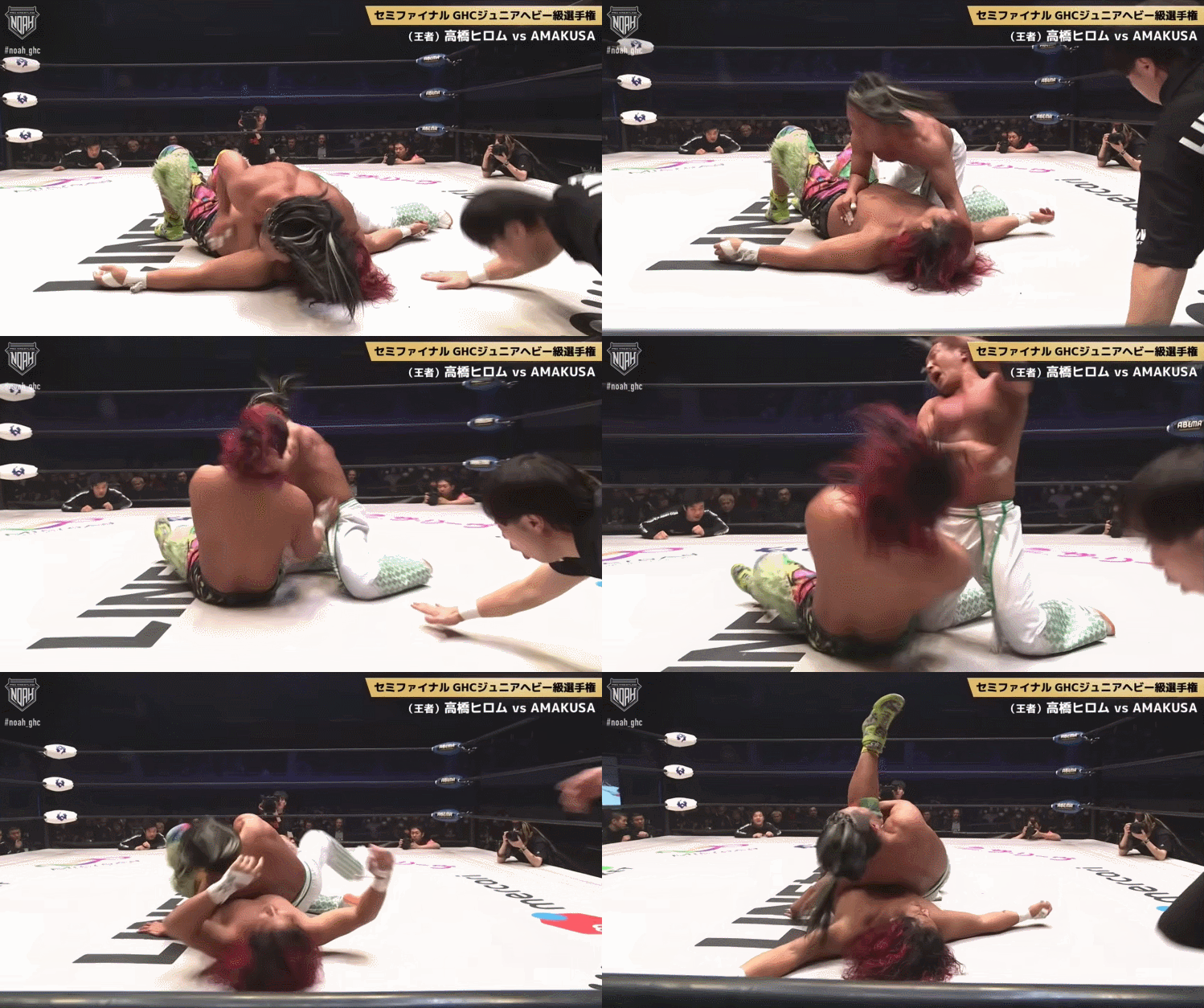
Though it wasn’t enough to win him the match, it certainly won some esteem from me, just like this variant of the crucifix bomb, which seemed a bit on the nose for AMAKUSA given the persona’s back story.
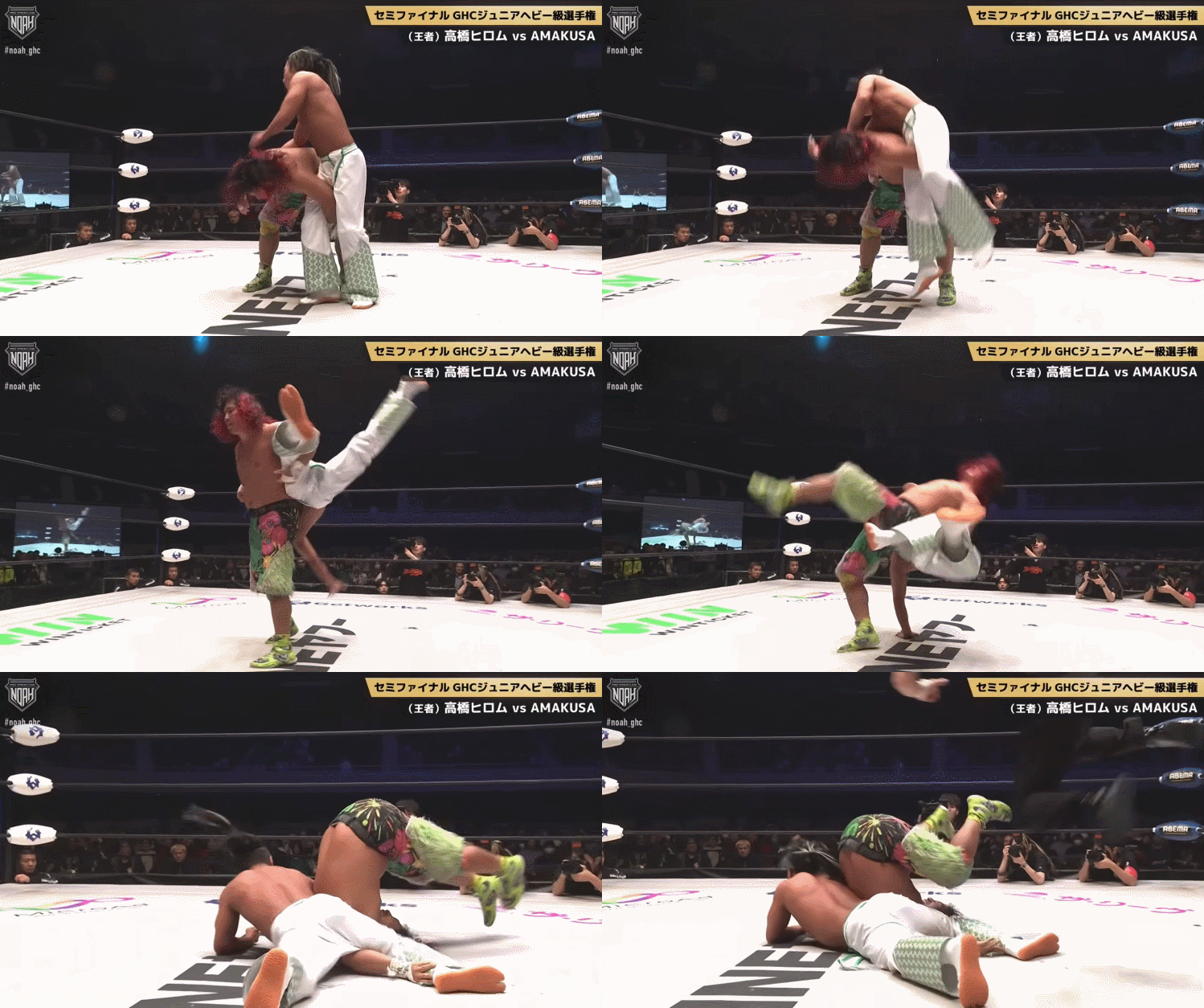
Nevertheless, AMAKUSA continued to pull cool toys from his war crate, like this Spiral Tap.
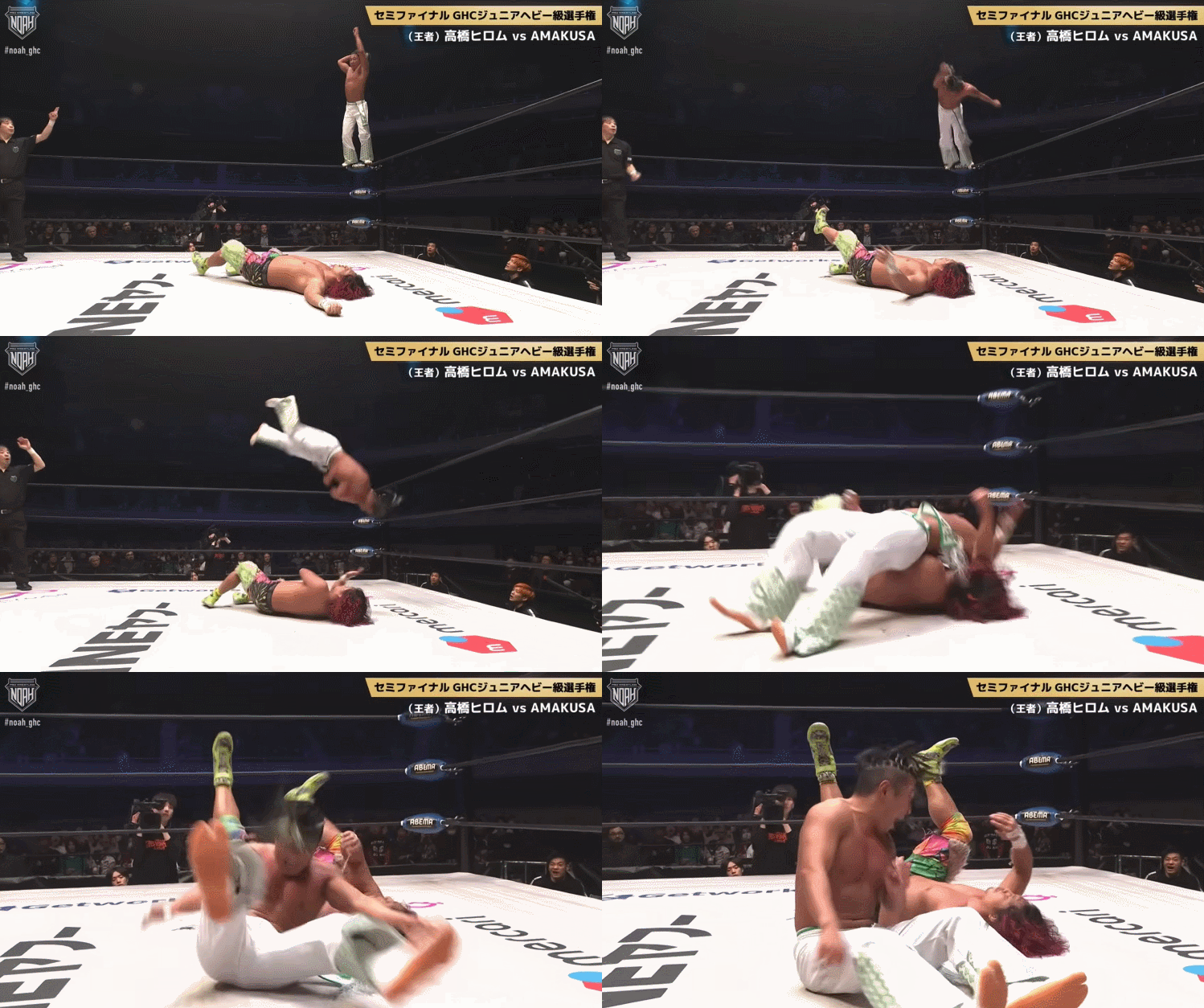
From there, Takahashi made his last case to remain champion with a Super Time Bomb, a lariat, and another Time Bomb. Stymied by AMAKUSA’s (supernatural?) resilience, Takahashi tried for a second Super Time Bomb, but AMAKUSA recovered his wits and outmaneuvered Takahashi to hit a Super Shiranui. A running double knee strike and a second Spiral Tap helped to claim the title for AMAKUSA.
Takahashi worked hard to provide the canvas for AMAKUSA to show off his very impressive offense. AMAKUSA came off as emotionally neutral; even when he tried to portray passion, he came off as cool. The match was packed with action, and the wrestlers hustled around the ring, leaving very little dead time. I just had a hard time connecting to it emotionally, possibly because AMAKUSA was a dead ringer for Japanese video games producer Tak Fuji by the end of the match.
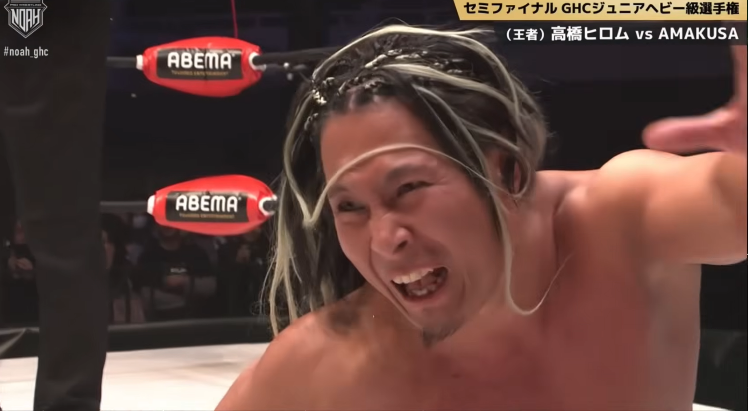
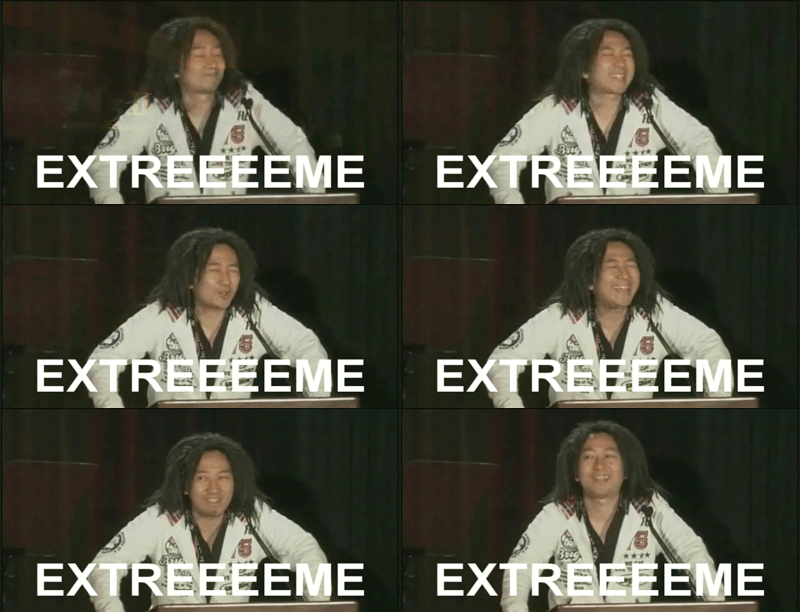
You can watch the show on Wrestle Universe and the match with English commentary on NOAH’s YouTube page.
AMAKUSA (c) vs. Daiki Odashima
NOAH Legacy Rise 2026
January 11, 2026
Cagematch ranking as of 2/1/26: 25
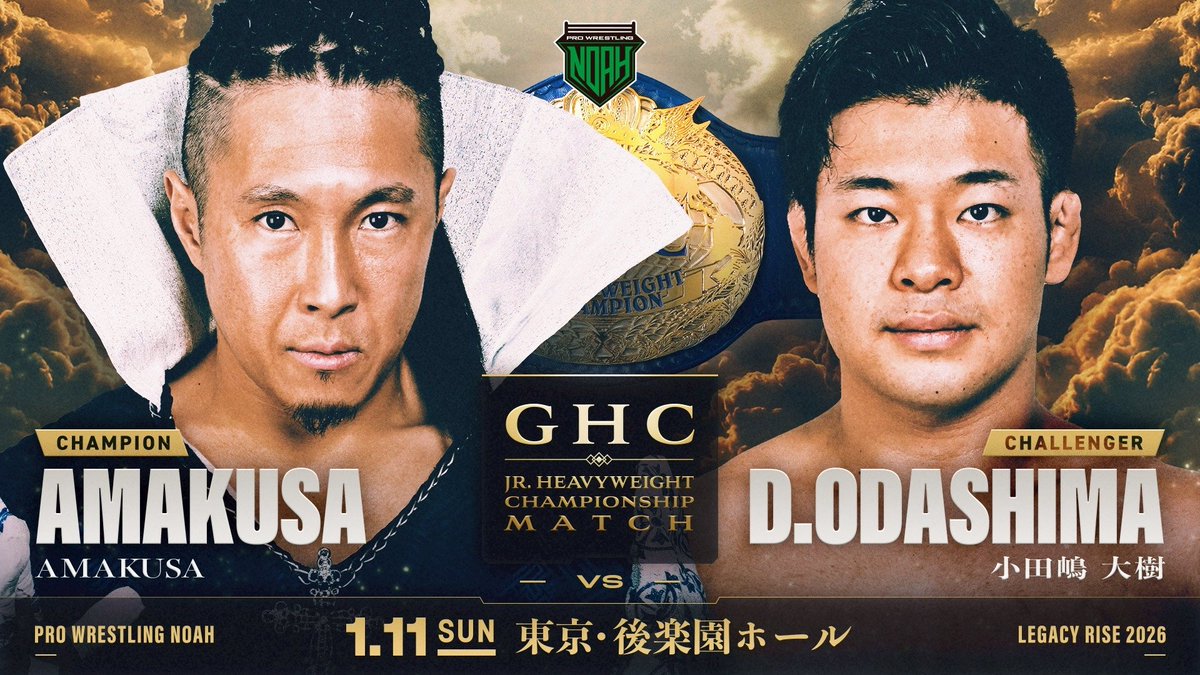
Since 2020, 30+ years old set dominated NOAH’s junior heavyweight division. This marked a change from who the earliest GHC Junior Heavyweight Champions were.
- The inaugural GHC Junior Heavyweight Champion, Yoshinobu Kanemaru, was 25 when he won the title.
- The next champion, Tatsuhito Takaiwa, was 29 when he beat Kanemaru.
- Takaiwa’s successor, Naomichi Marufuji, was 22 at his ascension.
- KENTA was 24 when he won the title for the first time.
- Makoto Hashi was 24 when he became champion.
- Mushiking Terry (aka Kotaro Suzuki) was 28.
- Bryan Danielson was 27.
The champions’ age has shifted older since the company was bought by CyberAgent in 2020:
| Wrestler | Birthday | Date of Title Win | Age of Title Win |
| Yoshinari Ogawa | November 2, 1966 | January 4, 2020 | 53y 2m |
| Kotaro Suzuki | June 18, 1978 | April 19, 2020 | 41y 10m |
| Daisuke Harada | November 13, 1986 | November 8, 2020 | 33y 11m |
| Seiki Yoshioka | January 5, 1988 | February 12, 2021 | 33y 1m |
| Atsushi Kotoge | October 18, 1985 | March 14, 2021 | 35y 4m |
| HAYATA | August 4, 1987 | June 27, 2021 | 33y 10m |
| Daisuke Harada | November 13, 1986 | January 10, 2022 | 35y 1m |
| Eita | November 27, 1991 | March 13, 2022 | 30y 3m |
| HAYATA | August 4, 1987 | April 29, 2022 | 34y 8m |
| Ninja Mack | December 29, 1989 | October 30, 2022 | 32y 10m |
| Dante Leon | August 12, 1994 | November 10, 2022 | 28y 2m |
| AMAKUSA | November 25, 1985 | December 23, 2022 | 37y 0m |
| HAYATA | August 4, 1987 | April 16, 2023 | 35y 8m |
| Daga | June 19, 1988 | November 5, 2023 | 35y 4m |
| AMAKUSA | November 25, 1985 | July 13, 2024 | 38y 7m |
| Daga | June 19, 1988 | September 1, 2024 | 36y 2m |
| Eita | November 27, 1991 | January 1, 2025 | 33y 1m |
| YO-HEY | February 6, 1988 | May 3, 2025 | 37y 2m |
| Hiromu Takahashi | December 4, 1989 | September 8, 2025 | 35y 9m |
| AMAKUSA | November 25, 1985 | January 1, 2026 | 40y 1m |
NOAH has not crowned a junior heavyweight champion who was younger than 30 years old at the time of their win since Dante Leon in 2022. The average age of the wrestler when they became the GHC Junior Heavyweight Champion since 2020 is around 35.65 years old. AMAKUSA’s victory actually raised that average from 35.42. So, it was exciting to see the 24-years-old Daiki Odashima challenge AMAKUSA for the title. If Odashima had won, he would have lowered the average age to 35.09.
When we last encountered Odashima, I had mentioned that I’d watch an Odashima match before I’d watch a Murashima match. Since Odashima won the GHC Junior Heavyweight Tag Team title with Daga, they’ve picked up a name (Los Intocables) and defended the title against Team 2000X (Jun Masaoka & Tadsuke), All Rebellion (Alejandro & Kai Fujimara) and Eita & Shuji Kondo. In NOAH’s Jr. Grand Prix in 2025, Odashima lost in the first round to the eventual tournament winner, Hiromu Takahashi. NOAH certainly hasn’t given Odashima the momentum of a runaway freight train yet. One can only hope that they don’t miss his moment of peak potential. Still, he was AMAKUSA’s first challenger for his newly won GHC Junior Heavyweight title. So, I was gladdened that NOAH at least tested the idea of elevating Odashima.
Odashima got a leather jacket and a t-shirt since we last saw him, and he’s added some gold accents to his red tights and a gold wrist band. He also developed a little more attitude, slapping AMAKUSA across the cheek as he broke his collar-and-elbow hold against the ropes. Most notably, he’s incorporated a few more flips. Luckily, he still had a fairly sensible haircut.
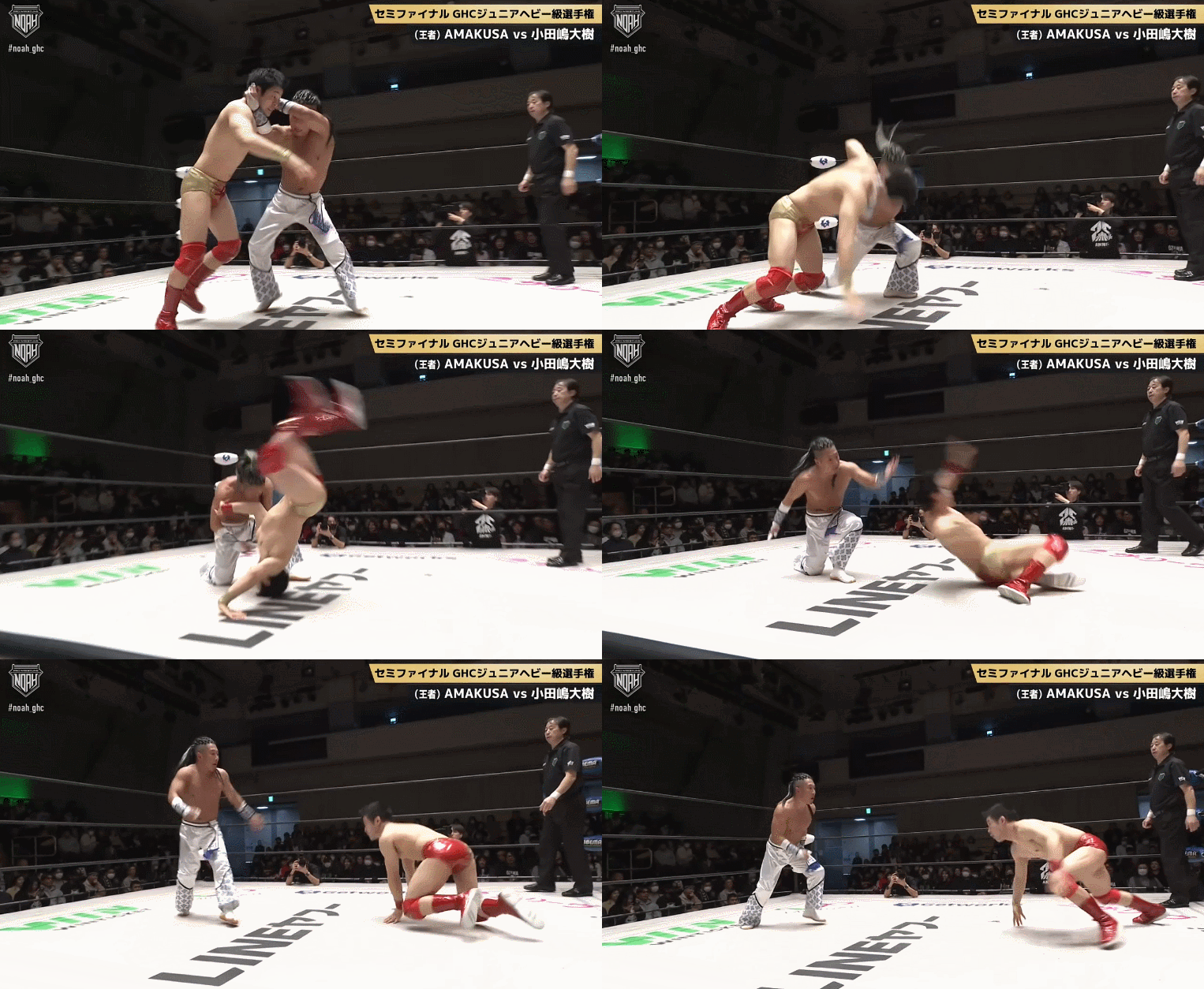
I was ambivalent about Odashima’s new flippiness because I found the earnestness and simplicity of his Young Lion approach refreshing. Becoming a more flippy junior heavyweight wrestler would move Odashima closer to the mean and remove some of what made him stand out against the likes of Alpha Wolf, Dragon Bane, Eita, Takahashi, and AMAKUSA.
His early burst caught AMAKUSA off guard, but AMAKUSA recovered and tripped Odashima on the apron, which escalated to a powerslam from the apron to the floor and a groin-first walk over Odashima that even Allen Iverson would describe as disrespectful.
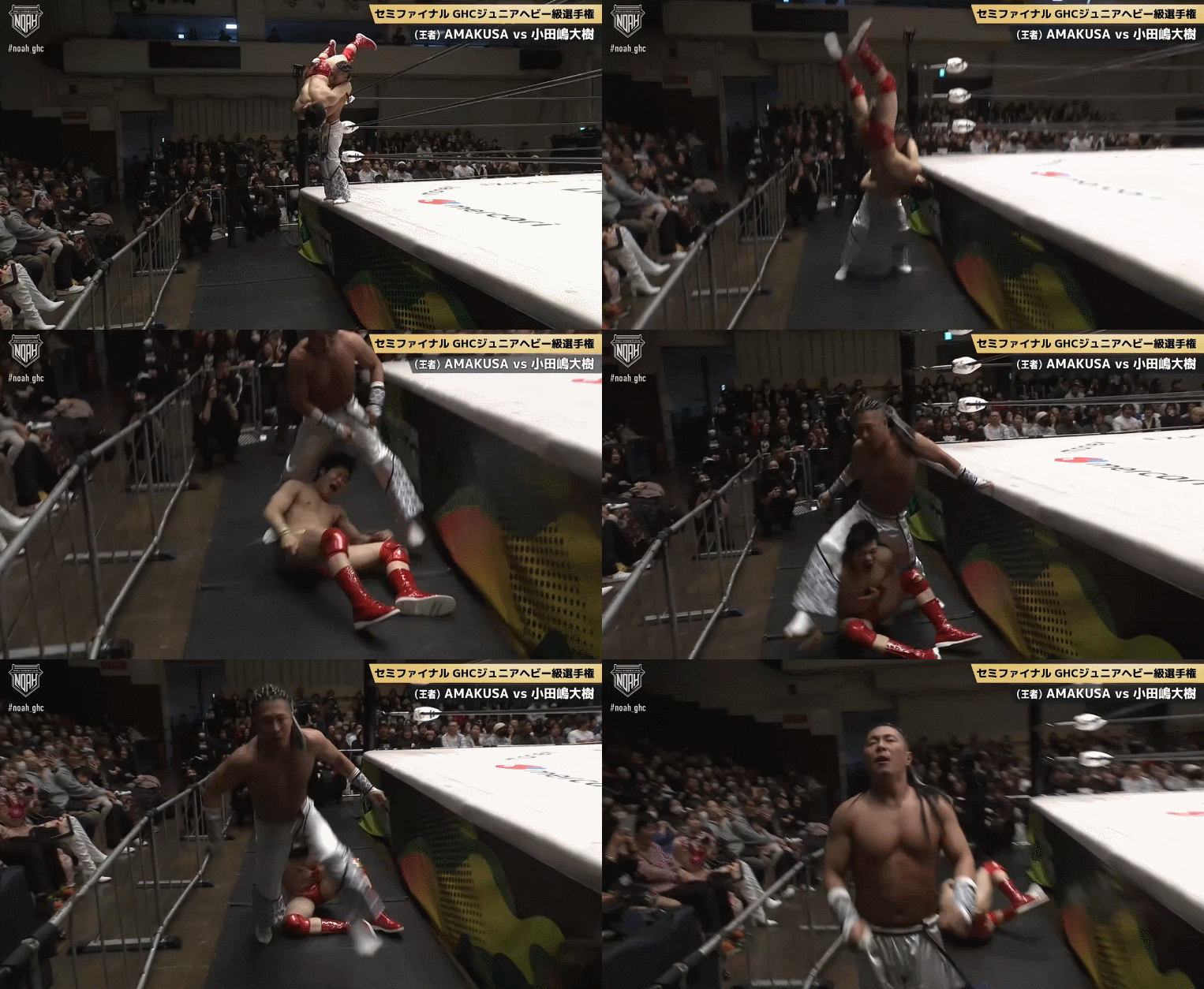
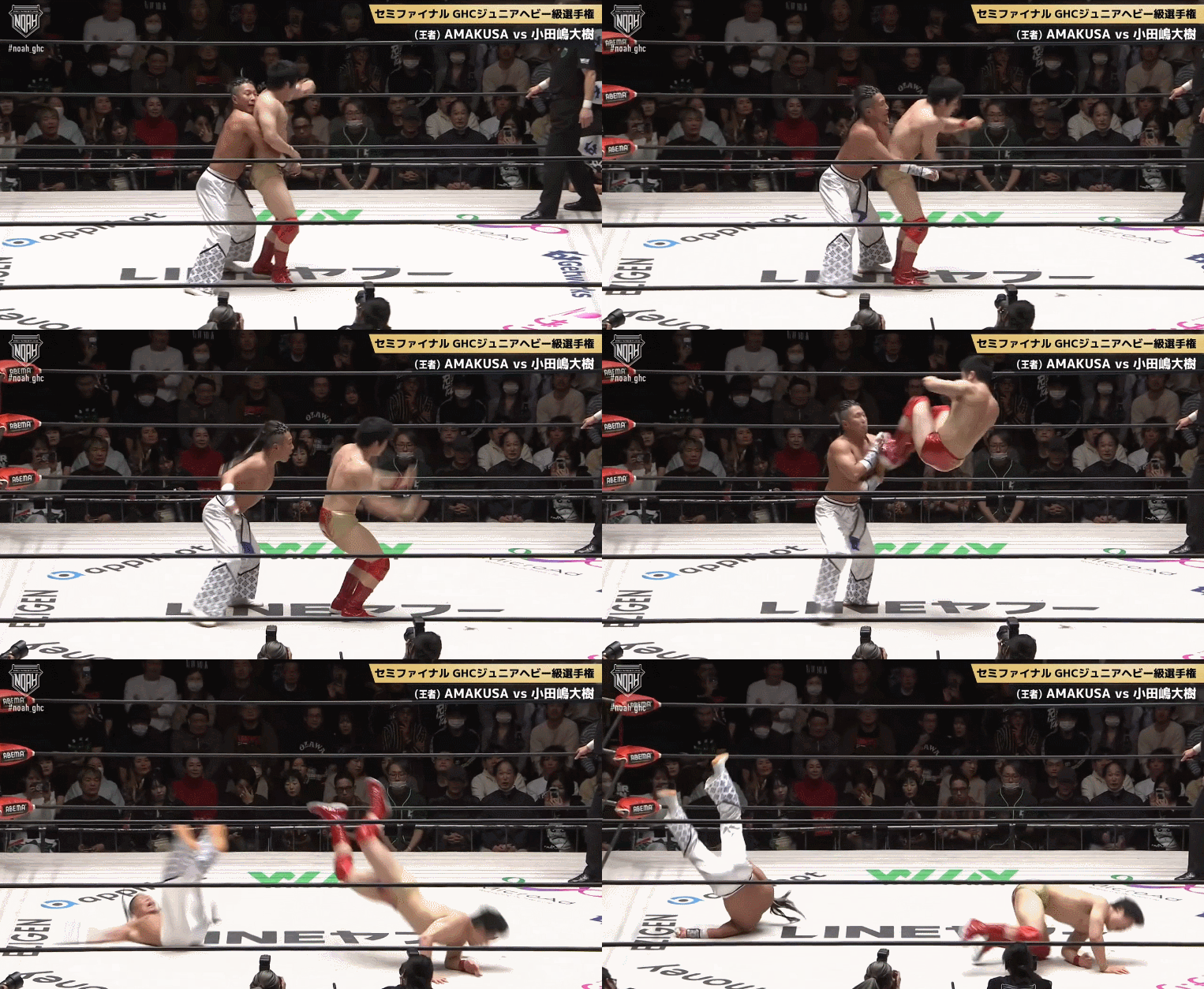
AMAKUSA carried that sense of disrespect over when he grudgingly brought Odashima back inside the ring because Odashima’s back was hurt too badly by that powerslam to get up himself. AMAKUSA then cajoled Odashima to fight him after humbling him in the ring some more with a Camel Clutch. A chop battle revitalized Odashima, and yeah, that’s the kind of fiery, macho nonsense I enjoy. Odashima started his offense with his inside out dropkick and then pulled off a wild flipping backslide pin.
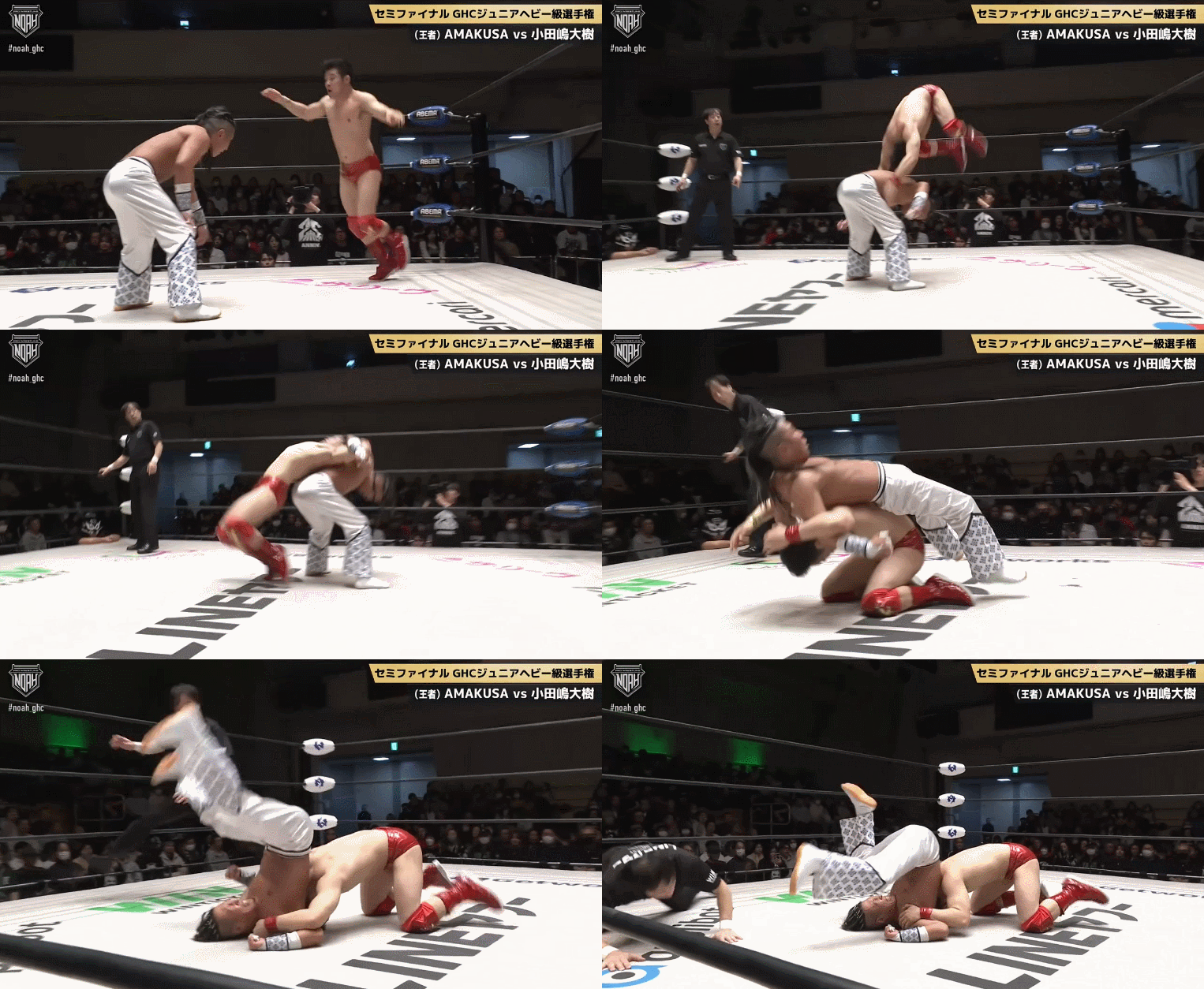
AMAKUSA sent Odashima back on the defense with a dodge that made Odashima fall right on his ass on the apron and a knee drop from the top, but Odashima recovered with this neat little cross-legged stack pin.
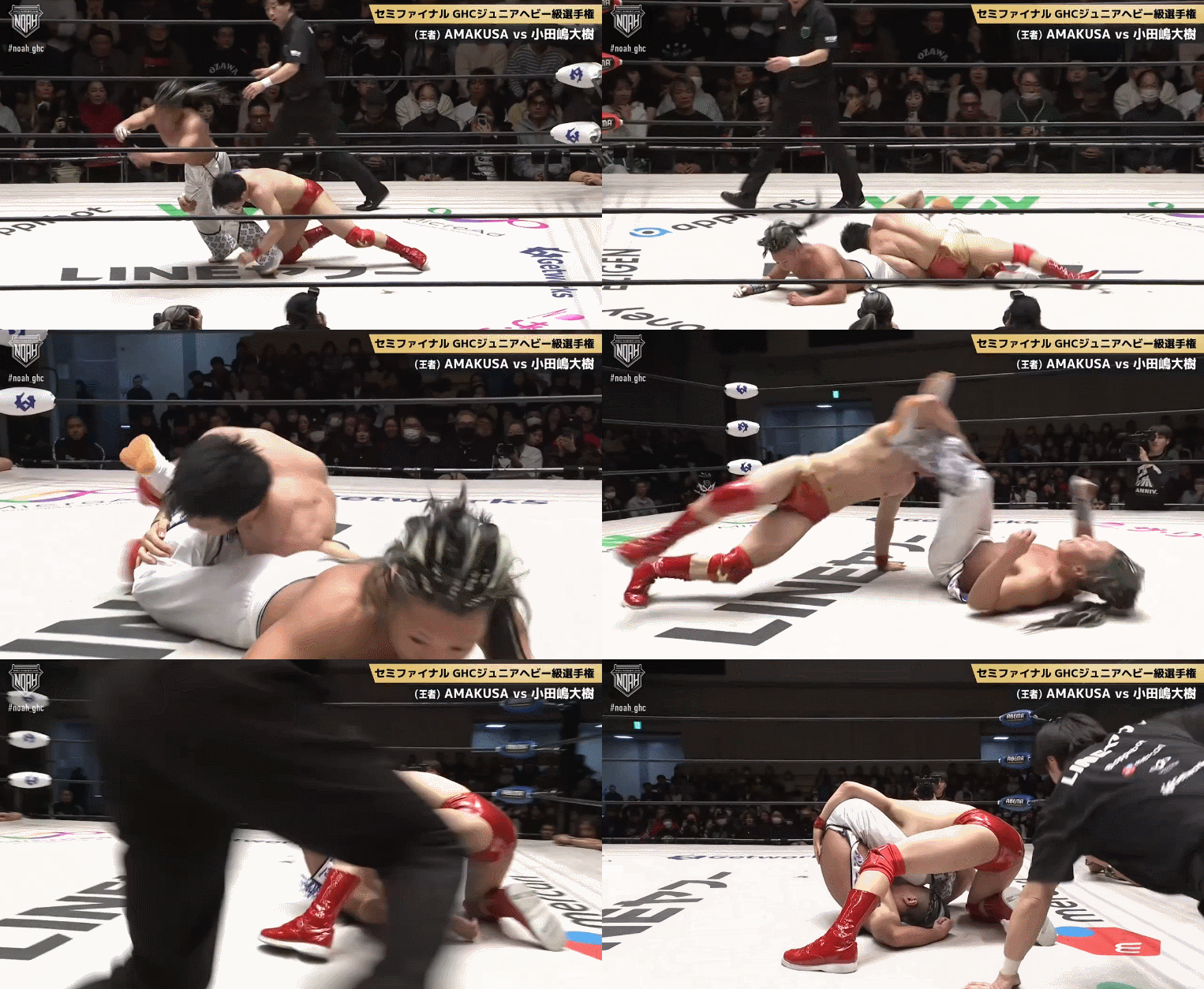
As the champion, AMAKUSA didn’t have to open the reserves to impress the crowd against the plucky young challenger the way that he had to when he challenged Takahashi. Nevertheless, he did give Odashima (and us) a smart combo of kicks at three levels: one at the shin to bring Odashima to his knees, one to the top of his head to stun him, and one to his face to knock him down.
Odashimsa persevered and won a battle on the top turnbuckle to drop AMAKUSA with a super fisherman’s suplex, which he turned into a pin, which he then turned into a submission attempt. AMAKUSA tried to set Odashima up on the ropes for something, but Odashima just used that position to hit a Canadian Destroyer. Odashima then followed up with a deadlift German suplex that looked effortless and a stalling German suplex that looked just as easy. Finally, Odashima seemed to steal a page from Kento Miyahara’s book and tried to lock AMAKUSA in the shutdown German suplex. However, AMAKUSA escaped, slammed Odashima with the crucifix bomb and a couple of overhead slams, and hit the Spiral Tap to repel this challenge from Odashima.
By the end, Odashima allayed my concerns that he would become less unique by becoming a more flippy junior heavyweight wrestler. He still had a compelling fire that made connecting to him very easy. Combining a flip with a backslide pin showed ingenuity, and it was clear that Odashima also understood timing and passion based on his attempt to lock AMAKUSA in the shutdown German suplex. This was a great first match in what will hopefully become a series as Odashima moves closer to becoming a key singles champion in NOAH. On the other side, AMAKUSA looked great as champion and helped Odashima accentuate his passion and toughness.
You can watch this match and the show on Wrestle Universe. I’d recommend watching both matches to see AMAKUSA as both the flashy challenger and as the steady champion; they’re both very good junior heavyweight matches.
Junta Miyawaki vs. Shinya Aoki
DDT Mission in Battle ~ Shinshun Kenran ~
January 25, 2026
Cagematch ranking as of 2/1/26: 65
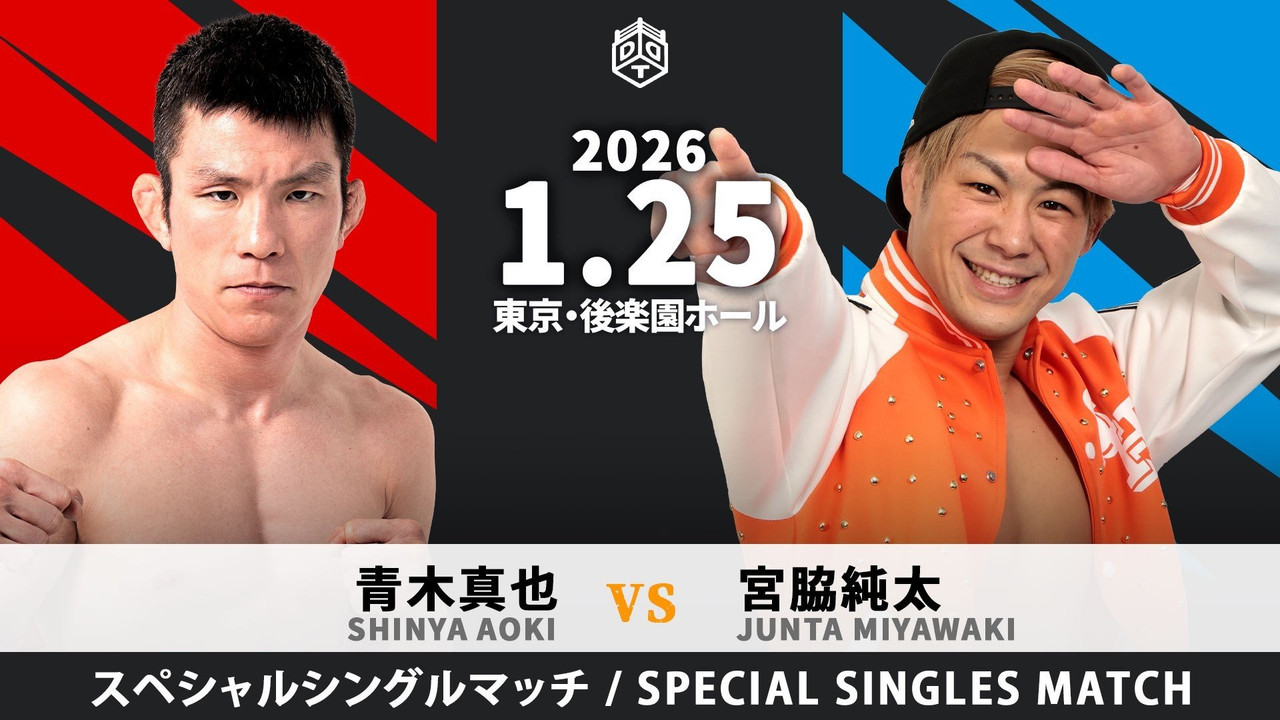
I had lamented that DDT seemed under-appreciated when I looked at the highlights of 2025. I liked Shinya Aoki’s match against Charlie Dempsey from 2025’s WrestleMania Week well enough. However, I was never able to fit Aoki’s match against Timothy Thatcher into my schedule even though it seemed like a treat for the grapplefucker in me. Aoki has a 49-12-0 MMA record according to Tapology and Sherdog, which certainly made him just a smidge more successful than, say, Takahiro Tababa or Masanori Kabu Watanabe. As a wrestler, Aoki has been a DDT roster member essentially since he started there in 2018.
Like Odashima, Junta Miyawaki is a product of the NOAH dojo. He became a regular member of the DDT roster this year; hopefully, the change will do him good. He never seemed to rise beyond occasional challenges for the GHC junior heavyweight title and holding the GHC junior heavyweight tag team title once with AMAKUSA in 2025.
The 28-year-old Miyawaki challenged the 42-year-old Aoki after they faced each other in a trios match in November. Miyawaki’s orange hair and backward baseball cap made him look strangely immature. I got what he’s going for, since his nickname is “Sunshine Hero,” and I know that DDT has room for a slightly goofier tone than other companies. Nonetheless, Miyawaki’s presentation made it a little harder to take him seriously. It’s not quite the impairment that walking around in a coat covered in Ziploc logos was, but it’s not as far as Miyawaki would probably hope. (I’m just saying that I shouldn’t look at a wrestler and think of Good Humor Creamsicles and SunnyD.)
Now, Shinya Aoki, that’s a haircut you can set your watch to. (Also, wow, that’s a lot of brands on DDT’s mat. Good for them.)
The match started respectfully. Aoki was a blur of motion, and Miyawaki frankly seemed outmatched by Aoki at the start. Even when Miyawaki was able to turn Aoki over for some pin attempts in the middle of the match, it seemed like Miyawaki was only able to do that because Aoki allowed him to do so. Therefore, it seemed remarkable when Miyawaki was able to catch Aoki’s arm and extend it in an armbreaker. Even Aoki seemed impressed.
After getting stretched some more on the mat, Miyawaki lured Aoki outside so he could dive on to him, which only made Miyawaki seem even more pitiable. Though Miyawaki and Aoki didn’t wrestle under UWF Rules, it seemed like they had a tacit agreement to make it a grappling bout. So, changing the match’s flavor after getting sonned for the past 11 minutes seemed like an admission by the “Sunshine Hero” that he wasn’t good enough to fight Aoki on Aoki’s terms and had to change the match to try to salvage his chances.
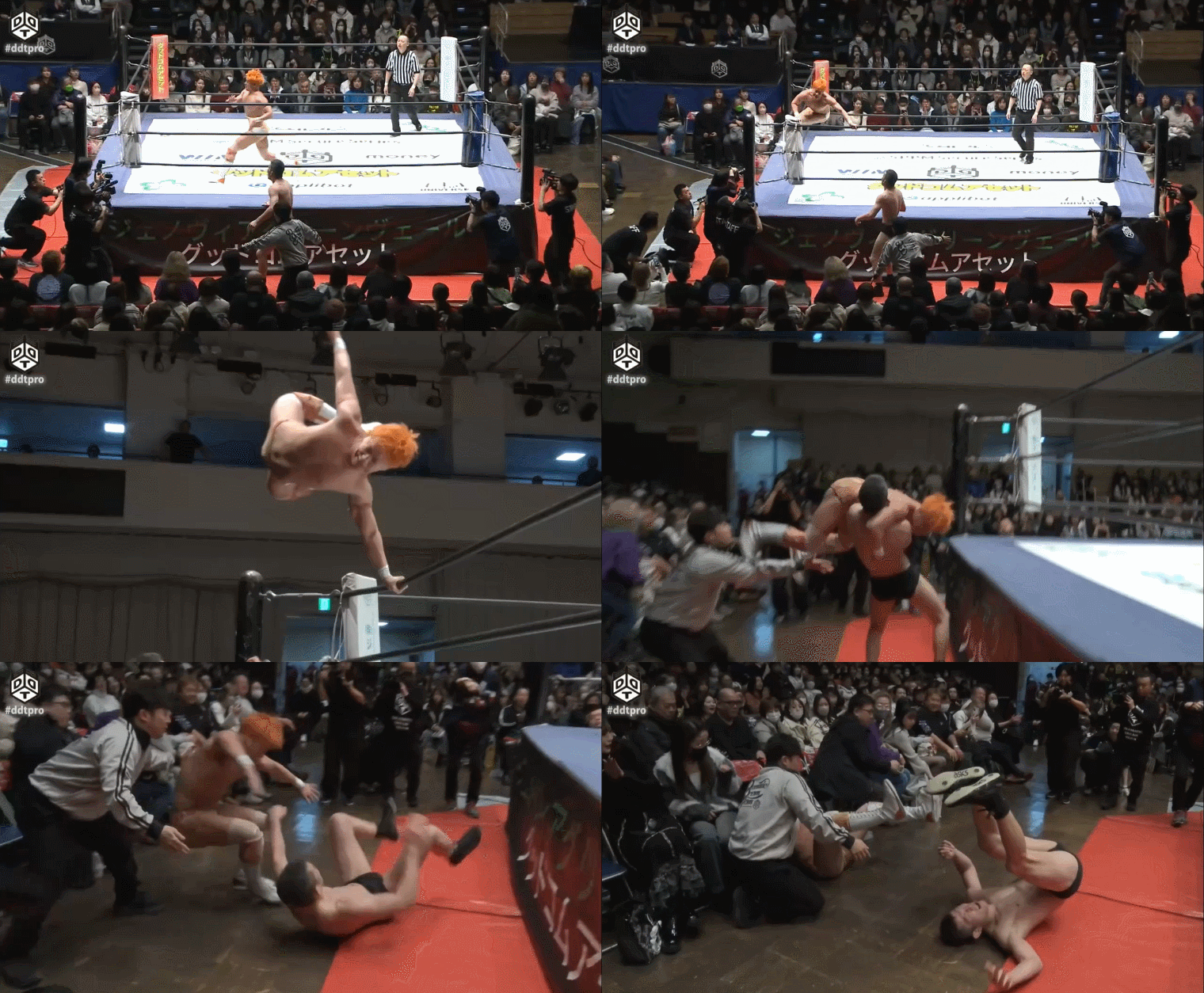
With all that said, I chuckled when Aoki immediately caught Miyawaki in a rear-naked choke after kicking out of Miyakwaki’s pin. Miyawaki and Aoki then traded some okay strikes and quick pinfall attempts until they reached the match’s time limit.
The match did not succeed in its goal since I now have no interest in seeing Miyawaki in another match. I still have great interest in checking Aoki’s other matches. Speaking on behalf of most fans, we understand that every match is a cooperative exercise between wrestlers. (That is unless it’s “Hacksaw” Jim Duggan vs. Matt Borne or some of Low-Ki’s more notorious matches.) The trick is to hide it, to give it the verisimilitude that fools you into investing into what was happening. Everything Miyawaki did in the match seemed like it was done with Aoki’s cooperation. The apparent skill gap between Miyawaki and Aoki made Miyawaki seem feeble and unappealing. You can watch this match and the show on Wrestle Universe.
Let’s update our list of wrestlers under the age of 30.
1. Sareee
2. Daiki Odashima
3. MIRAI
4. Jet Wei
5. Miku Kanae
6. Chanyota
7. Arisu Endo
8. Kodai Nozaki
9. Kohei Kinoshita
10. Kuro
11. NORI
12. Junta Miyawaki
Next time: “Let’s go, girls”
-Shania Twain, “Man! I Feel Like a Woman.”
We’ve seen what the lads have been up to; let’s go check in on some of our favorite women wrestlers.


