


With Trapped in the Cagematch, Kim Wong combs through the highest-rated matches according to Cagematch’s voters in preparation for the annual FSM 50 and the year-end Match of the Year extravaganza.
Miu Watanabe vs. Shoko Nakajima
TJPW Tokyo Princess Cup 2025 Night 4
August 17, 2025
Cagematch ranking as of 12/18/25: 59
In the summer of 2002, the phrase, “Welcome to the O.C., bitch” was introduced to the American vernacular. My friend and I scoffed at this ridiculous turn of phrase, the absurd character from which the phrase emerged (the white, blonde, beefy, and blue-eyed Luke Ward, played by Chris Carmack), and the very name of the show. “The O.C.? What the hell is that supposed to be?” we asked each other right before we tuned in because there was nothing else on TV on August 5, 2003. (It was a Tuesday in the summer. Of course there was nothing else available.) I don’t think my friend drank as deeply from the show’s elixir of Californian charm, but I had discovered a newfound favorite. It became appointment viewing, and I wore out my DVD set of the show’s first season. I even watched the behind the scenes special, aptly called The O.C.: Obsess Completely, that aired between the first and second seasons. (The less said about the second and third seasons, the better.) All this is to say that I tend to dive deeply into new favorites because I want to get the endorphin hit again and again.
After I first saw Bret Hart wrestle on a syndicated WWF show, I sneaked every episode of WWF Superstars of Wrestling, Wrestling Challenge, and All American Wrestling that I could past my parents so I could see him again. (They finally put their foot down when they saw Ultimate Warrior spit up black goo because he was cursed by Papa Shango.) Rey Mysterio Jr. got me to watch as much WCW Monday Nitro, Saturday Night, and Thunder as I could, which in turn exposed me to Juventud Guerrera, Psicosis, Dean Malenko, and of course Super Botcho Calo. Discovering Bryan Danielson and Low Ki made the early 2000s seem ripe with possibility, and finding El Generico, Sara Del Rey, and Necro Butcher in the mid 2000s felt like seeing potential blossom into reality. I started attending shows by this point, so seeing Danielson, Generico, and Sara Del Rey in person cemented them in memory. Reliable Internet access and quasi-legal (at best) file sharing sent my attention abroad, where it found Daisuke Sekimoto and Yuji Okabayashi in the early 2010s and Meiko Satomura, Yuji Hino, and Kento Miyahara in the mid 2010s. It takes someone like Miyahara to inspire the passion to watch every match in the 2017 and 2018 Champion Carnivals and a stubborn completionist streak to make it happen. Those same forces also helped me to look backward at Nobuhiko Takada and Bob Backlund. In the late 2010s, Evolve made regular trips to La Boom, which I still think is one of the best indie wrestling venues I’ve ever attended, and I found Darby Allin and Chris Hero. (I preferred Hero in Chikara to Hero in ROH, and I preferred “The Knockout Kid” version of Hero who feuded with Timothy Thatcher, Zack Sabre Jr., and Trevor Lee in EVOLVE most of all.) Recently, I followed Miu Watanabe’s rise (and fall) in TJPW and Sareee’s redemption tour around Japan as closely as I could, and they’ve joined the roster of wrestlers whom I’ll watch and recommend without reservations.
Previously, I had mentioned that Watanabe’s personality and charisma kept me interested in a match that did everything that it could to turn me off with shenanigans and that the match’s standouts were Watanabe and Shoko Nakajima. Nakajima was one of Watanabe’s best opponents during Watanabe’s reign as the Princess of Princess champion in 2024, and I had noted from their match in 2024 I wanted to see how Watanabe could improve how she built to a match’s ending. Watanabe then demonstrated improvement in how she escalated a match’s drama by her defense against Ryo Mizunami. When Watanabe lost the Princess of Princess title to Mizuki, I thought Mizuki’s victory was unconvincing, even after taking into account how unsolvable Mizuki’s Whirling Candy is supposed to be. TJPW then scheduled Mizuki for fewer title defenses in her 259-day reign (four total defenses) than they had for Watanabe’s 279-day reign (six total defenses). Watanabe’s loss drove my attention away from TJPW to other parts of the wrestling world, so I was glad to see that Watanabe seemed to be coming back for her crown in TJPW’s Tokyo Princess Cup 2025.
In the first two rounds, Watanabe defeated Raku and Haru Kazashiro while Nakajima defeated Watanabe’s regular tag team partner in Hakuchumu, Rika Tatsumi, and Mizuki, the Princess of Princess Champion at the time. Nakajima had held the Princess of Princess title twice before, while Watanabe was looking to reclaim the title. Nakajima was one of Watanabe’s toughest and best defenses during her first reign, and expectations were especially high after Nakajima and Watanabe had one of the highlight matches for a company other than AEW during Y’All In weekend.
Watanabe started the match with a little touch that I really appreciated. Her entrance felt a little lower energy, a little more subdued than usual. Before she entered the ring, she took a small breath as if to steady herself for the serious task of beating Nakajima, a major obstacle to regaining her title. Together, these touches showed her investment in the match to come and invited us to be invested in Watanabe’s success in the match.

Meanwhile, Nakajima proudly sported the Princess Tag Team Championship and the MLW Women’s World Featherweight Championship in her entrance because she is a proud Renegade. (And credit goes to MLW for producing multiple t-shirts for Nakajima’s fans in the United States to purchase.)
Nakajima and Watanabe started with their usual jockeying for position on the mat that led to the always impressive monkey flip reversal. Nakajima and Watanabe were even on the mat, though Watanabe showed a clear power advantage.

The match sped up when Nakajima and Watanabe showed off their agility and speed, and Watanabe reinforced that her power advantage was a problem that Nakajima would need to solve to advance to the tournament finals. Luckily, Nakajima was able to create some separation from Watanabe with a hurricanrana and used that space to build some speed for her tope suicida. Watanabe fell back on her power to slow Nakajima down, and Nakajima again showed how she could use space to her advantage by using the Tiger Feint Kick to attack Watanabe’s knee.
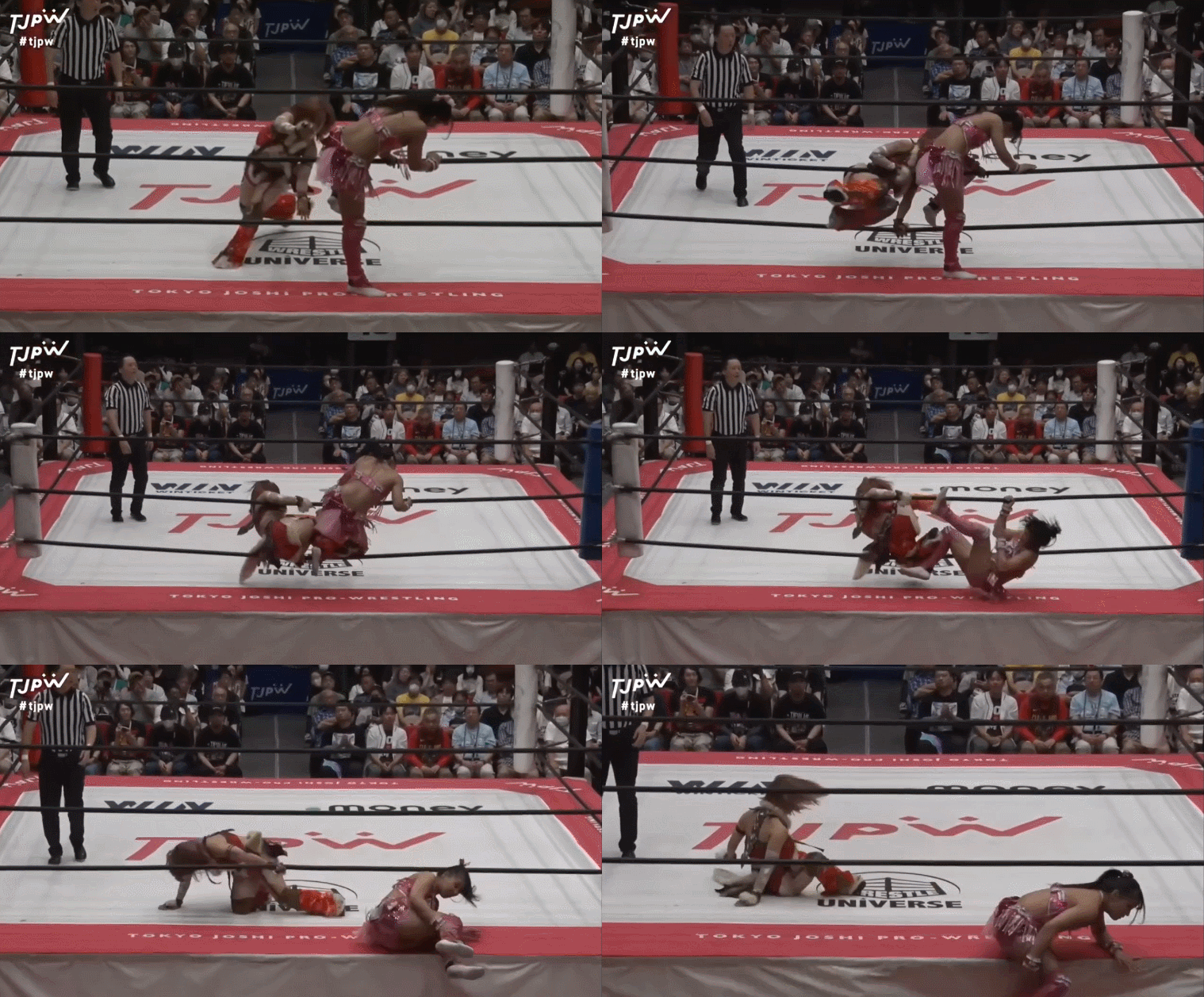
Nakajima’s attack on Watanabe’s leg then created the story for the rest of the match. Watanabe would try to use her leg as normal in her attacks, but she would feel the pain every time she did, from her backbreaker to Nakajima to her little stumble as she pivoted while she and Nakajima fought over who would be sent running to the ropes. And Watanabe committed to telling this story about her knee, as we saw when her leg buckled under the strain of lifting Nakajima over her head. Nor could she generate enough power to slam Watanabe out of the cravate in which Nakajima had trapped Watanabe.
Watanabe then had a choice: change her game up or grit her teeth through the pain. At first, she tried to persevere through the knee pain and use her usual offense, like this backbreaker:

Either way, she had to finish the match fast before she incurred too much additional damage to her knee since this was only a semi-final match in the Princess Cup. By this point, Watanabe and Nakajima knew that they would have to face former tag team champion Arisu Endo in the final. So, though Watanabe had tried to power through the pain, it wasn’t working. She couldn’t even turn Nakajima over for a Boston crab.
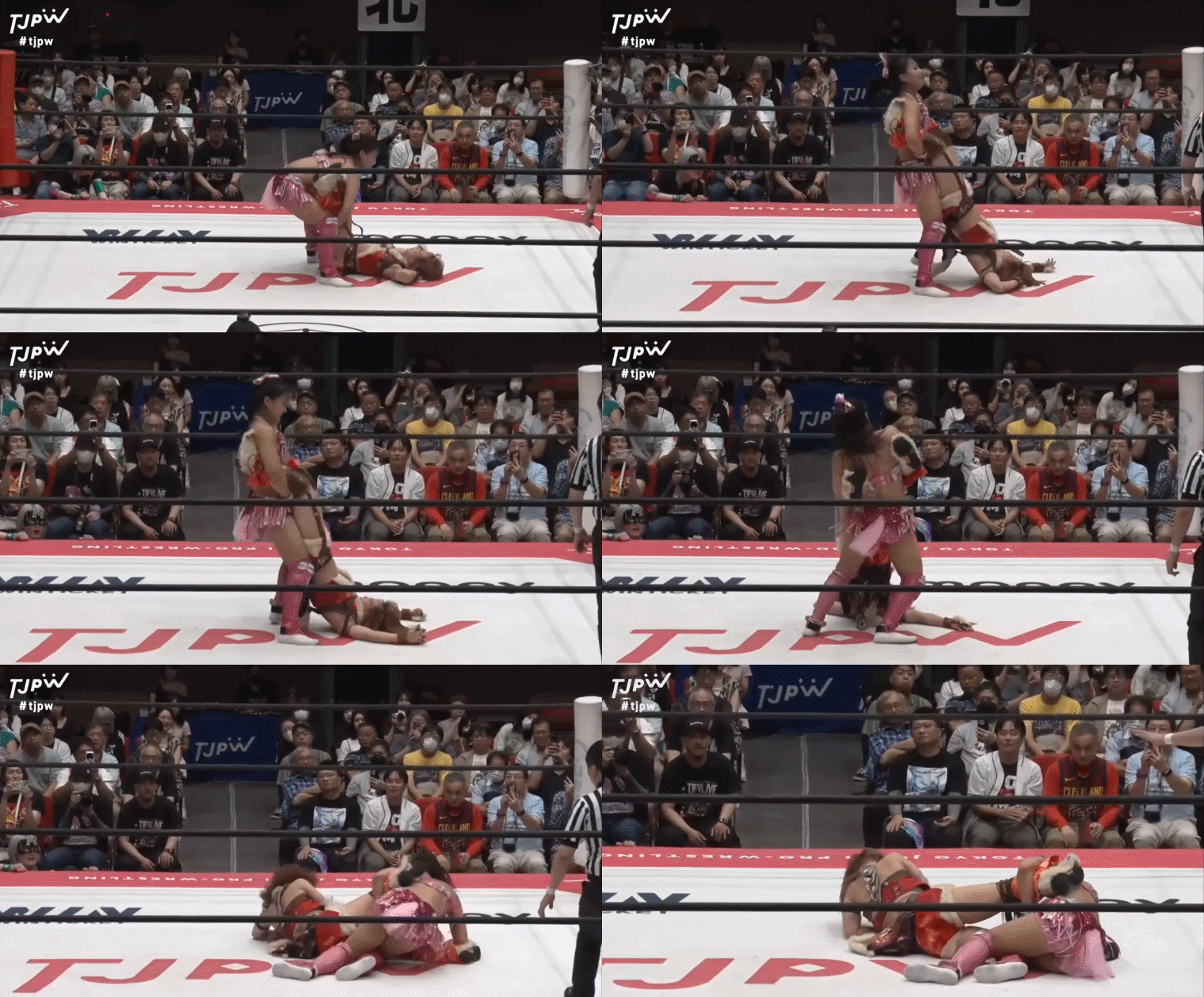
I’m truly impressed by Watanabe’s commitment to showing how injured her leg is, which made the moments when she was able to power through her knee injury, like her giant swing on Nakajima, felt more impactful. (And yes, Watanabe continued to sell the injury by clutching at her knee after flinging Nakajima away at the end of the giant swing.)
I was also glad to see Nakajima start to target Watanabe’s injured leg with a wrenching Dragon screw, but Nakajima opted to follow up with knockout blows like a DDT and a senton from the top rope. Watanabe blocked Nakajima’s senton with raised knees, but that obviously just hurt her leg even more.
From there, both women retreated from the ring to collect themselves and refocus from their pain (in the knee for Watanabe and in the back for Nakajima). They re-entered and kicked the match back into high gear with some crisp, quick grappling that Watanabe punctuated with a very snappy snap powerslam.
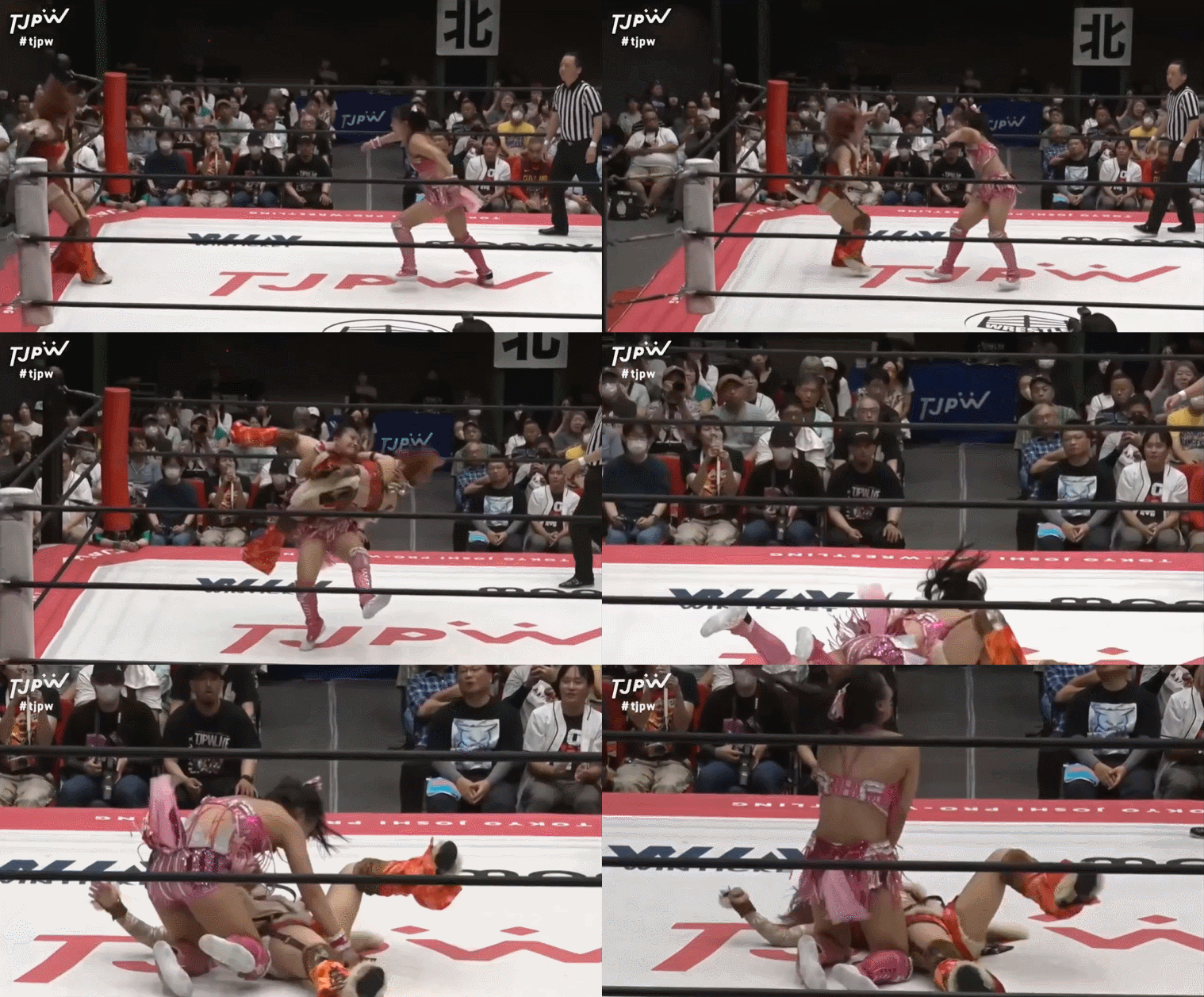
Things got a little awkward and melodramatic after Watanabe crumpled while trying to boost Nakajima up for the Tear Drop. Nakajima just stood there while Watanabe scooted away and even let her get to her feet before scooping her up for a Northern Lights suplex. We got another awkward moment when Nakajima tried to climb to the top turnbuckle. It looked at first like she stopped for no particularly good reason, but Watanabe may have grabbed her to stop her from finishing her climb. Because the entire match was shown from just the hard camera, we didn’t have another angle to show what Watanabe might have been doing. In the end, Watanabe was able to stall Nakajima for long enough to climb the ropes herself and win a struggle for positioning. She jumped from the middle turnbuckle to slam Nakajima to the mat and landed on her hurt knee. She overcame the pain long enough to tag Nakajima with her Laser Beam chop and deposit Nakajima with her Tear Drop to win the match and advance.
This was an exercise in wrestling storytelling and a demonstration of a focused commitment to selling an injured body part. The main takeaway was in how Watanabe persisted through her pain; I hadn’t seen Watanabe show that skill before. Nakajima, as an elder stateswoman, fan favorite, and an honorable MLW Women’s World Featherweight Champion, was sporting and allowed Watanabe to compete without seeming like a complete putz. Some of that came off a little awkwardly, but it made sense for Nakajima’s character. Wrestling fans who criticize modern wrestling for straying from the principles of convincing viewers to believe in their fake injuries should watch this match.
Not long after this match, Nakajima and Hyper Misao would lose their Princess Tag Team Championship to Ober Eats (Wakana Uehara and Yuki Kamifuku). Luckily for Nakajima, her reign as the MLW Women’s World Featherweight Champion, like MLW, hasn’t stopped yet. In fact, she actually defended the title on TJPW shows in November and December 2025.
The match and the show can be seen on Wrestle Universe.
Next time: Now that Miu Watanabe’s defeated Arisu Endo to win the 2025 Tokyo Princess Cup, it’s time for her to take back what is hers: the Princess of Princess title that Mizuki beat Watanabe for in January 2025. Will Watanabe strike out or hit a home run?


