


With Trapped in the Cagematch, Kim Wong combs through the highest-rated matches according to Cagematch’s voters in preparation for the annual FSM 50 and the year-end Match of the Year extravaganza.
Aja Kong & Chihiro Hashimoto vs. Manami & Meiko Satomura
Sendai Girls Meiko Satomura THE FINAL
April 29, 2025
Cagematch ranking as of 12/18/25: 69
Does any wrestler ever truly retire? I know that “wrestler retires” became a punchline thanks to Terry Funk’s many retirements and returns from retirements. When you’ve been fake fighting for a living since you’ve been a young adult, there might not be many options where you can earn the money you need to live. Even if you’ve committed to retiring and moving on from wrestling, the possible payday from a comeback might sometimes be too good to let go. Trish Stratus supposedly retired in 2006, and she’s wrestled 25 matches since then, including 10 in 2023. And modern medical technology has sent retirements from wrestlers like Adam Copeland, Bryan Danielson, and Nigel McGuinness right into the recycling bin of history.
So, part of me is very skeptical that Meiko Satomura has truly retired after her retirement match at “Satomura THE FINAL.” Certainly, the capitalization emphasizes that this is the last time that we’ll see Meiko Satomura wrestle, but that’s just marketing. After all, The End of Evangelion was stylized with capital letters too in its title screen, and we had four additional Evangelion movies in the decades since.
Nonetheless, since Satomura and Sendai Girls advertised this as her retirement match, we should hold it to the standards and expectations of a retirement match: it should summarize her career, create a capstone for her career, and be the platform for Satomura to create one last great moment by which we can remember her. Better that Satomura shine brightly in her last match than to fade away, hobbling around the ring and leaving everyone watching a final memory of a greatly diminished version of yourself.
It’s also notable that Manami was Satomura’s partner in the match. The 21-years-old wrestler made her debut in 2017, and she claimed Satomura as her trainer. Satomura’s other notable protege, Chihiro Hashimoto, was on the other side of the ring and teamed with Aja Kong, who has faced Satomura in 134 matches over 28 years. The stage was set for Satomura’s retirement: she was teaming with a protégé to face one of her most notable rivals and her most prominent protégé. I’d expect Satomura, Hashimoto, and Kong to structure the match so that Manami can leave a strong impression; she’s positioned to benefit the most from this match.
I respect Manami for using 2 Unlimited’s Twilight Zone for her entrance theme, but I would have respected her more if she had just used The Immortals’ Techno Syndrome (Mortal Kombat). Twilight Zone feels youthful because it’s a high energy song, but it’s also a song older than she is. (The song was released in 1992 and is 33 years old, and Manami is 21 years old. This also means that Hashimoto is as old as Manami’s theme song.)
Kenta Kobashi continued to run up his bill at the florist by presenting another giant bouquet of flowers to Satomura.
Hashimoto and Satomura started the same way they started in the tag match at Fortune Dream 10, and Manami brought a high speed element to the match that we didn’t get in the Team 200kg vs. Sareee and Satomura match. That speed came at a cost though: Manami was the smallest woman in the match, and she didn’t have the power or size to take Hashimoto or Kong straight on.

The match proceeded much as you’d expect. Kong and Hashimoto bullied Manami around until Manami was able to drive them off momentarily with a dropkick. Satomura then entered the match, and Satomura was able to get the better of Hashimoto momentarily until Kong interfered. At that point, Satomura couldn’t stand against both Kong and Hashimoto on her own, and she needed to be rescued by a reinvigorated Manami, who used her momentum to keep Hashimoto on her back foot. Manami couldn’t stand against Hashimoto on her own forever, and Hashimoto casually threw Manami into her team’s corner. Was it a mistake? Was it an attempt to call out Satomura? The motivation was unclear, but the effect was as Satomura took control and gave the fans some of her greatest hits, like this somersault kick that drove Hashimoto’s face into the mat.
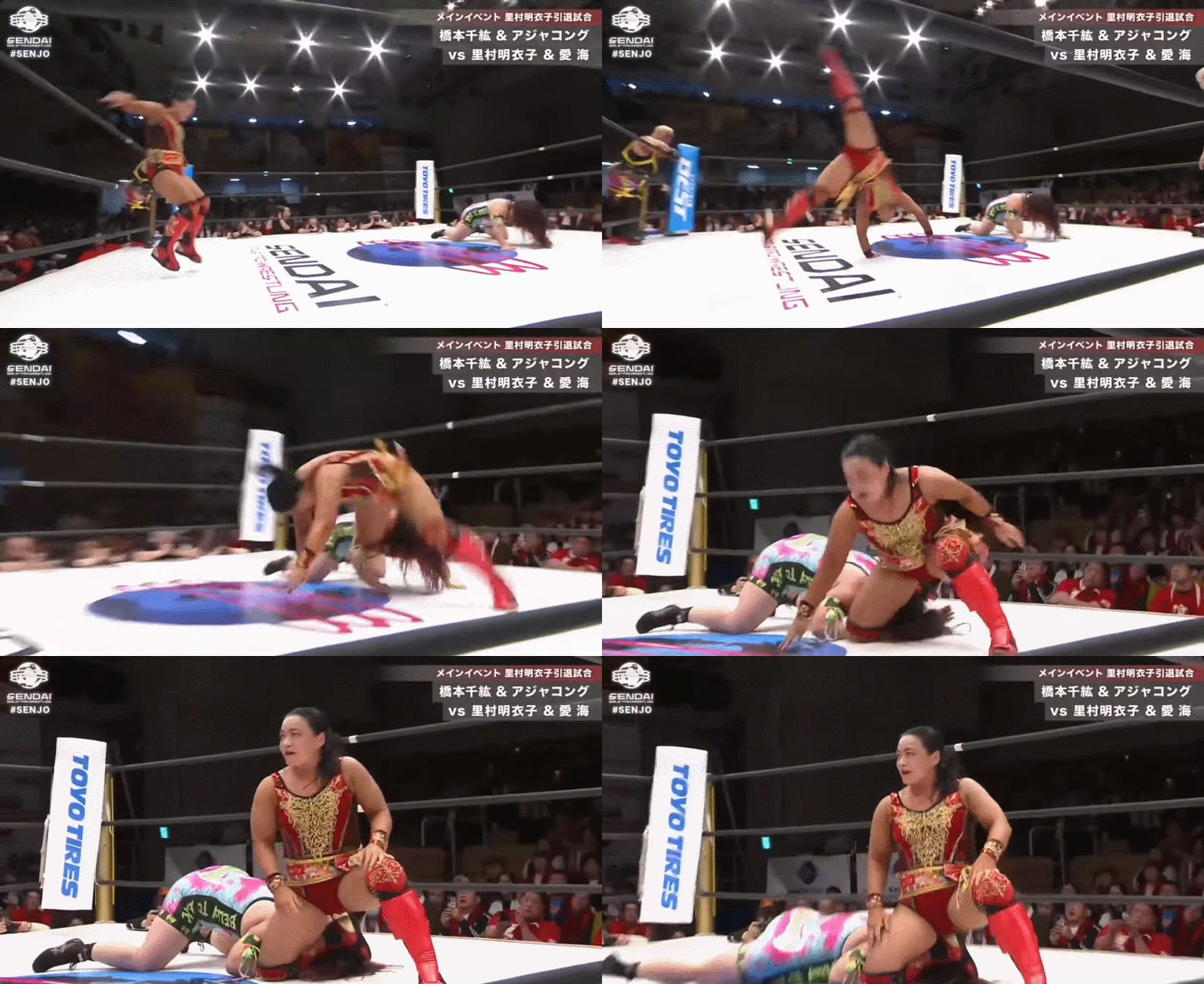
Despite that blow and various other kicks, Hashimoto still held the power advantage, so Hashimoto’s swiping slaps and lariats forced Satomura to the mat. She landed the powerbomb that won her the Sendai Girls championship, but Satomura was able to kick out. Out of frustration mixed with sadness, Hashimoto decided to tag in Aja Kong to really give the fans the greatest hits. Kong hit a trio of backdrop drivers:
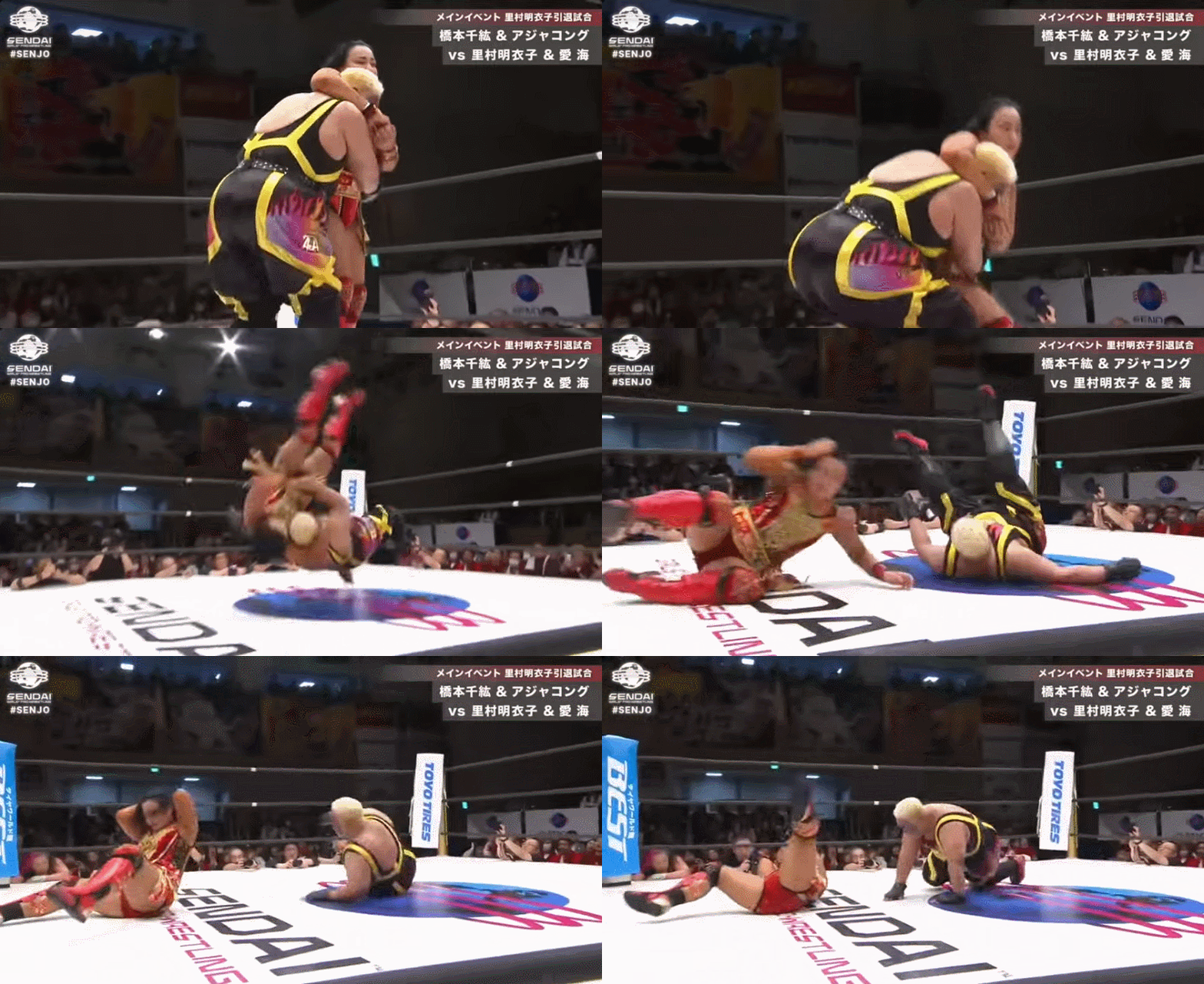
And Satomura caught Kong’s elbow drop and transitioned into an arm submission attempt. It didn’t really work for her, so they moved to other trademark Satomura and Kong exchanges: a Pele kick from Satomura, a spinning backfist from Kong, a Death Valley Driver that had to become a Samoan Drop due to Kong’s size, and a more successful Death Valley Driver. Kong pushed Satomura off her when she tried the Scorpion Rising kick and hit Satomura with a brainbuster on her trademark trash bin. The match started to feel out of the wrestlers’ control when Satomura had to change the Death Valley Driver into a Samoan Drop, and that sense continued when Hashimoto re-entered the ring and held Satomura up so Kong could hit her with a spinning backfist. Kong nailed Hashimoto instead, and then they tried it again only for Satomura to block the blow. Manami finally reappeared, but the camera failed to follow her when she hit her first running dropkick to Aja Kong. She disappeared again to take Hashimoto out of the ring so that Satomura could hit the Scorpion Rising kick on Aja Kong’s head to win her final match.
Manami didn’t leave much of an impression on me, so I’d wager that the match didn’t prioritize that. Instead, the wrestlers chose to highlight Satomura and treat the fans with some of her greatest hits with her nemesis, Aja Kong. The ending is high energy, but it felt a little out of their and the production team’s control. As a total match, it was a fitting capstone on Satomura’s career and her retirement tour.
What does Satomura leave behind? Trainees like Kagetsu, Hashimoto, Cassandra Miyagi, Mika Iwata, DASH Chisako, and Heidi Katrina. Well-regarded matches across decades and around the world. Leaving an imprint on wrestling fans’ collective memory about the harsh nature of joshi training by breaking Saika Takeuchi’s nose with a dropkick in the Gaea Girls documentary. The question of whether she belongs in the Wrestling Observer Newsletter Hall of Fame is outside this column’s remit, and others have debated her case with more evidence and counter-evidence than I can muster here. All I can say is that I’ve enjoyed every Satomura match that I’ve ever seen, and the simple fact that Satomura’s presence has me curious enough to consider seeing if any of her matches in WWE were worthwhile indicates that I think she was great and will be missed.
The match and the show can be seen on Wrestle Universe.
Next time: “It’s time to do it now and do it loud
Killjoys, make some noise
Na, na-na, na-na, na-na, na-na
Na, na-na, na-na, na-na
Na, na-na, na-na, na-na
Na-na, na-na, na-na”
– My Chemical Romance, “Na Na Na (Na Na Na Na Na Na Na Na Na)”
Nanae Takahashi is another notable joshi wrestler who retired in 2025. One of the veteran anchors in Marigold, Takahashi wrestled Mayu Iwatani on her retirement tour. We will check in on how Iwatani is doing in Marigold and ponder Takahashi’s legacy.


