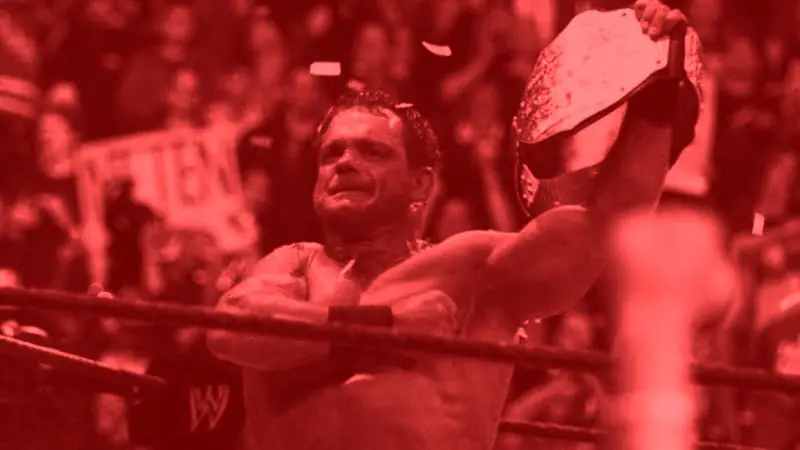
Nigel McGuinness came along at the wrong time.
While reviewing his work throughout his career, that is kind of an ironic thing to say, since one thing that becomes apparent when studying McGuinness is that he could have been a successful wrestler in any generation. McGuinness was a star in Gabe Sapolsky’s Ring of Honor, surrounded by some of the best workers in the world and holding his own against any opponent he came across throughout his career, from KENTA to Kurt Angle to Bryan Danielson.
His in-ring style would be easily transferable to any era you could think of. His offense is fairly basic yet incredibly effective. His bumping and selling are so emotive that you can picture him begging off as a heel like Ric Flair or Freddie Blassie in a sepia-toned tape from an old territory. His sneering, arrogant persona, crossed with a sense of legitimate toughness would have fit like a glove in any other era–it’s actually realistic to picture McGuinness stepping between the ropes and grappling with Lou Thesz or Buddy Rogers.
McGuinness, though, came along at a time when all of those traditional things that would be respected in pro wrestling were not valued. As great as McGuinness was and as obvious as his talent seemed to be, the major wrestling companies of his time didn’t seem interested in all of the things McGuinness brought to the table.
WWE was still hesitant to take a chance on a wrestler from the independents, with CM Punk still experiencing some growing pains as a main roster member and effectively the guinea pig for all indie stars in WWE. While McGuinness had decent size and a solid body, he wasn’t a giant that Vince McMahon would immediately be attracted to, and his in-ring style, focused on technical wrestling and stiff strikes, was not something that jumped out to superficial scouts.
When WWE finally became interested in McGuinness in 2009, the company ultimately balked at his medical records, which showed a biceps tear that the company felt needed to be surgically repaired. McGuinness would be tasked with paying for the surgery himself, which would also take him out of action for months and thus prevent him working and earning a living, all in hopes that WWE would turn around and reconsider once he was healthy. It was a cruel twist for McGuinness, who saw his longtime friend and rival Danielson get signed to WWE at the same time.
McGuinness would end up signing with TNA, which at the time was making an ambitious push to rival WWE, under the misguided leadership of Hulk Hogan and Eric Bischoff.
Despite management having little interest in pushing McGuinness (re-named with the WWE Performance Center name, Desmond Wolfe), McGuinness instantly got over in a feud with Kurt Angle, where he demonstrated the personality, intensity and in-ring ability that made him a standout in ROH.
Of course, the geniuses booking TNA, much like the people in charge of WWE, never understood McGuinness. Despite getting over with the fans and famously winning a fan poll that granted him a world title shot (finishing ahead of names like Rob Van Dam, Sting and Ken Anderson, who TNA very much wanted to push), McGuinness would get pushed down the card into the midcard.
McGuinness’ career largely came to a halt when he contracted Hepatitis B. While it’s never been fully explained how McGuinness contracted the virus, he implied in his documentary “The Last of McGuinness” that he contracted it while working bloody matches in TNA. He eventually left TNA and announced a retirement tour, working some final indie shots and wrapping up his career in 2011.
As he elaborates in his documentary, McGuinness retired because he had no place to work. As great as ROH was from an in-ring perspective, it was still an indie company and it was very difficult to make a full-time living working on the indies. WWE was not interested, and TNA was a clown show that didn’t know what to do with him. So he retired, and stayed retired for thirteen years.
McGuinness the wrestler
Personally, Nigel McGuinness is one of my favorite wrestlers of all-time. I first saw him as a teenager watching sketchy ROH videos, and was delighted when he showed up in TNA and laid out Kurt Angle with one of the stiffest clotheslines I had ever seen. He quickly became one of my favorite wrestlers to watch, and as more and more of his ROH career became available online, I consumed it as soon as I could.
McGuinness is not the typical wrestler that I gravitate towards as a fan. People who know my tastes will recognize that I really value explosiveness and athleticism in wrestling, with Kenny Omega, Will Ospreay and Shingo Takagi being among my favorite wrestlers of all-time. McGuinness isn’t close to that group as an athlete, and he never wrestled that kind of style, even while he shared the ring with a lot of the high-flying athletes of the US indies in the 2000s.
To me, McGuinness just had an undeniable, contagious nastiness to him. His work was characterized by a feeling that he was authentic and real. His personality, that of a British punk rocker with his spiked hair combined with the brash violence of a wannabe Millwall supporter, was definitely over-the-top in a pro wrestling sense, but also felt real enough that it didn’t feel like he was playing a role.
That edge and violence has made him one of the best control wrestlers of the century. One of the reasons I think his long matches are so good is because of that, when McGuinness is in control of a match and the babyface is selling, the match is never boring. His matches with Danielson are so great because it was also a perfect role for Danielson, with a vicious McGuinness working on top and Danielson fighting from underneath.
An unlikely comparison to McGuinness would be WALTER, who is also one of the best control wrestlers in history. While WALTER’s control periods are interesting simply because he is so incredibly violent in everything he does, McGuinness has a subtler level of edge to him, everything from the way he throws his strikes to the way he walks around the ring, even his haircut is violent.
He can also bump and sell–I can just hear his scratchy, Kentish voice ringing out throughout some poor Gabe-era audio system while he fights out of a hold. Like any classical heel, he always seemed to know exactly when to beg off to get heat, or when to take a powder. Those instincts and abilities all helped make him such a perfect wrestler for ROH during his career, especially as the ROH Pure Championship, since he was such a gifted technical wrestler and understood how to string a match together without constant high spots or outside interference.
I’ve always held the unpopular opinion that McGuinness was better than Danielson at his peak. As great as Danielson is, McGuinness just had a sense of physicality about him that Danielson never could quite get to for me. McGuinness’ charisma was more appealing, with Danielson serving as more of a classic master wrestler during his peak days of ROH, while McGuinness felt just a little bit rougher, more unpolished and believable as a violent bastard.
McGuinness returns
Sadly, due to his career getting cut short, there isn’t as much McGuinness on tape as there should be. AEW recently uploaded a massive 12-hour anthology of McGuinness matches, which was sorely needed since most of the limited amount of content on YouTube were a few of his well-known ROH matches and some NOAH matches he worked on in Japan.
The tragedy of McGuinness is that he should have hundreds of great matches for fans to choose from, as opposed to the Danielson matches in ROH and a handful of others. He does not because his career came to an end in 2011, a time when it was inexplicably difficult for a wrestler as talented as McGuinness to make it as a full-time professional.
Regardless of how one feels about AEW, there is no denying that they have been a major positive in the wrestling world because McGuinness would have never retired if there had been a place like AEW, a major wrestling company that understands the roots of the business and respects a worker like McGuinness.
As various wrestlers came out of retirement to join the AEW party, from Sting to CM Punk to Danielson himself, McGuinness remained distant and elusive. By his own accord, he could still physically wrestle, despite taking some brutal bumps during his career. The opportunity just didn’t seem to be there. Even as he was formally brought into AEW as an announcer and began not-so-subtly taking shots at his old rival Danielson, there didn’t appear to be any path towards him wrestling.
That ended at Wembley Stadium, when he made a seriously shocking return to the ring for the first time in 13 years, looking great at age 48.
At that point, even though he didn’t win his match to secure a title shot, it was clear he was back to wrestle Danielson, and AEW will deliver on that promise, with McGuinness taking on Danielson at Grand Slam next week.
I have little doubt that McGuinness and Danielson will have a great match on Wednesday. As great as it will be to see McGuinness wrestle again, I also know that I’ll feel a little melancholy about watching him in the ring.
When people talk about tragedies and what could have been in wrestling, they might focus on Magnum TA having his career cut short due to a car accident or even Danielson missing years of his prime in WWE due to injury, but I think they should focus on McGuinness, too. For 13 years, fans were denied seeing this guy in his prime simply because the wrestling world was so sick that it couldn’t make room for one of the obvious best talents of his generation. I hope this time he sticks around for a while, there is so much more for the world to see.
Listen to Jesse Collings’ podcast: Gentlemen’s Wrestling Podcast!
Powered by RedCircle